
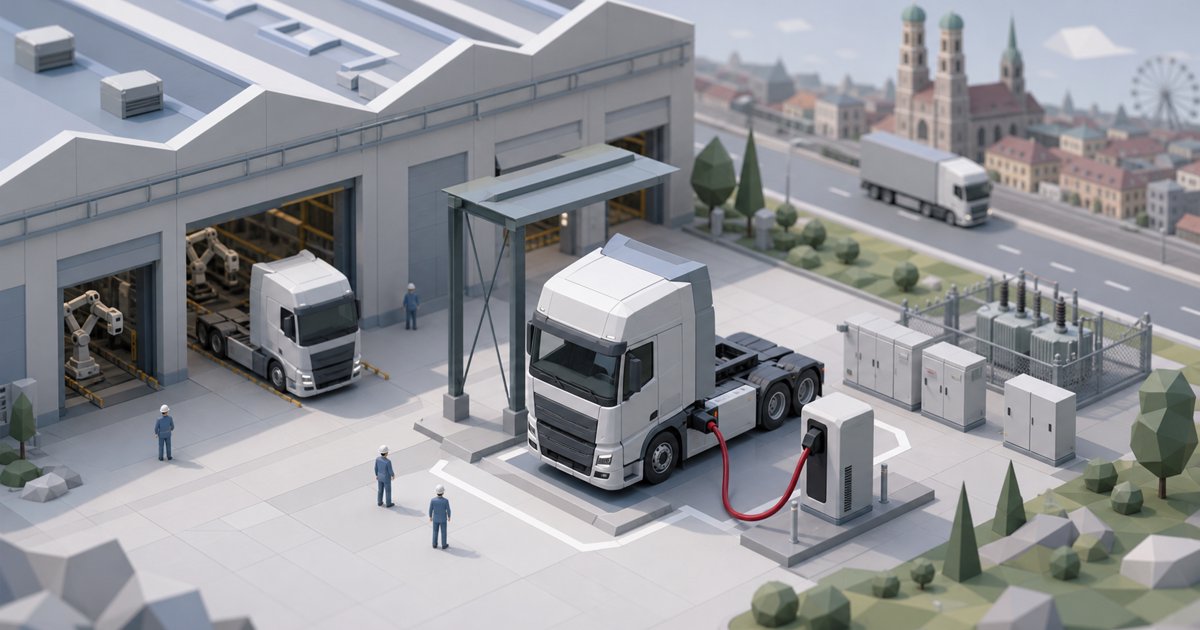
Megawatt charging has spent years as a specification and a trade-show demo. It is now rolling off a production line: MAN has built the first series-manufactured electric trucks fitted with the Megawatt Charging System at its Munich plant, and the first customer vehicles are being handed over in nine European countries.
What actually changed
MCS has been orderable on the MAN eTGX and eTGS for a while, but as an option waiting on a production line. That line is now running — the MCS variant entered series production in Munich in the second quarter of 2026, and the trucks leaving it support charging at up to 750 kW.
That is roughly three times the peak a Tesla Model 3 or Model Y sees at a V4 Supercharger post, and it is the point of the exercise. A truck battery is an order of magnitude larger than a car battery, so a car-grade charging curve would leave a 40-tonne vehicle parked for hours. MCS is a heavier connector and cable designed around that problem, and it is cooled through the truck's own thermal management system rather than the charger alone.
| Item | Detail |
|---|---|
| Models | MAN eTGX, MAN eTGS |
| Peak charging power | Up to 750 kW |
| Production site | Munich |
| Series production start | Q2 2026 |
| First deliveries | Nine European countries |
The cold-weather question was asked first
The number that matters for European operators is not the peak on a summer afternoon — it is what the truck does in February. MAN put an eTGX through the Kempower MCS Live Winter Days in Norrköping, Sweden earlier this year, and the truck charged at around 750 kW in sub-zero conditions, going from 10% to 90% state of charge in roughly 30 minutes.
Half an hour for a near-full charge is the figure that makes the regulatory maths work. EU rules cap a driver's continuous driving time at 4.5 hours before a 45-minute break, so a charge that fits inside a mandated rest stop costs an operator no extra time. That is the threshold electric trucking has been trying to reach.
Why the charger side is still the constraint
A truck that can take 750 kW is only half a system. Public MCS sites remain scarce across Europe, and the ones being built are concentrated on core freight corridors rather than spread evenly. Grid connections at that power level are the slow part — a handful of MCS bays can ask more of a local substation than a small industrial estate.
MCS is also not the only proposal on the table. Concepts running from six-megawatt connectors up to automated underbody charging are still in development, aimed at duty cycles where a driver plugging in a heavy cable by hand is the wrong answer. MCS looks like the standard for now, but the depot-charging end of the market has not settled.
What this means for European car drivers
Indirectly, quite a lot. Heavy-duty charging build-out is the part of European infrastructure furthest behind its 2030 targets, and truck corridors are increasingly being planned alongside car charging rather than separately. Sites specified to feed several megawatts to trucks arrive with grid capacity that car charging can share.
There is a competitive read-through too. Tesla's own Semi has been promised for Europe for years without arriving, and it uses a Tesla-specific high-power connector rather than MCS. Every quarter that MCS trucks ship in volume from established European manufacturers, the standard that European depots and public sites build around gets a little more settled — and a proprietary alternative gets a little harder to introduce.