
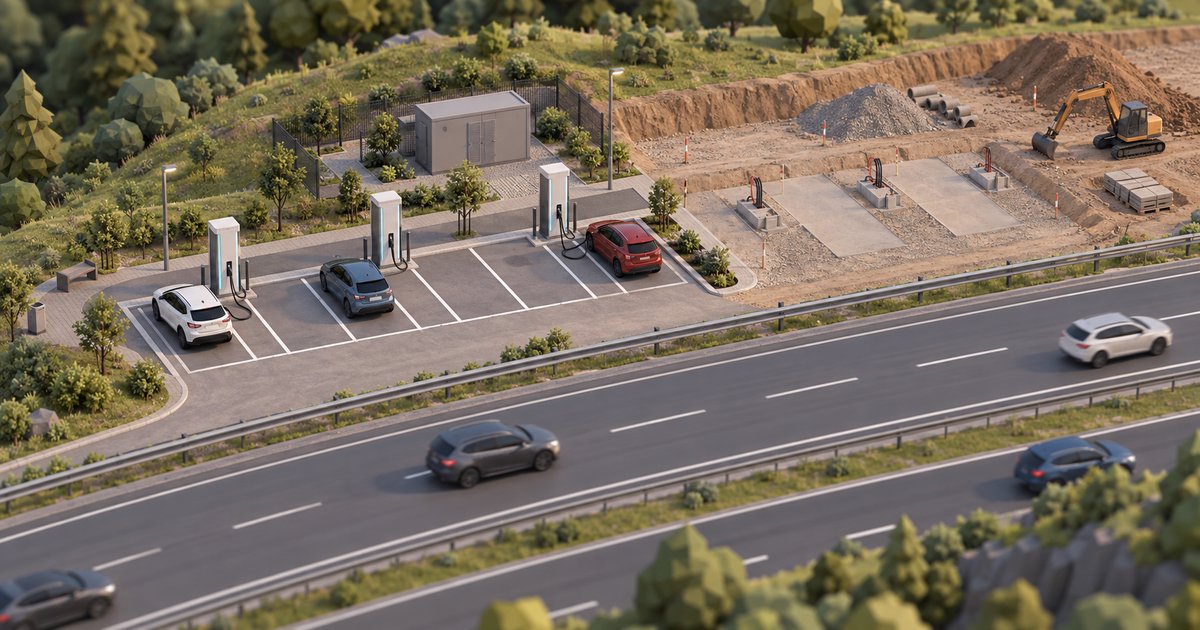
Germany's state-commissioned fast-charging network has reached a round number on the motorway. The 100th of 200 planned Deutschlandnetz charging parks on unstaffed autobahn rest areas opened this week at the PWC Räthisgraben site on the A81, in the direction of Stuttgart.
What the 100th site looks like
The park is operated by E.ON Drive Infrastructure and is built from three Alpitronic HYC400 cabinets, giving six charging points at up to 400 kW each. That is a specification worth reading carefully: 400 kW is the cabinet's ceiling per point, and no Tesla sold in Europe can draw it. A Model 3 or Model Y peaks well under half that. The headroom is there for 800-volt cars and, in time, for vehicles that do not exist in the fleet yet.
Who is building it and on whose money
Deutschlandnetz is not a commercial rollout. Four operators won the federal tender and build and run the sites on behalf of the German government:
| Operator | Role |
|---|---|
| E.ON Drive Infrastructure | autobahn and regional lots |
| Autostrom Nord | autobahn and regional lots |
| Fastned | autobahn and regional lots |
| TotalEnergies | autobahn and regional lots |
Progress is uneven across them. TotalEnergies has opened 11 of the 33 autobahn sites assigned to it, so the halfway point on the programme as a whole conceals operators at very different stages.
The deadline has moved
The original target was to have the autobahn sites finished by the end of 2026. That is no longer credible with half the locations still to come. Sites are now expected to be completed through 2027, and a small number will slip into 2028 — up to two years later than planned for the tail of the programme.
The causes are the ordinary ones for German infrastructure: grid connections, permits for building on rest areas that have no services and often no existing power of the required capacity, and civil works at sites chosen for their position on the network rather than their ease of construction.
Why this matters to a Tesla owner in Germany
Because it is the charging that happens when the Supercharger is full or is not there. Deutschlandnetz sites sit on unbewirtschaftete Rastplätze — the plain lay-bys between the big service areas — which are precisely the gaps in Tesla's own map. Every one of them is CCS, open to all brands, and placed by a state programme aiming at coverage rather than at traffic.
They also arrive under the payment rule that changes on 1 January 2027, when public chargers of 50 kW or more must accept a bank card. New Deutschlandnetz hardware is built to that standard, so the ad-hoc payment problem that still afflicts older German chargers does not apply here.
The honest summary is that Germany is building a good network late. One hundred motorway sites is real coverage; a target missed by up to two years on a programme this visible is a fair measure of how hard the last hundred will be.