
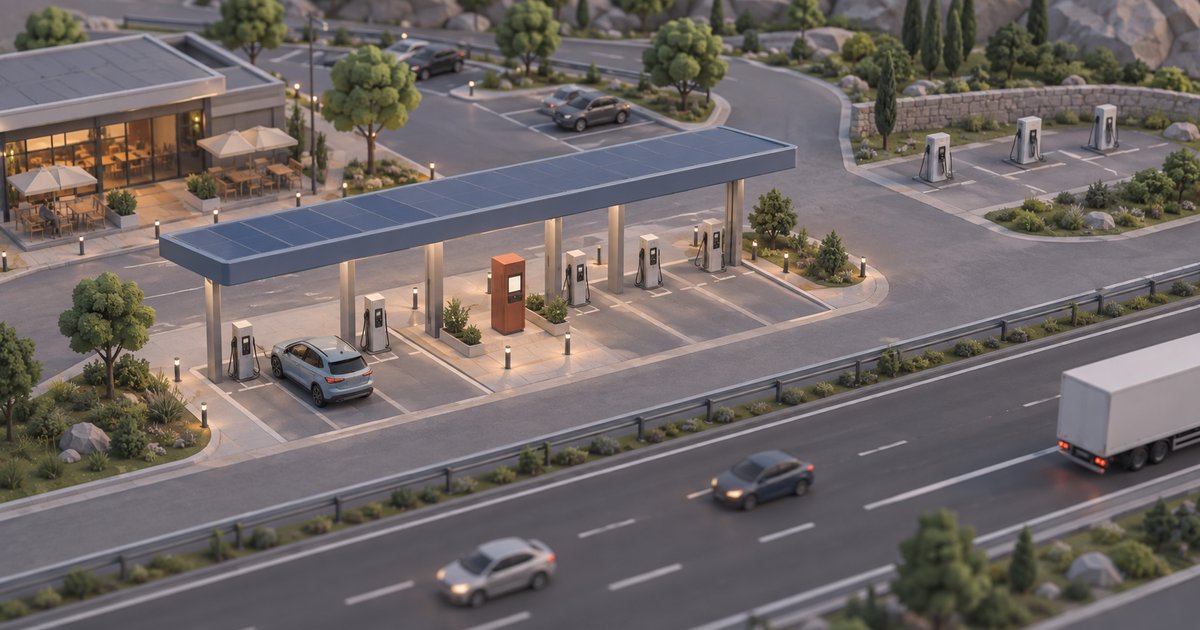
On 1 January 2027 the European Union's charging regulation does something it has never done before: it reaches backwards, to hardware already in the ground. Italian outlet Vaielettrico asked this week whether that means you will be able to pay by card at any charging point "everywhere, from January". You will not, and the distance between those two readings is worth knowing before a long drive.
What the rule already requires
AFIR — Regulation (EU) 2023/1804 — has required ad-hoc payment at newly deployed public charging points since 13 April 2024. Ad-hoc means charging without a prior contract: no subscription, no app account, no network-specific RFID card.
Above 50 kW the regulation names the mechanism: a payment card reader, or a device with a contactless function that can at least read payment cards. Below 50 kW there is a third option — where the point has an internet connection, the operator may send you to a secure online payment page, in practice a dynamic QR code. That is why a QR sticker is acceptable on a slow AC post and not on a motorway rapid.
What actually changes on 1 January
| Charging point | Deadline | Accepted method |
|---|---|---|
| Deployed from 13 Apr 2024, 50 kW or more | in force since Apr 2024 | Card reader or contactless |
| Deployed from 13 Apr 2024, under 50 kW | in force since Apr 2024 | Card reader, contactless or dynamic QR |
| Deployed before 13 Apr 2024, 50 kW or more, on the TEN-T road network or in a safe and secure parking area | 1 January 2027 | Card reader or contactless |
| Deployed before 13 Apr 2024, anywhere else | none | Grandfathered |
The last row is the one the headlines lose. Charging points built before April 2024 are grandfathered by default, and the retrofit obligation is carved narrowly out of that: high power, and a location on the trans-European transport corridors or at a secure truck parking area. A pre-2024 rapid charger at a supermarket two towns off the TEN-T network can stay app-only indefinitely, and nothing in AFIR obliges its operator to change.
A companion rule bites sooner: the ad-hoc price per kWh must be shown before the session starts, and must be reasonable — costs plus a reasonable margin. It does not stop the pre-authorisation practice we covered in Italy's summer charging prices, nor cap the ad-hoc premium German networks charge over a contract.
Tesla got there early, then changed its mind about how
Tesla has been fitting contactless readers to V4 Supercharger posts in Europe since the first such site opened in Graz, Austria, ahead of any deadline that applied to it. More recently it has dropped the per-stall reader at some new V4 locations for a single standalone kiosk serving the whole cluster. Both satisfy AFIR; one is far cheaper across a 20-stall site.
Vaielettrico reports that several Italian operators are moving ahead of the date too, naming Free to X — the Autostrade per l'Italia network — as one already retrofitting card payment onto existing motorway stations.
What this means on a European trip
For a Tesla driver the Supercharger network was never the problem; the app handles it. The 1 January date matters for the chargers you reach for when the Supercharger is full, is the wrong detour, or is not there — third-party CCS rapids on exactly the motorway corridors AFIR calls TEN-T. From January those should take a card, with no account.
Off those corridors, plan as before. The regulation has drawn a line down the middle of Europe's charging estate, and only one side of it has a deadline.