
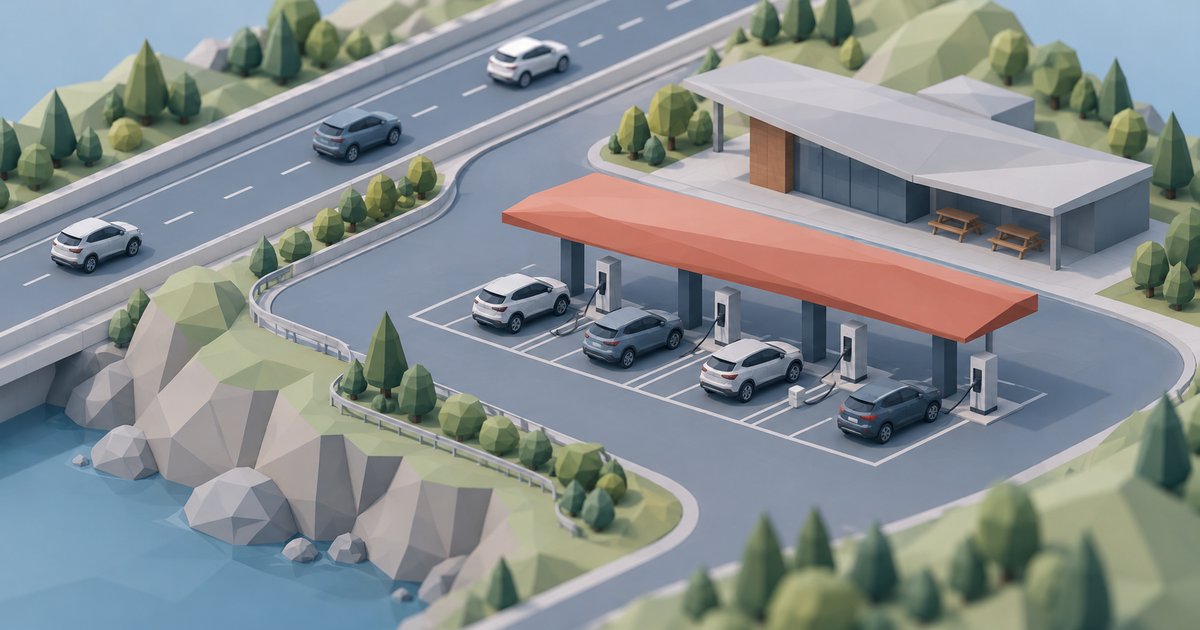
On 12 October 2026 Tesla Korea's account on X announced that Tesla had been selected as a charging operator for rest areas in the Korea Expressway Corporation's 2026 programme, and that Superchargers would as a result be installed "more densely" along the national expressways. Drive Tesla Canada read the attached list as 21 rest-area locations, counting both carriageways where a rest area has a site on each side, near Seoul, Yongin, Gangneung, Gyeongju and Andong among others. Tesla Korea put its network at 180 sites and more than 1,200 stalls. No opening dates were given; Tesla describes the listed sites as under construction or planned.
What the tender is
The Korea Expressway Corporation, the state-owned operator of the toll expressways and their service areas, tendered 392 chargers at 91 rest areas, 361 of them fast chargers of 200 kW or more and 31 multi-chargers, in three units. Electimes, which reported the preferred bidders on 20 August 2026, sets out the terms: the corporation provides the land, the operator installs and runs the chargers at its own cost for ten years and pays a site fee set as a share of revenue, then restores the site or hands the equipment over. After earlier rounds in which some units drew no bidder, the corporation cut the minimum revenue share from 19.59% to 7.04% and tendered by station rather than by region. All three units found a preferred bidder.
| Unit | Preferred bidder | Rest areas |
|---|---|---|
| 1 | SK Electlink | 32 |
| 2 | Chaevi | 29 |
| 3 | Tesla and GS Chargev consortium | 30 |
Tesla's 21 locations and the unit's 30 are not the same count. Electimes says the partners will build separately or on shared sites depending on the rest area, and that GS Chargev, the GS Group's charging subsidiary and Korea's largest operator of slow chargers, will buy and run its own fast chargers in its first rest-area project. The negotiations that follow a preferred-bidder award were still open in August; Tesla's post is the first word from the company that the award went through.
The clause that lets a Supercharger in
The tender rules require every charger to be usable by any EV fitted with Korea's standard DC Combo 1 connector, adapter included, regardless of manufacturer. Teslas sold in Korea carry Tesla's own port, so a Supercharger meets the rule only with an adapter, which Electimes says it appears to do. The Tesla plug had appeared on rest-area chargers before, but this is the first corporation-tendered project in which Tesla itself is the operator; its earlier expressway Superchargers sat at privately run rest areas.
The traffic runs the other way as well. Chaevi's unit, 131 chargers at 29 rest stops, puts the Tesla plug on 82 of them at up to 250 A, so a Tesla charges there without its CCS1 adapter.
Why the rest areas mattered
Kim Sung-tae, head of the Korea Electric Vehicle Users Association, told Electimes that Tesla had been "relatively passive" about investing in Korean charging despite topping monthly new-car sales, and called the direct participation welcome. The sales side is the one TeslAnt has followed: 12,372 Tesla registrations in September, an eighth straight monthly lead among imports, after the Model Y finished first across all brands in May and July.
The European contrast
Germany's equivalent, the federally tendered Deutschlandnetz on unstaffed motorway rest areas, is being built by charging companies, E.ON Drive Infrastructure, Autostrom Nord, Fastned and TotalEnergies among them; TeslAnt covered its hundredth site in September. Korea's programme has admitted a carmaker's own network on two conditions, a local partner and a plug every car can use. No European road authority has tendered on those terms yet.