
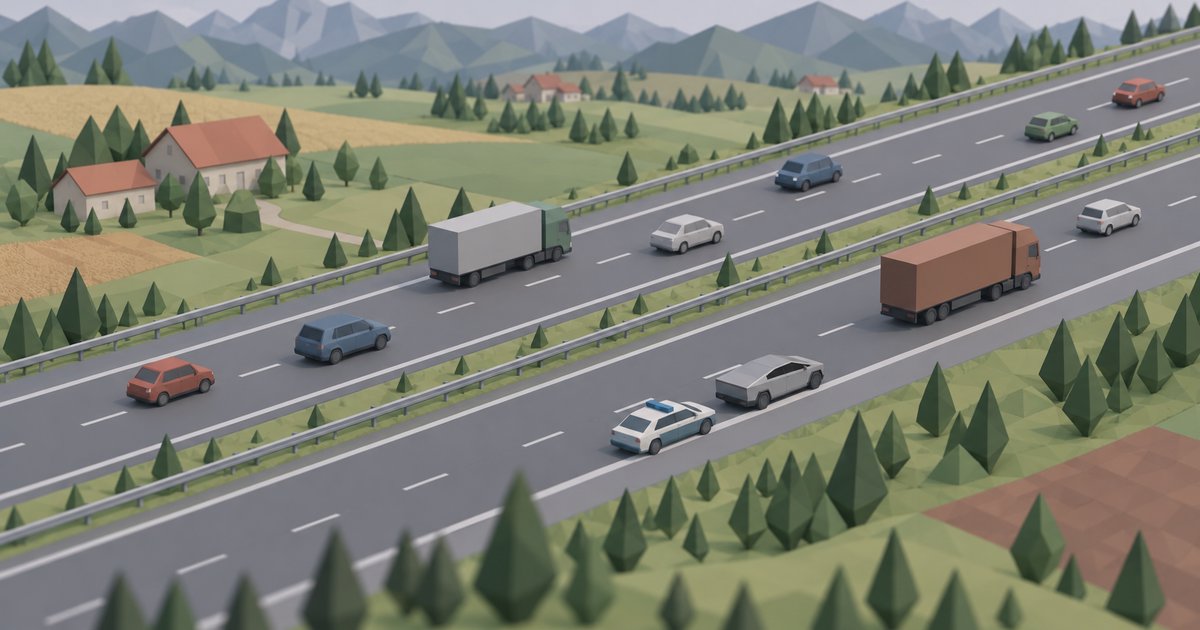
Motorway police stopped a Tesla Cybertruck with Polish number plates on the A99 near Vaterstetten, east of Munich, early on Sunday 25 October 2026, and the problem they found was not the truck. Its driver, a 50-year-old Swedish man, held only a category B car licence, so the officers barred him from driving on, BR24 reported.
What the police found
According to BR24, the officers pulled the Cybertruck over because the model is almost never seen on German roads. The check turned up the licence problem. BR24 puts the truck's permissible gross weight at 4.2 tonnes, which takes it out of the car category and into C1, the licence class for light trucks.
Apart from the licence, the Cybertruck was on the autobahn legally. Its Polish registration entitles it to use German roads, and BR24 notes that foreign-registered Cybertrucks may be driven in Germany as long as everything else is in order. What they cannot get is a German registration.
Why a car licence does not cover it
The EU's common licence categories, set by Directive 2006/126/EC, cap category B at a maximum authorised mass of 3,500 kg. Vehicles above that, up to 7,500 kg, need a C1 licence.
The Cybertruck is well past that line. When European road-safety organisations objected to a Czech registration in 2024, they pointed out that Tesla lists a kerb weight of 3,104 kg and a payload of 1,134 kg, electrive reported. Together that is 4,238 kg, in line with the 4.2 tonnes cited in the Bavarian case.
How a Cybertruck gets EU plates at all
Tesla has never obtained European type approval for the Cybertruck, and Germany has closed the door on national exceptions. In 2025 the Federal Ministry of Transport refused to let even US service members import and register the truck. After a legal review it concluded that the Cybertruck deviates too far from EU rules to qualify for an individual national approval, citing the rigid, sharp-edged stainless-steel body and the protection of pedestrians and cyclists, heise reported in October 2025.
Other member states have treated single private imports more leniently. In July 2024 a privately imported Cybertruck was reportedly approved for Czech roads, and road-safety groups warned the Czech transport minister that the country could become a "back door" for such vehicles into other member states. The Bavarian stop shows how that works in practice: a truck registered in one member state can be driven in another. BR24 did not say how this one obtained its Polish registration.
What it means
For anyone tempted by a grey-import Cybertruck in Europe, the A99 stop adds a second hurdle to the registration question: even a properly registered truck needs a driver with a C1 licence. Britain, outside the EU, has gone further, with police seizing imported Cybertrucks, as a Greater Manchester case in June showed.
Tesla does not sell the Cybertruck in Europe and has not announced a European version. Earlier this month it also cancelled the truck for Australia and New Zealand, refunding reservation holders who had waited nearly seven years.