
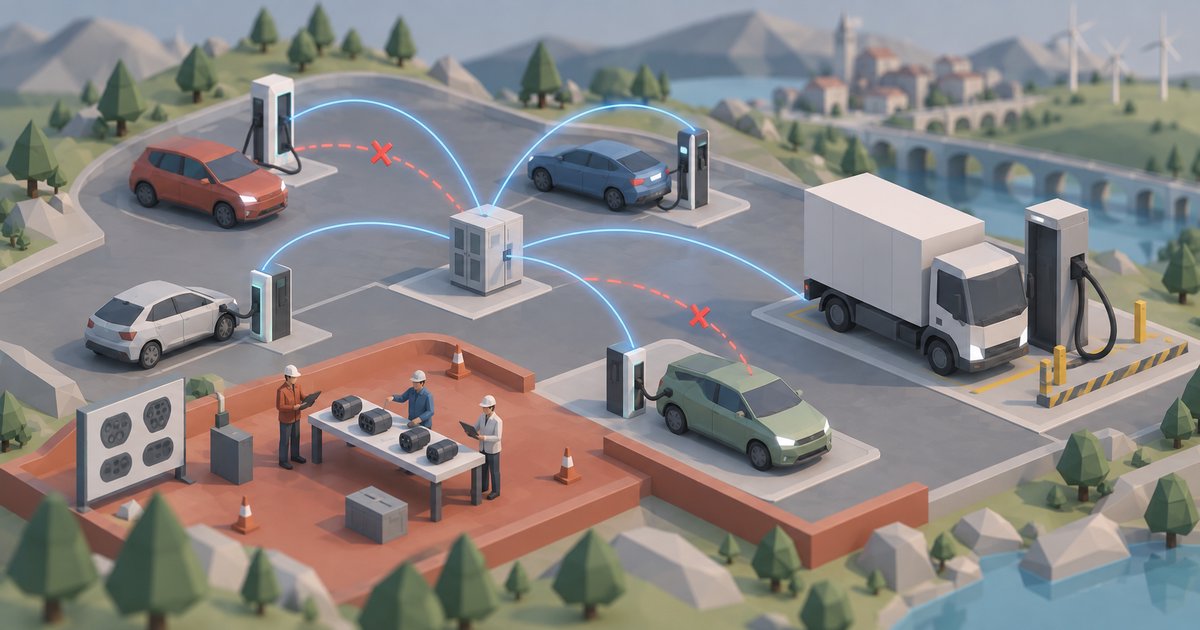
The CharIN Testival & Conference Europe 2026 ran from 22 to 25 September at Phoenix Contact's All Electric Society Park in Blomberg, Germany — one day of conference followed by three days in which engineers did nothing but plug vehicles into chargers and watch what happened. The trade title electrive reported from it on 26 September.
The anecdote it opened with is the whole problem in one image: a Mercedes-AMG at a charging station that did not start charging on the first attempt, and needed several tries before car and charger agreed on what was happening. That was at an event whose entire purpose is making sure they agree.
Speed dating between a car and a charger
CharIN's chief technology officer Michael Keller describes interoperability testing as "a kind of speed dating between the vehicle and the charging hardware" — a short, structured encounter in which two products that have never met have to establish a working relationship in seconds.
His framing of the stakes is the one that matters to owners: "Without 100% interoperability, the customer has no guarantee of a successful charging process when they arrive at an unfamiliar charging station."
That is not a theoretical standard. It is the ordinary experience of driving to a charger you have not used before and finding out whether today is a good day.
What is actually being tested
The test fields at CharIN's Testivals cover the communication layer rather than the cable: ISO 15118-20 Amendment 1, published in July 2026, which folds in MCS services, AC-DER applications and a revised security concept; TLS 1.3; and the mechanical fit of the MCS plug and inlet. The physical MCS interface is specified separately, in IEC TS 63379.
CharIN's finding on the mechanical side was that compatibility and locking mechanisms both need improvement — which is to say the connector does not yet reliably lock into every socket it is meant to.
Bidirectional capability is further behind again. At CharIN's earlier Testival in Arnhem in May 2026, 13 of 23 DC systems and 7 of 11 AC systems supported bidirectional energy flow. Keller is explicit that vehicle-to-grid work is at an early stage against European grid requirements: "We must be able to use vehicle batteries flexibly for the power grid and to stabilise energy supply — that is a major issue," and it needs many parties moving together.
Megawatt charging has hardware, not volume
On MCS the tone was different. Keller said it is "already surprising how many have now reached the point of actually implementing this standard," and the truck side has real numbers behind it.
| Vehicle | Peak charging power |
|---|---|
| Mercedes-Benz eActros 600 | up to 1,000 kW |
| MAN eTGX | 750 kW |
| Volvo FH Aero Electric | 700 kW |
His caveat was about supply, not capability: "There are enough charging stations available for purchase. There are already trucks equipped with it, but not yet in the required volume."
Why a Tesla owner should care
Because outside the Supercharger network, every charge a European Tesla makes depends on exactly this handshake succeeding. Tesla has opened its network to other brands and Tesla drivers increasingly use third-party CCS sites, so the interoperability CharIN is testing is now the failure mode on both sides of that trade.
It also decides the timetable for two things Tesla has committed to in Europe. Tesla's European Megacharger network is MCS, and the European Semi is specified to charge at 800 kW on MCS from 2027 — a standard CharIN has just described as implemented but not yet deployed in volume. And bidirectional charging, the feature that would let a car do what a Powerwall does, is sitting in the half of the test results that still fails.