
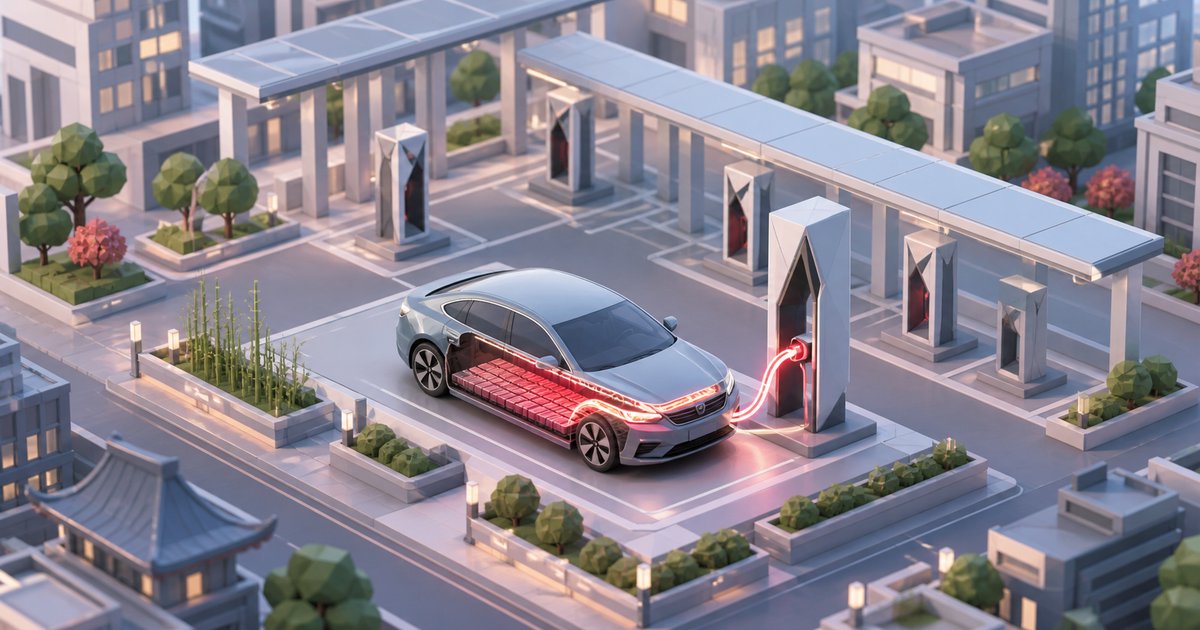
BYD has put the Qin Max on sale in China at prices starting below 100,000 yuan, and the number that matters is not the price. It is five minutes — the time the electric version claims to go from 10% to 70% charge.
The specification
The Qin Max is a mid-size saloon, 4,866 mm long on a 2,820 mm wheelbase, sold in both battery-electric and DM-i plug-in hybrid form. The EV range starts at 109,900 yuan, roughly €13,000, and tops out at 143,900 yuan.
| Version | Price (yuan) | CLTC range |
|---|---|---|
| EV 530 km Leading | 109,900 | 530 km |
| EV 530 km Transcendence | 119,900 | 530 km |
| EV 530 km Excellence | 129,900 | 530 km |
| EV 630 km Transcendence | 132,900 | 630 km |
| EV 630 km Excellence | 143,900 | 630 km |
| DM-i 230 km Leading | 99,900 | 230 km (electric) |
Motors are rated at 120 kW or 240 kW, the faster car reaching 100 km/h in about five seconds. Range figures are CLTC, a notably generous cycle — expect meaningfully less on WLTP, and less again in real use.
Five minutes is the headline
The EV uses BYD's second-generation Blade battery with the company's flash-charging system, and BYD claims 10-70% in about five minutes and 10-97% in about nine.
Two caveats belong next to that claim. It is a manufacturer figure, measured under conditions BYD has not fully published. And it requires charging infrastructure capable of delivering it, which in practice means BYD's own megawatt-class chargers in China — not a European motorway stop. The second-generation Blade pack is also the one whose independently measured behaviour recently became a political matter in China, after BYD reported the engineer who tested it.
Even discounted heavily, the direction is the point. Tesla's V4 Superchargers peak far below this, and charging speed is the axis on which Chinese manufacturers have chosen to compete.
Why this matters to a Tesla buyer in Europe
The Qin Max is not sold in Europe and BYD has announced no plans to bring it. Read it instead as a statement of what the platform underneath BYD's European cars can now do.
BYD already sells the Seal against the Model 3 in Europe, and it has been expanding its European position aggressively. The technology in the Qin Max — second-generation Blade, flash charging, a Model 3-sized saloon engineered down to a price Tesla cannot approach — is what arrives in European showrooms next, adjusted for European regulation, tariffs and tastes.
The price will not transfer. A car at 109,900 yuan does not become a €13,000 car in Berlin; EU tariffs on Chinese-built EVs, homologation, transport and dealer margin all intervene, and BYD prices its European cars against European rivals rather than against its home market. What does transfer is the engineering, and charging speed is the part of it Tesla has the least room to dismiss.
Tesla's answer so far has been the Supercharger network's reliability rather than its peak rate — a real advantage, and one that gets less decisive each time a rival halves the time at the plug. On battery chemistry the gap is narrowing from the other direction too, with CATL targeting solid-state pilot production in 2027.
Bottom line
A China-only saloon with a charging claim worth treating sceptically and watching closely. The five-minute figure is the competitive threat, not the price.