
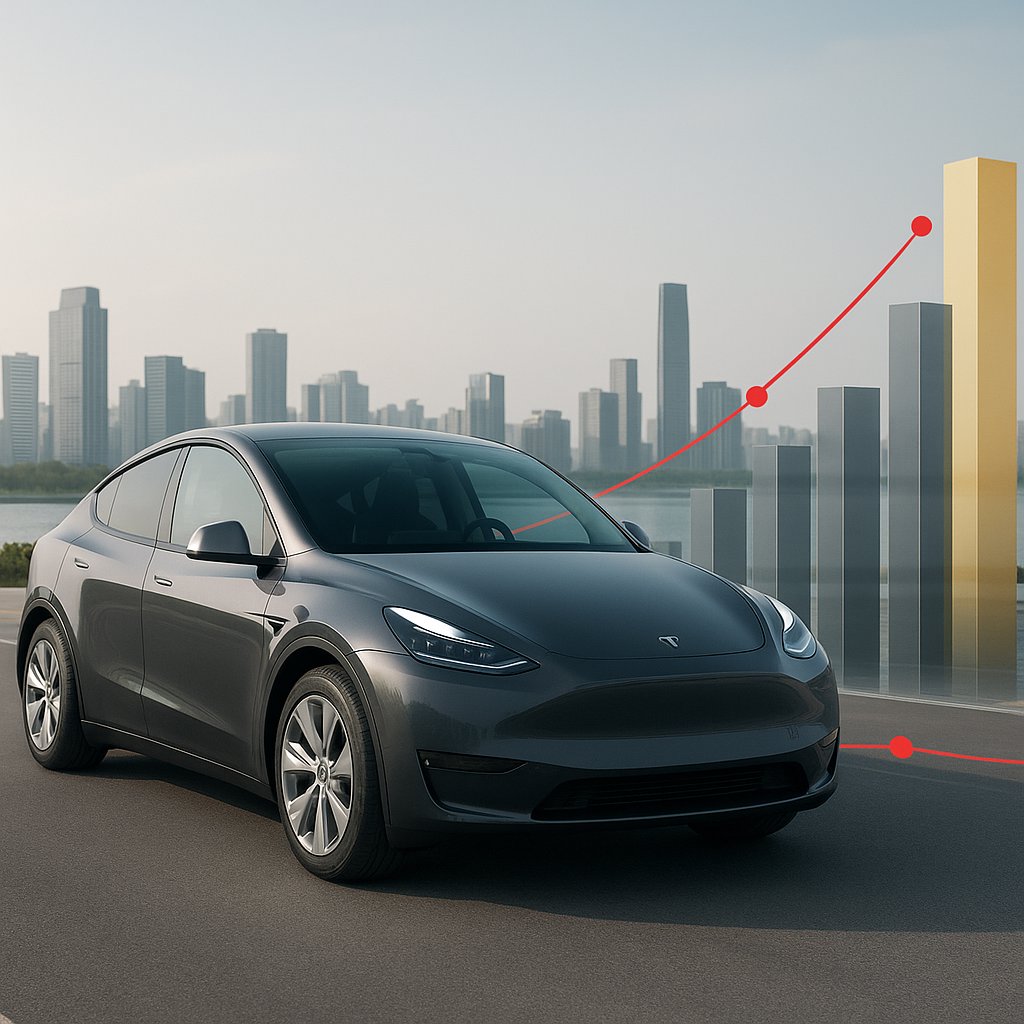
Europe's plug-in passenger car market cleared one million units in a single quarter for the first time, with 1,083,241 BEVs and PHEVs registered in Q1 2026 — up 28% year-on-year, according to Autovista Group data published on 15 May 2026. Battery EVs took 67% of the plug-in mix at 725,375 units (+25.4% YoY); plug-in hybrids grew faster at +33.6% to 357,866 units. March alone delivered 504,885 plug-in registrations, accounting for 46.6% of the quarter and a 38.4% YoY jump.
The headline shifts in brand share land in the order Tesla cares about most: Tesla climbed back to second place among EV brands, but the growth-rate league is being rewritten by Chinese OEMs that didn't exist on European registration tables three years ago.
Top 10 EV brands in Europe — Q1 2026
| Rank | Brand | Units (Q1 2026) | Share | YoY |
|---|---|---|---|---|
| 1 | Volkswagen | 96,601 | 8.9% | +2.8% |
| 2 | Tesla | 78,642 | 7.3% | +45.4% |
| 3 | BYD | 73,535 | 6.8% | +154.7% |
| 4 | Audi | 66,086 | 6.1% | +50.1% |
| 5 | Mercedes-Benz | 64,385 | 5.9% | +11.6% |
| 6 | Skoda | 60,349 | 5.6% | +66.9% |
| 7 | Renault | 52,107 | 4.8% | +46.3% |
| 8 | Volvo | 45,805 | 4.2% | -7.6% |
| 9 | Ford | 42,674 | 3.9% | +49.9% |
Volvo is the only top-10 brand showing a YoY decline.
Tesla model performance
The Model Y reclaimed Europe's top BEV slot with 51,395 units (7.1% BEV share) in Q1, well clear of the second-placed Skoda Elroq at 28,305 units. The Model 3 added another 26,671 BEV units, putting Tesla's two-car line above 78,000 deliveries before any contribution from Model S, Model X or Cybertruck. In March alone Tesla surged 85.3% to 52,801 registrations and 10.5% market share — the brand's strongest single month since the 2023 peak.
The rebound is unevenly distributed across markets. Tesla grew 255.8% in Germany and 331.5% in some segments alongside Chinese newcomer Leapmotor, while the company continues to underperform its 2023 baseline in Norway. Country leadership patterns also shifted: Volkswagen retook Germany (despite a 6.7% decline) and the UK (+23%), Renault held France (deliveries fell 11.5%), Fiat stayed on top in Italy (+31% domestic share) and Toyota held Spain (+2.8%).
Chinese pressure and the Model Y price hike
The BYD line in this dataset is the one Tesla will have noticed: BYD grew 154.7% YoY across Q1 and a further 150.9% in March alone, ranking third in the continent. The brand's BEV/PHEV mix is now near-even at 53.1% PHEV and 46.9% BEV, giving it cover in markets where BEV incentives have rolled off. Leapmotor and Xpeng followed with three- and four-figure percentage gains across Germany, UK, Italy and Spain — Leapmotor surged 437% in the UK and 1,300.6% in Italy.
This is the backdrop against which Tesla raised Model Y prices by up to €1,000 across France, Germany, the Netherlands and Norway on 22 April 2026, and added a $1,000 US Model Y price hike on 16 May. The Q1 numbers explain the rationale: with Model Y demand re-anchored as Europe's best-selling BEV and Berlin output set to climb 20% from July, Tesla appears comfortable testing pricing power again rather than chasing volume share.
What it means for buyers
For European Tesla buyers, the data points in two directions. The Model Y remains Europe's best-selling BEV and Tesla is back to growth, so trade-in values and used-car demand should hold. But the Chinese growth curve is steep enough that the 2027 buyer's choice will look very different — already the second-placed BEV (Skoda Elroq) is built on VW MEB hardware, and BYD's Seal U, Sealion and Dolphin Surf are sitting just below the Model 3 in the rankings. Anyone planning a long ownership cycle will want to weigh the resale-curve implications of that.