
A Chinese reviewer who measured the temperature of BYD's second-generation Blade battery and published the results has been cut off from the country's main social platforms, reported to police by BYD, and is now named in a national enforcement notice. The dispute is worth following in Europe, because it is about whether anyone outside a manufacturer is allowed to check a battery claim.
What the test showed
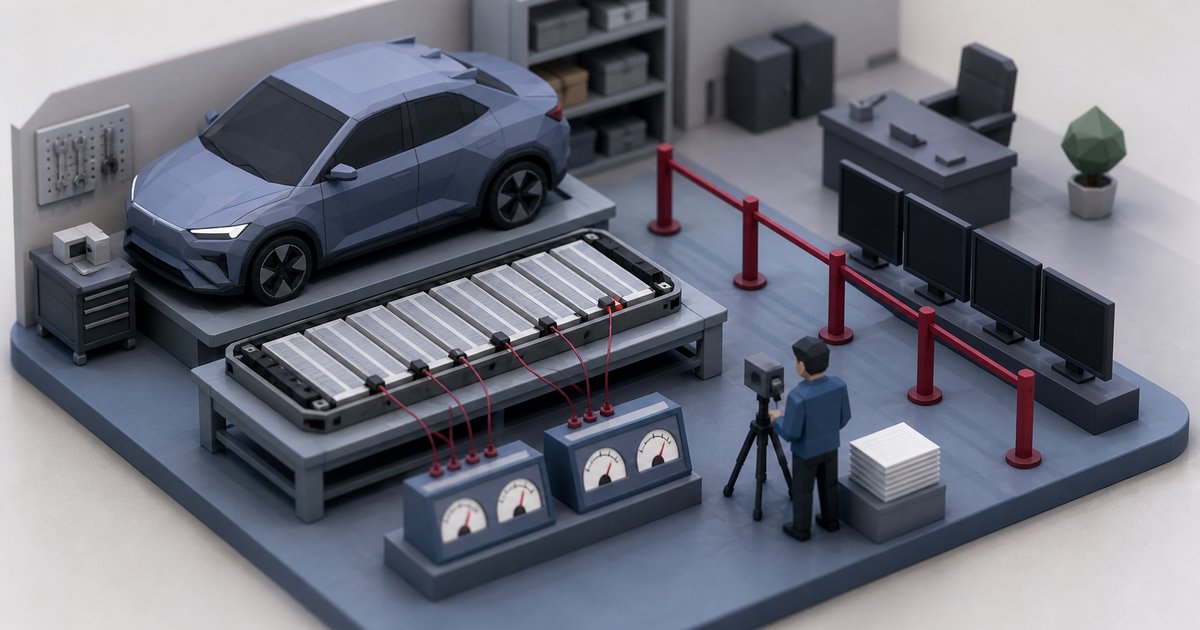
In May 2026, the automotive channel CaiShenRoad — run by blogger Cai Shen Dao — livestreamed a fast-charging session on a BYD Fangchengbao Ti3 fitted with the Blade 2 pack. Five probes placed on the surface of the cells recorded a peak of 76.42 °C. The car's own battery management system reported roughly 71 °C at the same moment.
That gap between measured surface temperature and reported BMS value is the whole dispute. In July, after being blocked from posting, the blogger had the test repeated at a Chinese state laboratory, which recorded 78.5 °C on the second-generation Blade.
| Measurement | Peak temperature |
|---|---|
| Cell-surface probes (May livestream) | 76.42 °C |
| Vehicle BMS reading (same session) | ~71 °C |
| Chinese state laboratory (July) | 78.5 °C |
What happened to the tester
The response escalated across three months:
- Early July — the Cyberspace Administration of Shenzhen removed his access to WeChat, Bilibili, Douyin and Weibo, barring him from posting, commenting or earning income on them.
- 30 July — he said on Weibo that BYD had filed a police report against him with the Songjiang District police in Shanghai after he released hundreds of pages of test data. Neither BYD nor Shanghai police confirmed a complaint or an investigation.
- 4 August — the Cyberspace Administration of China published a notice naming his Bilibili account in a case concerning "false product evaluations" that damaged an enterprise's product quality and reputation.
BYD has not published its own measurements of the cells in question, and no regulator has published a technical finding that contradicts the state laboratory number.
Why a European reader should care
BYD is not a distant Chinese concern here. It sells across Europe, took a record fifth place in Romania in July, and has priced the seven-seat Ti7 for the UK. The Blade 2 pack is the product European buyers are being sold on.
Nothing established so far says the battery is unsafe. Lithium-iron-phosphate cells tolerate high temperatures better than nickel chemistries, and a surface probe reads hotter than the averaged value a BMS reports — the two figures are not measuring the same thing, and a manufacturer arguing that point would have a case. The problem is that the argument is not being had in public on technical grounds. It is being settled by removing the person who took the measurement.
That is a familiar shape. Tesla pressed the Dutch regulator to keep its FSD safety review confidential, and the result there was the same: a conclusion the public is asked to accept without the evidence behind it.
Europe's answer is meant to be disclosure by default. China now has a battery-health yardstick under GB/T, and the EU battery passport arrives in February 2027. Those regimes are only worth anything if independent parties can test against them and publish what they find.