
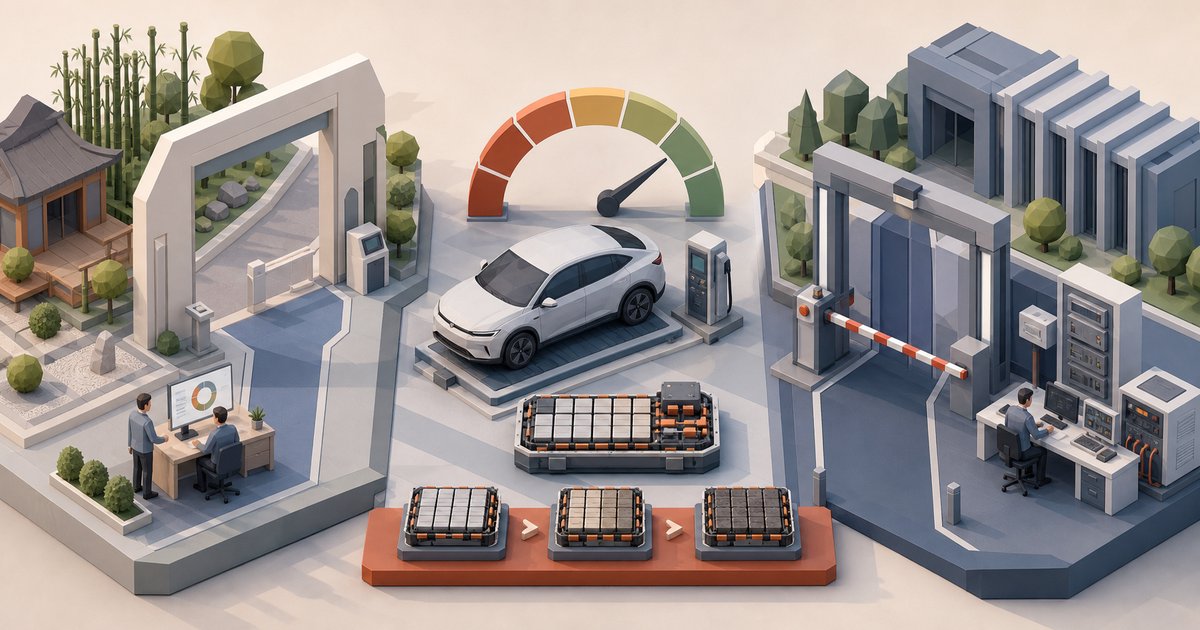
China disclosed a new national standard for electric-vehicle battery health on 2 August 2026, via CCTV News. GB/T 46991.1-2025 covers battery-health display systems in light-duty passenger cars, and it does two distinct things: it sets capacity-retention reference points over time, and it puts a bound on how badly a car is allowed to lie to you about them.
The second part is the more interesting one, and the part almost every headline has skipped.
The numbers
| Age / distance | Minimum capacity retention |
|---|---|
| 5 years or 100,000 km | 82% |
| 8 years or 160,000 km | 75% |
| 10 years or 200,000 km | 70% |
Alongside those, the standard governs what the car displays. State of Available Energy — the ratio of the battery's current usable energy to what it left the factory with — must not deviate more than 5% from measured reality. A displayed "virtual mileage" figure must stay within 3%.
That is a consumer-protection measure dressed as a metrology spec. A battery-health readout nobody can trust is worse than no readout at all, because it produces confident wrong decisions in used-car negotiations.
The catch: recommended, not required
GB/T standards come in two flavours, and this one is the softer kind. It is a recommended national standard, framed around evaluation and reporting rather than enforcement, with no penalty regime attached.
So it is not a warranty, and no Chinese manufacturer is compelled to hit 75% at eight years. What it creates is a common yardstick — a reference every buyer, warranty assessor and residual-value analyst can point at. Given how much of the second-hand EV market's uncertainty comes from the absence of any shared definition of a healthy battery, a voluntary standard that everyone quotes may end up doing more work than its legal status suggests.
How Europe compares
Europe is going the other way: fewer numbers, but binding ones. Euro 7 sets battery durability requirements for M1 passenger cars — battery-electric and plug-in hybrid — at 80% capacity after 5 years or 100,000 km, and 72% after 8 years or 160,000 km, whichever comes first.
| China GB/T 46991.1-2025 | EU Euro 7 | |
|---|---|---|
| 5 years / 100,000 km | 82% | 80% |
| 8 years / 160,000 km | 75% | 72% |
| 10 years / 200,000 km | 70% | not specified |
| Legal force | Recommended | Mandatory |
| Display accuracy | SOCE within 5% | not specified |
Euro 7 applies to newly type-approved vehicles from 1 January 2027 and to newly registered vehicles from 1 January 2028.
Read across and the picture inverts twice. China's retention reference points are slightly stricter than Europe's on paper, and China regulates the accuracy of the readout where Europe currently does not. Europe, meanwhile, has actual teeth: miss the Euro 7 threshold and a car does not get type approval.
Why this matters for European buyers
Chinese-built EVs are an ordinary sight on European price lists now, and every one of them will have to clear Euro 7 from 2027 regardless of what it does at home. So GB/T 46991.1 does not set the bar for cars sold here.
What it does is give European buyers a second reference point — and, if manufacturers start shipping a standardised, accuracy-bounded health figure in their home market, a reason to ask why the same number is not on the screen in a car sold in Frankfurt or Milan. Battery degradation is the single biggest unknown in EV residual values. Two large markets independently deciding it needs measuring is how that unknown eventually stops being one.