
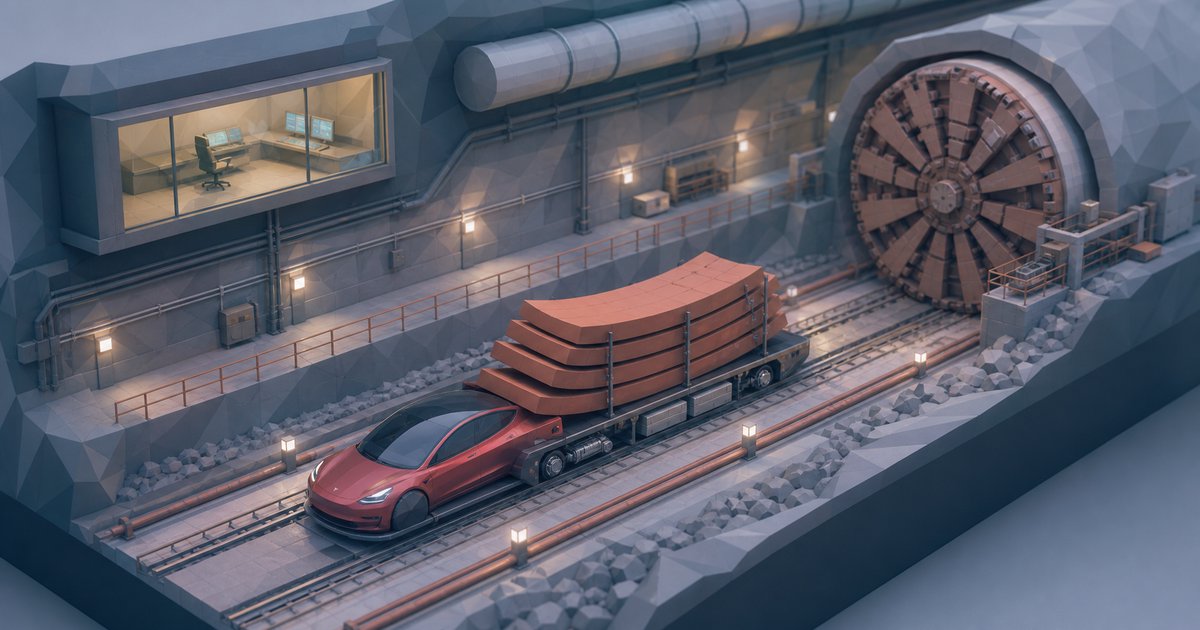
The Boring Company has shown off a new piece of tunnelling equipment, and the interesting part is not what it does but what it is made of. Liner Truck 3, announced on 7 August 2026, hauls concrete tunnel segments to the boring machine's cutting face — and it does so on Tesla Model 3 battery packs and Model 3 drive units, with no one in the cab, because there is no cab.
What it is
The vehicle exists to solve one specific logistics problem. Tunnels are lined with precast concrete segments, and those segments have to travel from a surface staging area down to the machine boring the tunnel. That trip has traditionally required a driver in a confined, dusty, poorly ventilated space.
| Specification | Liner Truck 3 |
|---|---|
| Payload | 22,000+ lb of concrete segments |
| Range | 28 miles |
| Maximum operating speed | 12 mph |
| Occupants | None |
| Control | Remotely piloted from the Global Operations Control Center, Texas |
The performance figures are deliberately unambitious. A vehicle that never leaves a tunnel does not need highway speed or long range, and 12 mph with 28 miles of range is sized to the job rather than to a spec sheet. What it does need is torque and durability, which is where a pair of automotive-grade drive units and a proven pack earn their place.
The Tesla parts are the point
Reusing Model 3 batteries and drive units in industrial equipment is a quiet demonstration of something Tesla has argued for years: that a high-volume automotive powertrain is cheap and robust enough to become a general-purpose industrial component. Boring Company gets a validated, mass-produced, serviceable drivetrain without engineering one, and Musk's companies keep the money inside the group — the same logic visible in the Tesla and SpaceX chip fab in Grimes County.
It also sidesteps the obvious alternative. A diesel tunnel vehicle needs ventilation capacity sized around its exhaust, and ventilation is one of the more expensive parts of a tunnel. Electrifying the vehicles that work underground shrinks that requirement.
"Zero People In Tunnel"
Liner Truck 3 is a component of a stated operating philosophy the company abbreviates as ZPIT — Zero People In Tunnel. The truck is not autonomous in the sense Tesla uses the word: it is remotely operated, flown by a human sitting in Texas rather than by a neural network. An earlier liner truck was tested at the company's Bastrop research tunnels, and a factory tour published last month showed an employee driving a fully loaded truck with a PlayStation controller.
That distinction matters. Remote operation is a far easier engineering problem than autonomy, and it delivers most of the safety benefit here, because the hazard being removed is human presence underground rather than human judgement.
Why European readers should care
Boring Company does not operate in Europe, and its tunnels are currently confined to Las Vegas and Nashville. The relevant part is the pattern. European tunnelling and mining contractors face the same ventilation costs and the same underground safety rules, and several are already electrifying heavy plant — Strabag has just run a partly electric construction site in Oberhausen. Liner Truck 3 is a working example of how quickly that gets cheaper once passenger-car powertrains are treated as off-the-shelf parts.