
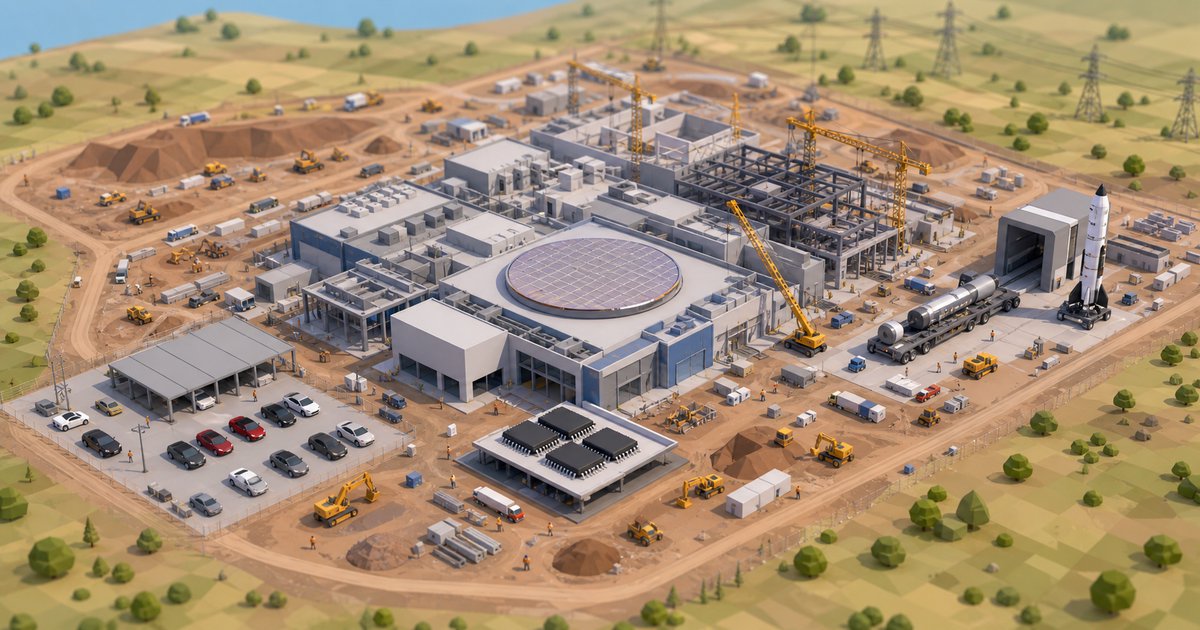
Tesla and SpaceX have named the site for Terafab, the semiconductor megafactory Elon Musk first teased in March. It is going to Grimes County, Texas, about an hour north-west of Houston, and the two companies put the initial phase at roughly $16.8 billion.
What the two companies actually confirmed
The finished site is planned at more than 100 million square feet, which Tesla and SpaceX describe as the largest chip manufacturing facility on the planet. It is designed as a vertically integrated complex — production, packaging and testing of advanced logic and memory devices under one roof rather than split across a foundry, an assembly house and a test partner.
The companies say the facility will employ at least 3,000 people drawn from Grimes and neighbouring Brazos County. Construction is due to start within months, and SpaceX has already paid the county a non-refundable $10 million.
Separate the committed number from the projected one
| Claim | Status |
|---|---|
| Grimes County site | Confirmed by Tesla and SpaceX |
| ~$16.8 billion first phase | Confirmed |
| >100 million sq ft when complete | Company plan |
| At least 3,000 jobs | Company statement |
| Up to $119 billion full buildout | Reported by CNBC in May, not a committed figure |
That last row is where most coverage gets loose. The $16.8 billion is what has been committed to a first phase. The much larger figures that have circulated since May describe what a complete buildout could eventually cost. A projected ceiling on a multi-phase industrial project is not the same as money allocated, and the two should not be added together or used interchangeably.
Why a car company is building a chip fab
Tesla's constraint on self-driving compute has not been design for some time — it has been supply. The company designs its own inference silicon and buys the manufacturing from external foundries, which puts its roadmap behind someone else's capacity queue.
Terafab is the same playbook Tesla ran on cells and on structural castings: when an input is strategic and the supply is contested, build it. The $2 billion AI hardware acquisition TeslAnt reported in July pointed the same direction.
What it means for European owners — and what it does not
Two things, and the second is the one to be careful about.
The useful read is that inference-chip supply is the reason Tesla has no firm plan for HW3 retrofits: every usable chip goes into a new car before it goes into an upgrade. More capacity eventually loosens that.
The trap is treating this as a retrofit timeline. Construction has not started. A leading-edge fab takes years from groundbreaking to qualified output, so Terafab will not produce a single chip inside the window in which the HW3 question gets answered. If your HW3 car gets an upgrade path, it will be because Tesla changed its position or bought capacity elsewhere — not because of this announcement.
There is a shareholder question here too. Tesla reported record revenue with squeezed margins in Q2, and a multi-billion commitment to a joint venture with a private company Musk also controls is a capital allocation decision worth asking about at the next earnings call.
Update: 2026-08-15
On 14 August 2026 crews broke ground in Grimes County, which supersedes this article's statement that construction had not started. Drone footage published the day before by TeslaNorth already showed earthmoving underway on the cleared site, and TorqueNews followed with the first published image of the works. Ground was broken roughly a week after the 6 August site confirmation, ahead of the "within months" the two companies indicated at announcement. What has not changed is the part that matters for owners: breaking ground is not production. A leading-edge fab takes years from groundbreaking to qualified output, so the HW3 retrofit question will be settled long before Terafab yields a usable chip.