
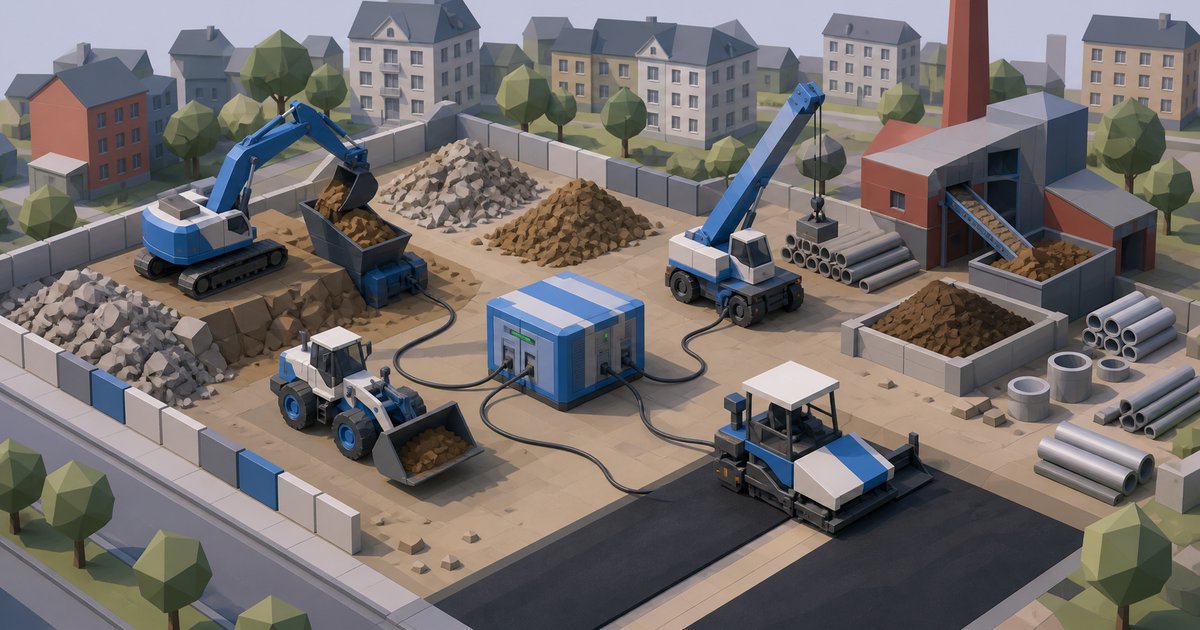
Construction sites are one of the harder places to electrify. The machines are enormous, the duty cycles are brutal, the grid connection is temporary, and the site moves. German contractor Strabag has just finished a trial in Oberhausen that took the problem on directly, and published numbers rather than intentions.
What was built, and with what
The project was the expansion of an existing soil treatment facility, lifting its annual intake from 120,000 to 350,000 tonnes across a 17,600 m² site. Strabag ran 11 electric machines on it, including a 25-tonne excavator, a wheel loader, an electric mobile crane and a road finisher. Machines without a battery equivalent — and the logistics vehicles serving the site — ran on HVO100 renewable diesel instead.
| Element | Detail |
|---|---|
| Electric machines | 11 |
| Largest electric machine | 25-tonne excavator |
| Mobile battery storage | 153 kWh |
| Non-electric machines | HVO100 renewable diesel |
| CO2 avoided | ~18,000 kg |
| Energy cost reduction | ~90% |
The physical output was substantial for a demonstration: 20,000 tonnes of material demolished and recycled, 7,400 m² of new asphalt surface, and 128 m of PVC pipework installed.
The 153 kWh battery is doing the real work
The mobile energy store is the component that makes the rest viable, and it is small — 153 kWh, roughly two large passenger-car packs. Its job is not to supply the site's total energy but to buffer it: absorbing power from a modest grid connection over time, then releasing it fast when an excavator demands a peak.
That is the same trick behind battery-buffered fast charging, and it is why the approach scales to sites where a heavy grid connection would be slow and expensive to obtain. It is also, in miniature, the argument Tesla makes for grid-scale storage with products like the Megapack 3 now in production in Texas — batteries let you build less wire.
The cost picture is honest about the trade
Strabag's own framing is the most useful part of the announcement. Electric plant costs more to buy, and the company says the higher equipment cost is only partially compensated by lower operating and maintenance costs. The roughly 90% cut in energy costs is a large number, but it applies to energy alone, not to the total cost of owning the machines.
That is a more credible position than a claim of outright parity, and it identifies exactly where the remaining gap sits: purchase price. Sustainability lead Robert Kucza framed the trial as breaking down prejudices about what electric plant can do rather than as proof it is already cheaper.
Why it matters across Europe
Non-road mobile machinery is a meaningful and largely unregulated slice of European emissions, and it sits outside the CO2 rules that govern cars and trucks. Trials like this one are how the sector establishes whether battery plant can hold a schedule.
The secondary benefits may prove more decisive than the carbon maths. Lower noise and no local pollutants matter enormously for urban work, where sites operate next to housing and restricted hours limit what a contractor can do — the same practical case that has driven electric heavy vehicles into service faster than expected, as with MAN's 750 kW-charging electric trucks entering series production.