
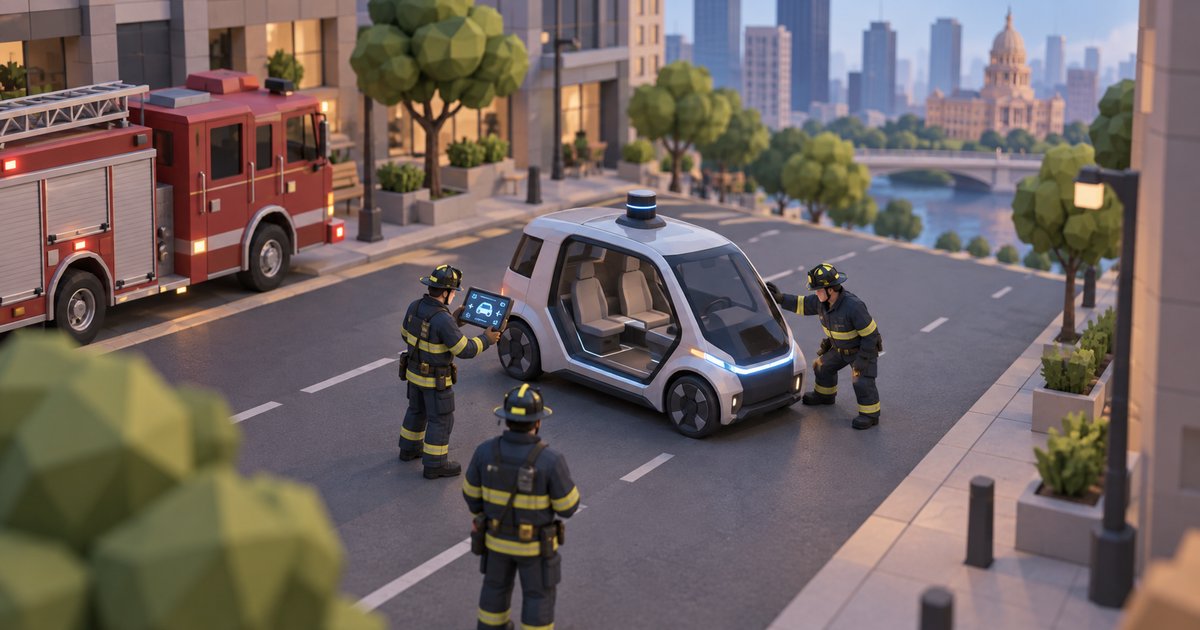
Austin's fire department has spent two weeks with driverless Cybercabs on its streets, and the question it keeps coming back to is the most basic one in the job: how do you move a car that has nothing to steer?
Battalion Chief Matt Holmes put it plainly on 17 September 2026. "Our concern is if we have to move a vehicle like a Cybercab that does not have pedals or (a) steering wheel, what is the process for us to gain access into that vehicle, and then what is the technology in that vehicle that allows us to move it?"
That is not a question about crashes. It is about the routine work of clearing a lane, which a crew does several times a shift.
The concern is access, not autonomy
The department raised it first on 8 September, days after the Cybercab began carrying the public in Austin, warning that a stopped Cybercab could block a street with no practical way for responders to relocate it.
Tesla has not left them without instruction. The company gave Austin first responders three days of training and emergency guidebooks, and crews can move the car through its touchscreen using the buried virtual joystick TeslAnt covered on 9 September. A fire captain who completed that training told NBC News it was "not the silver bullet", and called for federal safety standards covering autonomous vehicles.
The gap is that the Cybercab removes more than the steering wheel.
| From a responder's view | Cybercab | Model Y Robotaxi |
|---|---|---|
| Steering wheel and pedals | None | Fitted |
| Rear seats | None | Fitted |
| Side mirrors | None | Fitted |
| Route to manual control | Touchscreen joystick | Conventional driving |
| In Texas records, 18 Sep | 58 | 390 |
Every row is a procedure a crew already knows for one vehicle and has to relearn for the other, at a kerbside, at night, under time pressure.
Tesla's answer so far is more training
On 18 September Tesla published video of a first-responder session in Austin, walking crews through the safety and emergency features of both the Cybercab and the Model Y robotaxi and gathering their feedback.
Holmes is not asking for the cars to stop. The department wants "open dialogue with Tesla and address any issues that come up, and then look for more opportunities for training." That is a working relationship, not a dispute — but the process is unfinished while the fleet grows. Texas Department of Motor Vehicles records listed 58 Cybercabs on 18 September, up from 49 ten days earlier, alongside 390 Model Y robotaxis under the same authorisation.
Why this matters in Europe
No Cybercab operates on a European road, and Tesla holds no robotaxi permission in any European country. What travels is the question.
When Texas published Tesla's own first-responder plan at the start of September, the striking thing was that it stated the car's operating envelope without ever justifying it — the Cybercab's design domain was the Model Y's, word for word. Austin is where that document meets practice, and the people who would perform the extrication are the ones reporting that the procedures are not yet settled.
European type-approval asks the harder version of this question before the cars carry anyone, which is why Zoox publishing a full safety case for a robotaxi with no controls remains the more relevant precedent. A safety case argues why an envelope is safe; a guidebook tells a crew what to do. Austin's responders are saying those are not the same thing.