
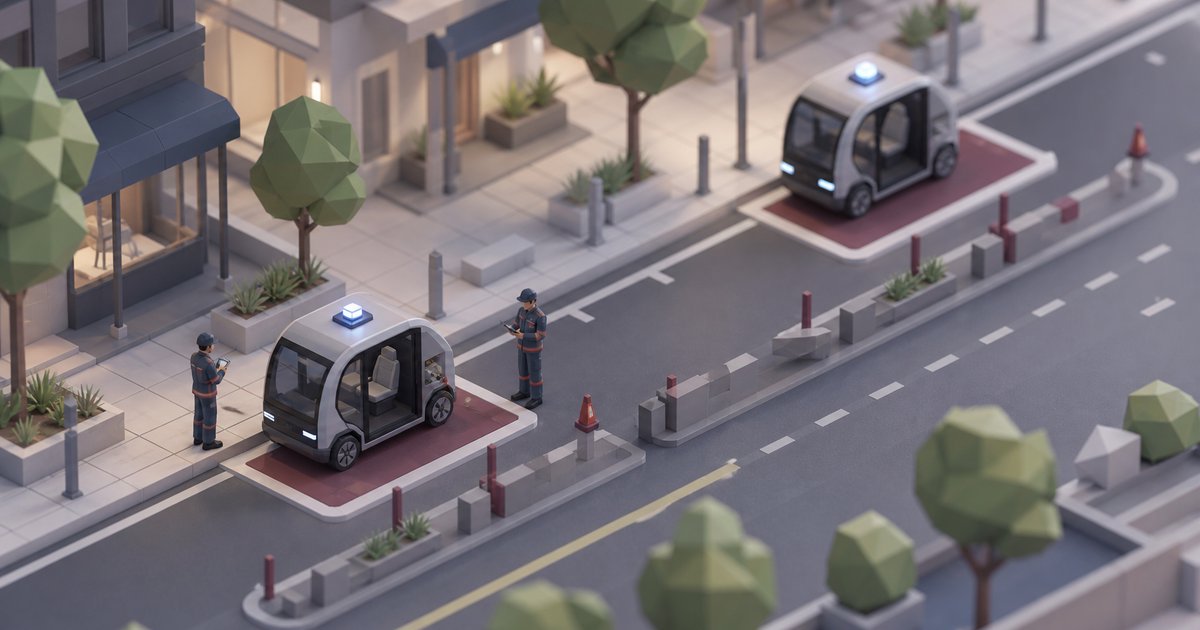
Texas has published Tesla's first-responder manual for the Cybercab. It now sits on the Department of Public Safety's connected-and-autonomous-vehicles page beside plans from Waymo, Zoox and Torc — and beside Tesla's own Model Y Robotaxi plan — three days before the Cybercab launch event on 3 September. The document is Tesla's own, version 1.1, dated 16 July 2026; what changed is that it is public. It is the first written statement of what Tesla says the Cybercab can and cannot do, and it follows Tesla putting 45 Cybercabs on the Texas robotaxi register in a single day.
What Tesla tells a police officer the car is
The Cybercab "is equipped with Tesla's SAE Level 4 automated driving system" and, in Autonomous Mode, "is designed to be capable of performing the entire dynamic driving task without any input from a human driver." It has two seats and "is not typically equipped with a steering wheel or acceleration and brake pedals."
One note draws a line Tesla has not drawn publicly before: a Cybercab that does have a wheel and pedals "is typically an engineering or test vehicle, and operates at SAE Level 2 autonomy." A warning in capitals adds that lack of movement, or of any visual indication of Autonomous Mode, "does not mean Autonomous Mode is off."
How it is stopped, and how it is switched off
Pull up behind it with lights and sirens and the car parks at the first safe spot, avoiding private driveways, then flashes its hazards at roughly twice the normal rate — the signal that Autonomous Mode has disengaged. It stays put until a Tesla representative moves it or re-engages it.
Autonomous Mode is disabled in only four ways: by a Tesla representative, after a safety-critical event, after a first-responder stop, or while charging. Once off, it cannot be switched back on until a Tesla representative reviews the incident. An officer wanting to drive the car must show a badge to the B-pillar camera to be granted control access, and an agency can phone in a closure that blocks Robotaxi service within 1,000 feet of it for about an hour.
Immobilising it is physical: cage the car on all four sides where its cameras can see the cage, chock the wheels — "Cybercab moves quietly, so never assume it is powered off" — and hold a door open, which forces it to park.
The operating envelope is the Model Y's, word for word
| Cybercab plan | Model Y Robotaxi plan | |
|---|---|---|
| Version, date | 1.1 — 16 July 2026 | 1.4 — 26 June 2026 |
| Automation claimed | SAE Level 4 | SAE Level 4 |
| Steering wheel | Not typically fitted | Fitted |
| Design domain text | identical | identical |
Chapter 5 of the Cybercab plan is chapter 5 of the Model Y plan with the model name swapped. Both claim all public roadways plus car parks, charging stations, car washes and garages; both claim day and night; both claim "light and moderate precipitation such as rain, fog, and snow"; both exclude flooding, heavy rain, icy roads, hurricane winds and off-road use. The copy runs to the small print — each points the reader to an "Arizona Areas of Operation Appendix", in a plan filed in Texas.
So a car with no steering wheel is credited with exactly the envelope of a converted Model Y that has one. That may be Tesla's genuine engineering position. It is also the claim carrying the least evidence here, because nothing in a first-responder plan is required to justify it.
Why this matters in Europe
None of this reaches a European road: Tesla has no robotaxi permission in any European country, and Europe's route to a Cybercab still exists only on paper.
But this is the paperwork Europe will demand, and the comparison to make is with Zoox, which published a full safety case for a robotaxi with no controls. A safety case argues why an envelope is safe; a first-responder plan only states what it is. European type-approval asks for the first kind.