
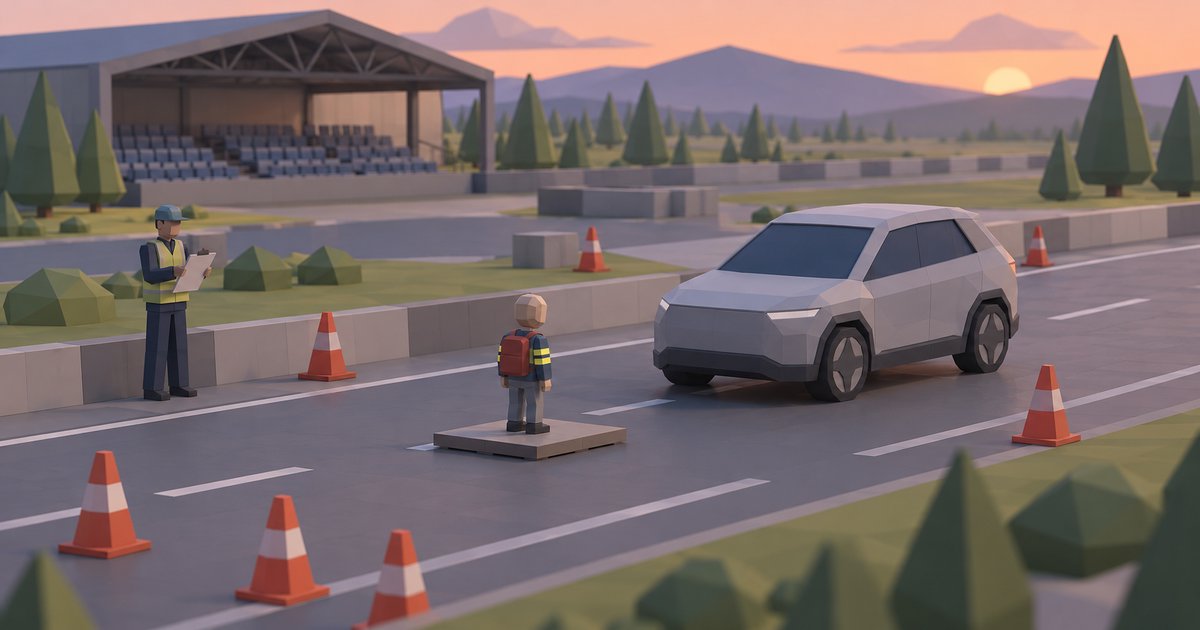
Germany's motoring club ADAC has found that cars' automatic emergency braking can be confused by the very clothing meant to keep pedestrians safe at night. In a test of six current models, including the Tesla Model Y, nearly every system failed to brake, or braked too late, for a child dummy in reflective clothing carrying a school bag. ADAC published the results on 27 October 2026.
What ADAC tested
The tests were run in the dark, following Euro NCAP's night-time procedures, with pedestrian dummies in different clothing:
| Scenario | Result |
|---|---|
| Adult in an ordinary hi-vis vest | All six cars detected it and avoided a collision |
| Adult in standardised workwear (road crews, rescue services, police) | Almost all cars failed to detect it, or did so far too late |
| Child in dark clothing | All six cars detected it and braked |
| Child in reflective clothing with a school bag | Almost every system failed to brake or braked too late; only the Mercedes CLA was unaffected |
The six cars were a Mercedes-Benz CLA, Tesla Model Y, BYD Seal, Hyundai Tucson, Dacia Duster and Opel Astra Sports Tourer. ADAC chose the Model Y and the Duster to examine systems that rely on cameras alone. The CLA and the Seal combine cameras with radar. The Hyundai and the Opel were picked because their makers' Euro NCAP results differ between day and night.
Where the Model Y stands
ADAC does not publish a result for each car. It also warns that the results are not directly comparable, because each car was tested at its own reference speed. But it says the CLA was the only car not thrown by the child's reflective clothing, which puts the Model Y among those that were. A photo caption adds that the BYD Seal would have missed the child crossing the road. In the workwear test, ADAC names only the CLA, which warned too late or could not fully avoid the dummy despite partial braking.
The result contrasts with the Model Y's US record. In September, Tesla's camera-only braking earned a Good in the pedestrian test behind the IIHS award the Model Y won. IIHS tests cover specific scenarios at set speeds in defined conditions.
Why it happens, and why software could fix it
ADAC says the systems appear to be confused by reflectors sitting low on the body, and that a person in warning clothing is not properly recognised as a person. Because the weakness lies less in the sensors than in how the car classifies what it sees, ADAC's experts say existing cars could be improved by a software update. Tesla updates its active-safety software over the air, so a fix would not need a workshop visit.
Euro NCAP has tested pedestrian emergency braking at night since 2016. Its 2026 protocol varies the test conditions to check that systems are robust, but clothing is not one of the variables. ADAC is calling on carmakers to rework their systems.
What it means on the road
ADAC's advice to pedestrians is to keep wearing hi-vis: it makes them far easier for a human driver to see, and that gain outweighs the risk from a late emergency brake. A particularly high share of pedestrian deaths happen at night. For drivers heading into Europe's darkest months, the test is a reminder that emergency braking is a backup, not a guarantee.