
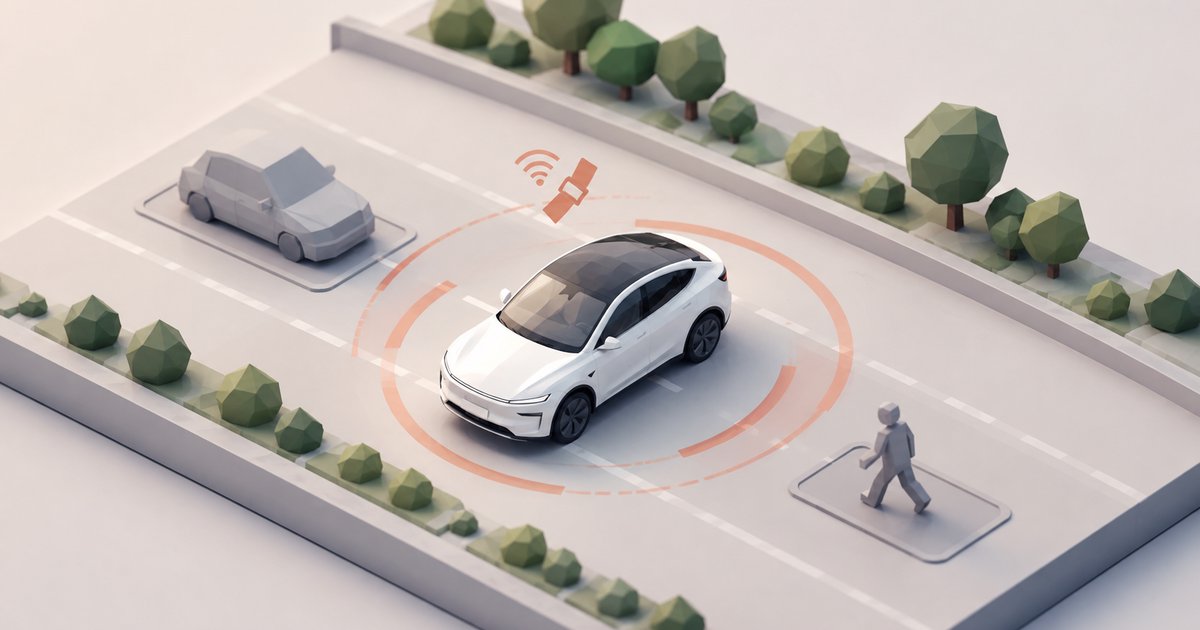
The Insurance Institute for Highway Safety awarded the refreshed Tesla Model Y its Top Safety Pick+ rating on 3 September 2026, the institute's highest award. The car earned Good — the top grade — in every crash test and every crash-avoidance test it was given.
The scorecard
| Test | Rating |
|---|---|
| Small overlap front | Good |
| Moderate overlap front (updated) | Good |
| Side (updated) | Good |
| Front crash prevention, vehicle-to-vehicle | Good |
| Front crash prevention, pedestrian | Good |
| Headlights | Good |
| Seat belt reminders | Marginal |
Six Goods and one Marginal. Because the IIHS does not require a seatbelt reminder rating for the award, the Marginal does not cost the Model Y anything — but it is the only test the car did not top, and it is a chime, not a crash structure.
The IIHS lists the winner as the 2027 model year Model Y in its midsize luxury SUV class; the ratings apply to 2026 and 2027 builds of the refreshed car.
The result worth arguing about
The two front crash prevention Goods were earned with Tesla's standard vision-based automatic emergency braking. No radar, no lidar — cameras and neural networks, tested against both a vehicle target and a pedestrian target, at the highest grade.
That is a concrete data point in a dispute that has run since Tesla removed radar. It does not settle it: the IIHS tests specific scenarios at specific speeds in defined conditions, and the awkward cases for vision-only systems — low sun, heavy rain, fog — are not what these tests measure. But "vision-only AEB cannot score Good on the IIHS pedestrian test" is no longer an available position.
The institute explicitly did not evaluate Full Self-Driving (Supervised). This award is about the safety systems every Model Y has as standard, which is the right comparison for a buyer.
Tesla's wider IIHS position
The 2026 Cybertruck also holds a Top Safety Pick+, in the large pickup class — a result that surprised people who had looked at the stainless exoskeleton and assumed the worst for the structure. The Model 3 has taken top IIHS honours across several testing cycles.
What it is worth to a European buyer
Directly, not much. The IIHS is an American insurance-funded body, and European new car safety is rated by Euro NCAP, which uses different tests, different scoring and a different star system. An IIHS award confers nothing on a European Model Y, and the North American car differs in details of lighting and restraint calibration.
Indirectly it is useful, because the two programmes have converged on similar physics. The updated IIHS moderate overlap test loads the rear seat specifically, and rear-seat protection is exactly where Euro NCAP has been raising its own bar. A car that scores Good there is not going to be embarrassed in Europe.
The seatbelt reminder result is the one thing a European owner may notice for a different reason: EU rules already require reminders on all seats, so the Model Y sold here has to clear a bar the IIHS only recommends. The Marginal grade reflects how insistent the chime is, not whether it exists.
For anyone weighing a Model Y against a rival on safety, the honest summary is that this was already a very safe car and remains one. Nothing here changes a purchase decision. It removes an argument that was being used against it.