
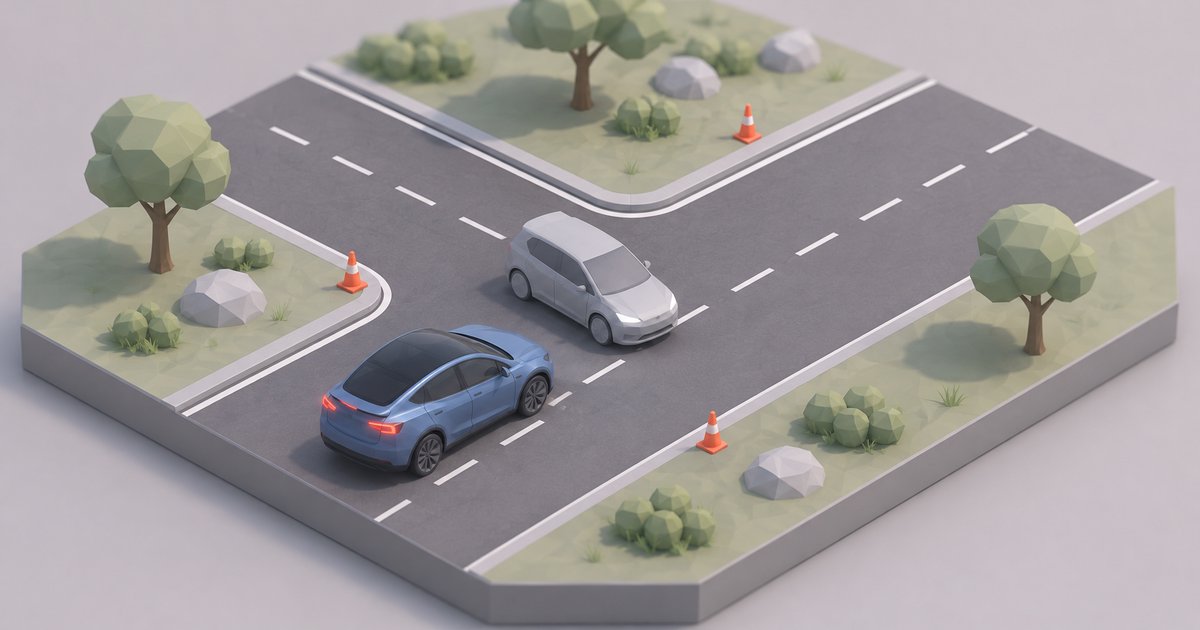
The American motoring club AAA has tested how the latest emergency braking systems cope at intersections, and one result stands out. When another car turned into the test vehicle's path from a side road, the Tesla Model Y warned the driver, braked and avoided a collision in all five runs. The Chevrolet Equinox, Ford Explorer and Hyundai Tucson hit the target every time. AAA published the research on 12 November 2026.
What AAA tested
AAA and the Automobile Club of Southern California's Automotive Research Center tested four 2026 model-year SUVs, each with intersection automatic emergency braking (AEB) as standard, in 74 valid closed-course runs in daylight. A robotic soft car stood in for the other vehicle. Warnings were set to the middle sensitivity, or the setting each maker specified, and every car had its latest software installed.
There were two crash types. In the turn-into-path test, the car drove straight at 48 km/h while the target turned right into its path from a perpendicular road at 8 km/h. In the turn-across-path tests, the car turned left at 15 km/h across an oncoming target doing 30 km/h: first exactly as in Euro NCAP's standard test, with the turn signal on and a steering robot, then without the signal, then with a test driver steering.
| Collision avoided | Chevrolet Equinox | Ford Explorer | Hyundai Tucson | Tesla Model Y |
|---|---|---|---|---|
| Car turning into path | 0/5 | 0/3 | 0/3 | 5/5 |
| Left turn, Euro NCAP set-up | 5/5 | 5/5 | 5/5 | 5/5 |
| Left turn, no turn signal | 5/5 | 5/5 | 0/3 | 5/5 |
| Left turn, test driver steering | 5/5 | 5/5 | 5/5 | 5/5 |
Where a car gave neither a warning nor any braking in its first three runs of a scenario, AAA stopped there to limit damage.
How the Model Y did it
In the turn-into-path runs, the Model Y warned on average 1.72 seconds before impact would have occurred, began braking 0.86 seconds before it and stopped with an average gap of 1.60 m to the target. The Equinox warned in four of its five runs but braked in only one. The Explorer and the Tucson neither warned nor braked. All three struck the target at around 40 km/h on average.
In the left-turn tests, the Model Y avoided the oncoming target in all 15 runs, with or without the turn signal. The Tucson was the only car whose system depended on the indicator: without it, there was no warning and no braking, and it hit the target at 45 km/h on average.
"AEB is making progress in the limited intersection scenarios it is tested to handle. Unfortunately, performance outside those scenarios is spotty," said Greg Brannon, AAA's director of automotive engineering and research.
What it means for European drivers
The scenario all four cars passed is the one Euro NCAP has used since 2020, when it added a limited set of intersection tests, AAA notes. The side-road turn that three of them failed is AAA's own test, not part of any standard. The US has no intersection test standard at all: NHTSA drafted a test procedure in 2019 for research but has not adopted one. An AAA Foundation analysis of 2020-2024 US data found that angle crashes, including these intersection types, account for about 41% of fatalities in two-vehicle crashes.
AAA tested a US-market Model Y. Model Ys sold in Europe also rely on cameras alone for emergency braking, but AAA did not test one, so the result cannot simply be assumed to carry over. Tesla's record in other independent tests is mixed: the Model Y earned an IIHS Top Safety Pick+ in September, but in ADAC's night-time test in October it was among the cars that failed to brake in time for a child in reflective clothing.
AAA's advice applies to every car: treat intersection AEB as a backup, not a substitute for attention.