
Tesla's answer to vehicle-to-load stops at the American border. The Outlet Adapter it switched on for Model Y Premium this week delivers 2.4 kW at 120 volts through a NEMA socket, which describes a North American house, not a European one. Owners here have had nothing to buy.
An accessory maker is now selling into that gap. WETOX, the international brand of Weidianbao, has put its D2 discharge adapter on Kickstarter in NACS and CCS2 versions, and Electrek reported on 15 August that the company had been awarded what it calls the world's first ISO 15118-20 certification report from the testing house SGS.
How it works on cars that were never built for it
The D2 does not rely on a bidirectional onboard charger, because European Teslas do not have one. It connects to the DC fast-charging pins and performs the DC-to-AC conversion inside the adapter itself. That is the whole trick, and it is why one box can serve a Model 3, Model Y, Model S or Model X. WETOX also lists the Ford Mustang Mach-E.
| Specification | CCS2 (European) version |
|---|---|
| Output | 230 V, 50 Hz |
| Hardware maximum | 6,600 W |
| Continuous | 6,000 W |
| Usable on a Schuko socket | 3,680 W |
| Sockets | Type E/F, G, I, L, N |
| Weight | approx. 5.5 kg |
| Sealing | IPX5 main unit, IPX6 power strip |
| Operating range | −10 °C to +40 °C |
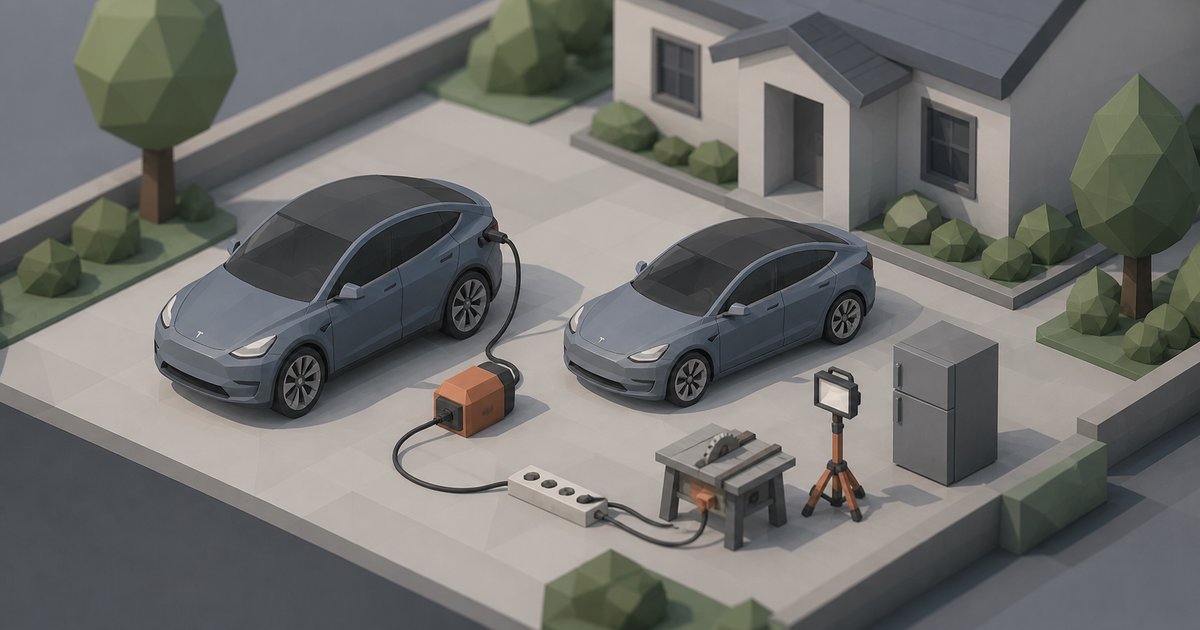
The drop from 6,600 W to 3,680 W is not sleight of hand. A Type F Schuko outlet is a 16-amp socket, and 230 V at 16 A is where a domestic plug stops regardless of what the box behind it can push. Even derated it is a different class of tool from Tesla's accessory: 3,680 W against 2,400 W is the difference between running a fridge through an outage and running a table saw.
What is certified, and what is not
The certification deserves precision. What WETOX announced is a report against ISO 15118-20 — the vehicle-to-grid communication standard — issued by SGS. The company separately lists DIN 70121 support, a CE declaration of conformity and an FCC report.
A communication-protocol certification means the adapter negotiates with the car correctly. It is not Tesla sanctioning the practice, and it is not a warranty position — and pulling several kilowatts out of a traction battery through the fast-charge pins is the kind of use a manufacturer tends to have opinions about.
What it means for European owners
Two cautions before anyone pledges. This is a crowdfunding campaign, not a product on a shelf: it runs to 30 August 2026 and had passed roughly $120,000 in pledges when Electrek covered it. WETOX says mass production is finished and fulfilment follows immediately, a stronger position than most Kickstarters, but no independent test has been published.
Price is the other unknown. WETOX's own store lists the CCS2 D2 at CAD $2,404.68 and shows it sold out; the Kickstarter early-bird figure has not been published. At anything near the listed price this is not an impulse accessory.
One compatibility note for older European cars: a Model S or Model X on a Type 2 port needs the CCS protocol enabled before the adapter has anything to talk to.
Bottom line
The interesting part is not the gadget. It is that a capability Tesla rations by market and by build date turns out to be reachable through the DC port on cars that already exist, at higher power than Tesla's own adapter. European owners now have a route to V2L. They just do not have one from Tesla.