
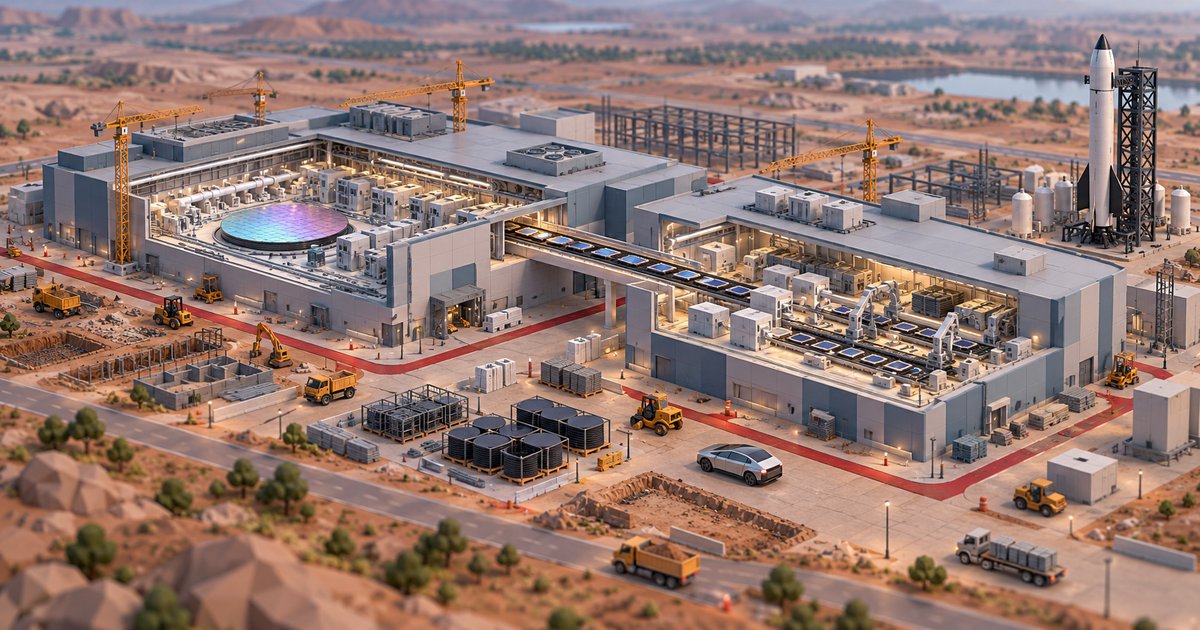
Elon Musk has confirmed that Terafab, the semiconductor megafactory Tesla and SpaceX are building in Texas, is in talks with TSMC. His confirmation ran to eight words.
Asked about a report that the world's largest contract chipmaker was circling the project, Musk replied on X on 3 October 2026: "Just discussions, but something may come of it." That is the entirety of what either company has said on the record.
What was actually reported
The underlying story is Tim Culpan's, published on his Culpium newsletter the same day. Culpan, a long-time semiconductor correspondent, wrote that he had learned of TSMC's Texas expansion thinking roughly six weeks earlier and had held the story waiting for corroboration. His reading of the most likely outcome is specific:
"The most likely scenario is for TSMC to try to own and operate the new factory."
Two structures have been described in the reporting that followed. In the first, TSMC owns and runs the fab while SpaceX and Terafab take equity stakes or commit to buying chips in volume over a long period. In the second, SpaceX and Terafab keep majority ownership and TSMC contributes process technology and the expertise to operate the plant.
Neither has been agreed. TSMC has not commented. The company reports third-quarter earnings on 15 October 2026, and analysts now expect to be asked about Terafab there.
The tension is the story
Terafab was announced as the opposite of a foundry deal. When Tesla and SpaceX confirmed the Grimes County site and a $16.8 billion first phase in August, the design was explicitly vertically integrated: logic, memory, advanced packaging and test under one roof rather than split across a foundry, an assembly house and a test partner, on a site planned at more than 100 million square feet with at least 3,000 staff.
The stated reason for building it was that Tesla's constraint on self-driving compute had stopped being design and become supply — the company designs its silicon and rents someone else's capacity queue to make it.
TSMC owning and operating that plant would be the queue, moved. TSMC is a pure-play foundry whose whole proposition is making other people's chips without competing with them, and a captive fab for two Musk companies does not obviously fit inside that. Reconciling the two is the part no one has explained.
Tesla already buys from TSMC
Worth being precise about what would and would not be new here. TSMC is not a prospective Tesla supplier; it is an existing one. Musk has confirmed that AI5 and its successor will be built at both Samsung's Taylor plant and TSMC's in Arizona, and AI5 entered trial production at Taylor in September.
What would be new is TSMC's relationship to the building rather than to the chip. TSMC has committed $100 billion to Arizona against a total planned figure of $265 billion, and is reported to be weighing a second US hub near Dallas. Intel had already signalled involvement in Terafab, offering its 14A process; TSMC entering the conversation reads as a change in who Musk expects to make this work.
What it means for an owner
Nothing yet, and probably nothing for years. Terafab's output is aimed at Optimus and training infrastructure, not at cars — AI5 is not going into Tesla's vehicles, and the Cybercab launched on AI4. A fab that has not broken ground, under a partnership that does not exist, does not change what is in any car on a European road.
Treat the 15 October earnings call as the next real checkpoint, and treat everything before it as eight words from Musk and one well-sourced reporter's read.