
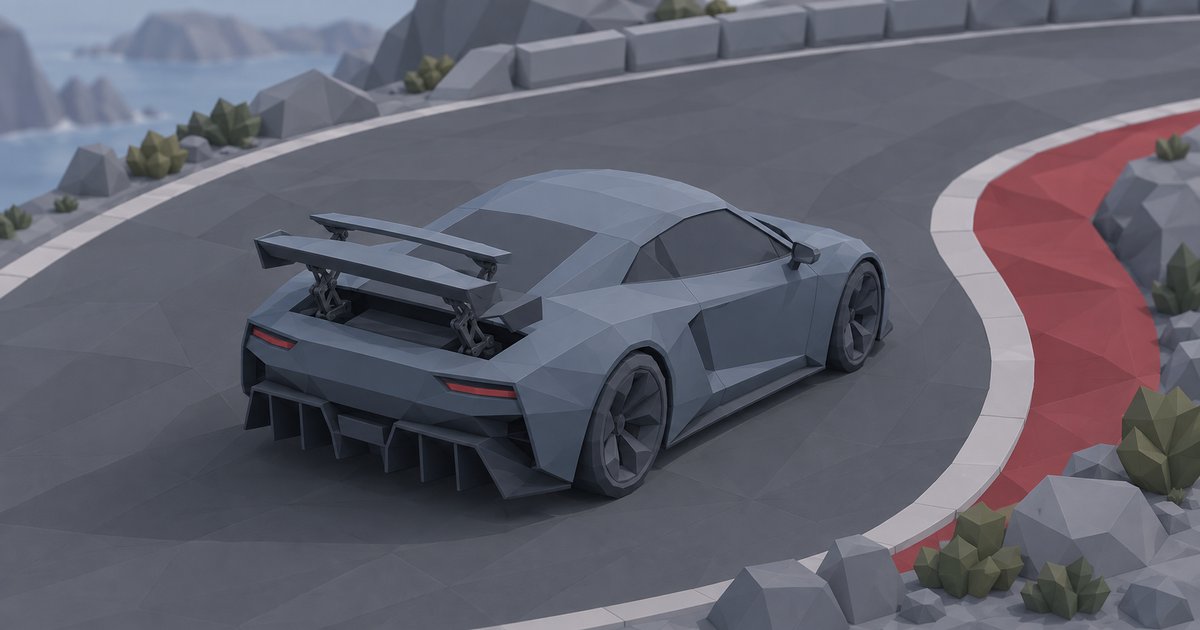
The US Patent and Trademark Office published a Tesla application on 24 September 2026 describing a two-piece active rear wing that sits flush in a car's bodywork and deploys to generate up to 700 kg of downforce. The drawings show a low fastback 2+2 coupe with a substantial rear diffuser. The document never says "Roadster", and it arrived a week before Tesla unveils one.
What the filing describes
The application is US 2026/0285418 A1, "Deployable and Active Rear Wing Assembly with Safety Features", credited to inventors David Lemire and James Michael Arthur Crook. It was filed in August 2025 as a continuation of a March 2025 application that is now listed as abandoned, so the work predates the publication by more than a year — and Tesla thought it worth refiling.
| Detail | |
|---|---|
| Wing elements | Main element plus a leading-edge slat |
| Slat position | 3–15 mm ahead of the main element |
| Actuation | Four-bar linkage |
| Deployment time | Under 3 seconds, stowed to fully deployed |
| Angle change | Under a quarter of a second |
| Downforce, DRS mode | 0 kg |
| Downforce, high-downforce mode | Up to 700 kg at top speed |
| Speed threshold cited | Above 100 mph (about 160 km/h) |
Stowed, the main element sits flush with the deck lid thanks to a stepped shape, and the slat hides underneath the rear panel. The car reads as having no wing at all until it needs one.
The two ends of that range are the interesting part. The filing describes a DRS mode making zero downforce — the drag-reduction trick Formula 1 uses on straights — and a high-downforce mode making up to 700 kg. A wing that changes angle in under a quarter of a second is not a spoiler that pops up at a set speed; it is a device meant to be worked corner by corner.
For scale, the McLaren Senna — a road-legal car designed around aerodynamics to an extent almost nothing else is — is quoted at around 800 kg.
Why this is filed under rumours
A patent is a real primary document, which makes it better evidence than a leak. It is not evidence of a product.
Carmakers patent far more than they build. The application does not name a vehicle, does not commit to a specification, and does not promise that anything in it reaches a showroom; Electrek's Fred Lambert makes the same caveat. The inference that this is the Roadster comes from the shape in the drawings and the timing of the publication, not from anything Tesla has said.
What makes the timing hard to ignore is the calendar. Tesla has scheduled the Roadster unveiling for 1 October in Texas, and reopened North American reservations on 19 September. A patent describing hypercar-grade aerodynamics on a low two-door, published by the USPTO seven days before that event, is either a coincidence or a preview.
What Europe gets, so far
Nothing announced. Tesla reopened Roadster reservations in the United States and Canada only, the reveal is in Waco, Texas, and the company has given no European pricing, allocation or timing. A car that has been promised since 2017 and is still 12 to 18 months from production after next week's reveal is not one a European buyer should plan around.
What to watch on 1 October
If the production Roadster has a visible fixed wing, this filing was a discarded branch. If the deck lid is clean and something rises out of it on the move, the numbers above become the specification to check — particularly the speed at which high-downforce mode engages, because 700 kg above 160 km/h is a track figure, not a road one.
The title's "safety features" are worth a look too: an element that deploys in under three seconds and can make most of a car's weight in downforce has failure modes, and Tesla evidently spent design effort on what happens when it jams or deploys unintentionally.
Nothing here changes what Tesla sells today. It is a reminder that the Roadster shown next week has been in detailed engineering for at least eighteen months.