
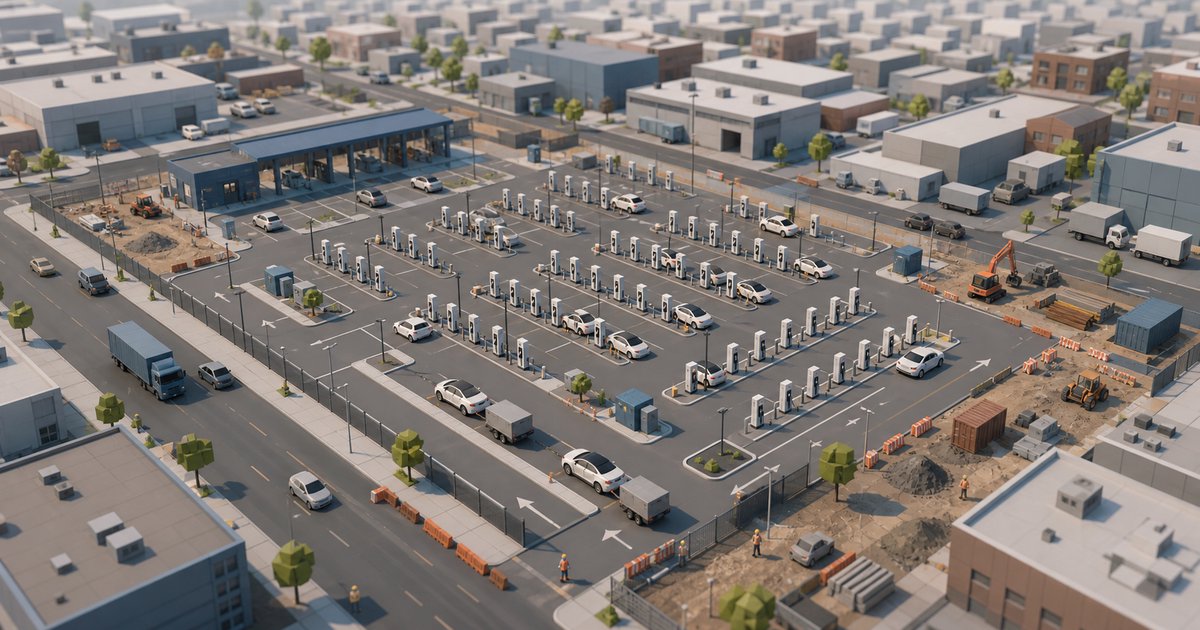
Tesla is building a Supercharger in Queens large enough to change what a city charging site looks like. The station going up at 48-26 54th Road in Maspeth is reported at 64 stalls, which would make it the biggest Supercharger on the US East Coast.
The figure comes from Sawyer Merritt, who posted on 16 August that Tesla is "currently building a new 64-stall Supercharger station in Queens, New York" and that it will be "the biggest Supercharger station on the East Coast of the U.S."
The stall count is not quite settled
Worth flagging the inconsistency rather than smoothing it over. Merritt's post says 64 stalls and calls it the biggest. Teslarati's write-up gives a range of 64 to 68 and describes the site as tied for largest on the Eastern Seaboard with the station in Halifax, North Carolina, which has 68 stalls.
Those two claims cannot both be exactly right, and Tesla has not published a final configuration. Sixty-four stalls makes it the largest outright only if Halifax is smaller than 68; at 68 it ties. Either way the site is in a class of its own for the region, and the final number is the sort of detail that shifts during construction.
Why Maspeth
The location choice is more interesting than the headline number. Maspeth sits on I-495, the corridor between Manhattan and Long Island, which makes it a natural stop for drivers heading in either direction rather than a destination charger.
It also answers a genuine gap. Manhattan has only five Superchargers, and those typically carry four plugs each — roughly twenty stalls for the densest part of the city. A 64-stall site one borough over does more for New York charging capacity than anything inside Manhattan realistically can, given the space a station of this size needs.
Two of the stalls are pull-through, for cars towing trailers. That is a small detail with a specific audience: Cybertruck and Model X owners with a trailer currently have to unhitch at most sites.
What a 64-stall site actually signals
Tesla's early network was built around eight- and twelve-stall sites on interstates. Stations at this scale are a different product: they assume sustained queueing demand, they need grid capacity closer to a substation than a car park, and they only make sense where a robotaxi fleet or very high private throughput justifies the connection cost.
New York is also one of the markets where Tesla has been expanding Cybercab road testing. A very large urban station near a major artery is exactly the infrastructure a driverless fleet needs, whether or not that is the stated purpose here.
What European owners should take from it
No European site is planned at this scale, and this is a US project — but the design question it answers is one Europe has too. The pinch point on European Supercharger trips is rarely total network size; it is a handful of sites on holiday corridors that saturate for a few weeks a year while nearby sites sit idle.
Tesla's answer in Queens is to build one very large station on the through-route rather than several small ones near the destination. That is a template European operators could copy, and it becomes more relevant as the network carries other brands' traffic — as TeslAnt covered when Poland's Superchargers opened to all brands with published prices. More cars per site raises the value of stall count over site count.