
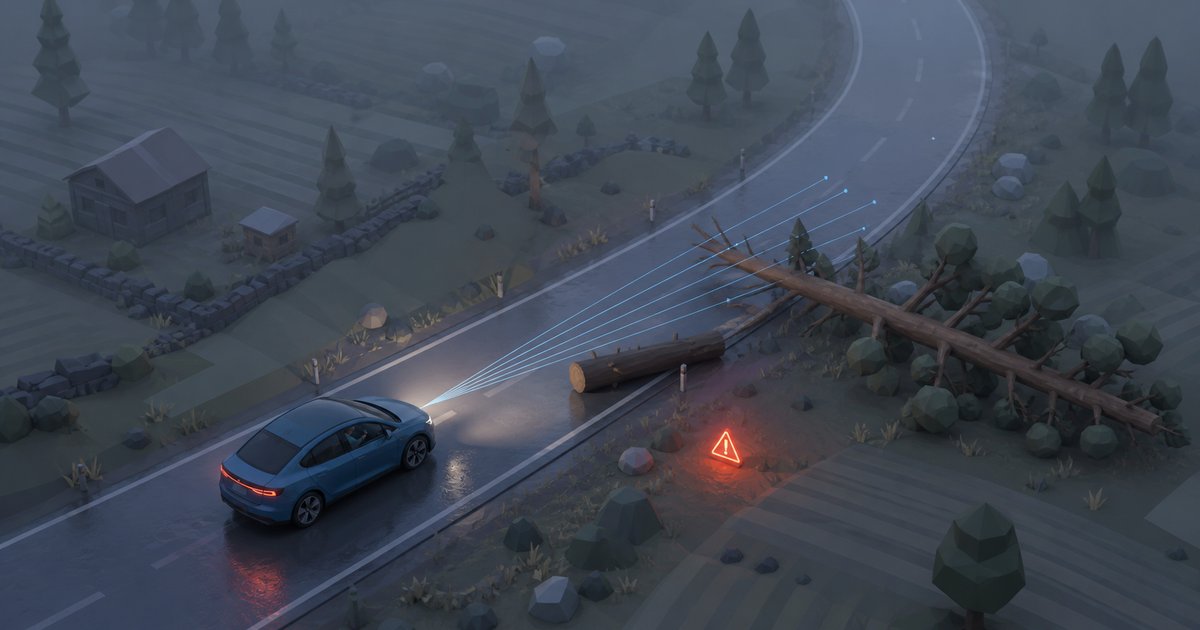
Two Tesla owners posted videos on 21 August of cars running FSD v14.1 Lite failing to react to large objects lying in the road. In one, the car drove straight over a log at 32 mph. In the other, the driver says he reran the same stretch three more times and the car missed a fallen tree every time.
Both cars are Hardware 3. Neither incident produced a collision report, and Tesla has not commented.
What the two videos show
| The log | The fallen tree | |
|---|---|---|
| Posted by | @donvarri | @Baldersonmichae |
| Conditions | Wet, foggy rural road | Night |
| Speed | 32 mph (about 51 km/h) | Not stated |
| Car's response | Drove over it without braking or slowing | No slowing; driver braked manually |
| Repeated? | No | Yes — same spot, three more attempts, same result |
| Reach | 800,000+ views | — |
The second is the more interesting one, because a repeatable failure is a different class of evidence from a one-off. The driver's own summary was not hostile to the software: FSD v14.1 Lite is "a big step forward and will improve safety a lot", he wrote, before adding that at full reliance "the car would have hit it hard".
What FSD Lite actually is
FSD v14 Lite is a compressed build of Tesla's v14 stack made to fit Hardware 3 — 8GB of RAM and a fraction of HW4's bandwidth. It began rolling out in June 2026 and has had a rough few months: owners reported HW3 computers running above 90°C and in some cases reaching 96°C, with thermal shutdowns forcing disengagement, and v14.1 Lite was released partly to address that overheating.
Static obstacle detection is the canonical hard case for a vision-only system. A log lying still across a lane produces no motion cue and little vertical signature; it is exactly the geometry a compressed perception model is most likely to spend fewer parameters on. Two videos are not a study, and nobody should read them as a failure rate. But they are the specific failure mode a smaller model would be expected to have.
Why this matters in Europe, even though Lite is not here
European HW3 owners cannot get this software at all, and that is the point. When Tesla launched FSD (Supervised) in the Netherlands it excluded HW3 cars, which is what prompted the Dutch collective claim now standing at 7,907 verified owners across 39 countries and €15.5 million in reported FSD purchases. Lite is the build those owners would plausibly receive if the claim forces Tesla's hand — it has already left North America once, for South Korea.
So the question "how well does the HW3 build see things" is not academic here. It is a question about what the remedy in that dispute would actually be worth.
Keep the frame straight
FSD (Supervised) is Level 2 in every market it operates in. The driver is responsible for the car, and in both videos the responsible party was awake and watching — one intervened, one did not need to. Electrek's context is the part that stings rather than the clips: Tesla has sold roughly four million cars marketed as full-self-driving capable at up to $15,000, and has acknowledged it has no clear path to unsupervised autonomy on HW3.
The videos do not change that. They illustrate it.