
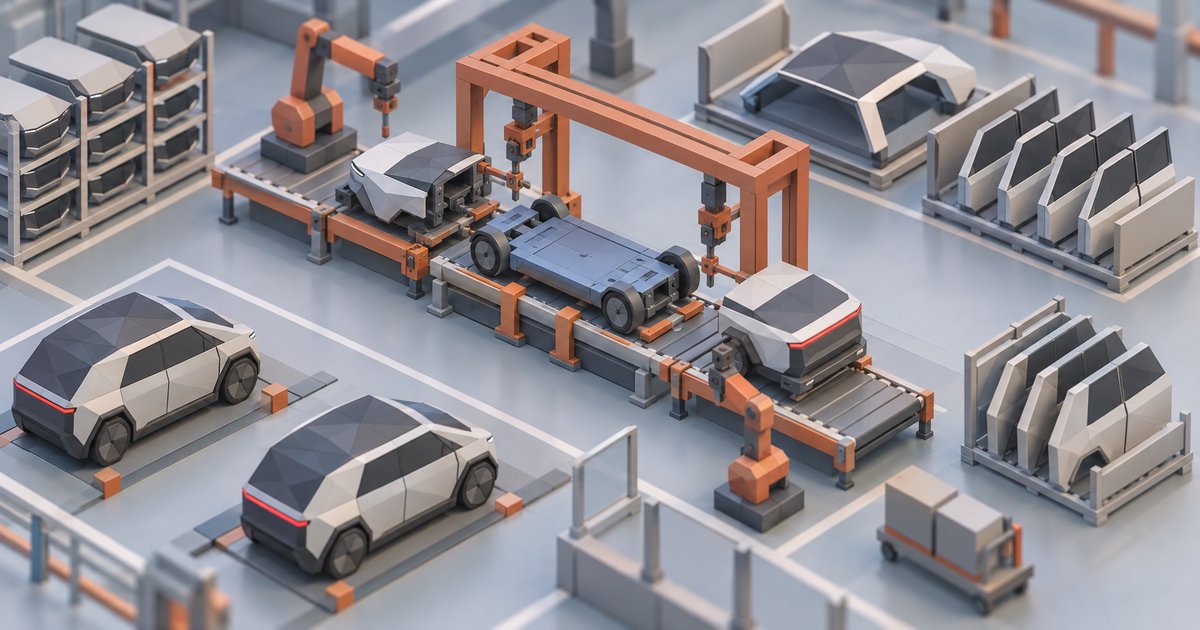
Tesla's official Robotaxi account posted a roughly 48-second clip from the Cybercab launch event on 8 September 2026, and it is the clearest look yet at the assembly method the company has been promising since 2023.
What "unboxed" actually means
A conventional car is built by moving a body shell down a single line and adding parts to it. Everything waits for the shell, and the line has to be long enough to hold every station in sequence.
The Cybercab is not built that way. The battery box, the front section and the rear section are assembled at the same time on parallel lines. They are brought together only at the end, where the sides, the roof and the doors are added around them. Work that used to happen inside a mostly-finished body — awkwardly, through door apertures — happens on open modules instead.
Tesla's claim is that this halves the size of the assembly line, which means more capacity in the same building.
The numbers Tesla is quoting
| Vehicle | Cycle time |
|---|---|
| Cybercab, line design target | Under 10 seconds |
| Cybercab, long-term goal | 5 seconds |
| Model Y, for comparison | About 34 seconds |
Cycle time is the interval between finished cars coming off the line. A Model Y at roughly 34 seconds is already fast by industry standards. Under 10 seconds would be something else, and 5 seconds would be a rate no passenger-car line has run at.
Two caveats belong with those figures. They describe what the line is designed for, not what it is currently achieving — Tesla has published no actual rate. And a two-door car with no steering wheel, no pedals, no wing mirrors and far fewer parts than a Model Y is an easier thing to assemble, so the comparison flatters the method as much as it demonstrates it.
Why the footprint claim is the interesting one
The cycle-time headline is the one that travels, but halving the line is the claim with money attached. Tesla said at the Cybercab's Austin launch that it wants volume production before the end of this year and eventually two million units annually. Two million cars a year from conventional lines is an enormous amount of building; from lines half the length, materially less.
Pilot production began at Gigafactory Texas in February 2026. The video is the first public sight of the process running rather than described on a slide.
What it means for Europe
Nothing immediately, and that is the honest answer. No Cybercab carries a passenger in Europe, and the first one will not until the FSD approval vote scheduled for 6 October has happened.
What the video changes is the credibility of the volume story behind it. Tesla has opened a fleet-purchase interest form, and the question any prospective fleet operator asks is whether the cars can actually be built in the numbers implied. A line running at the rate Tesla describes would answer it; a line that never gets past pilot rates would not.
There is a second-order point for anyone who buys an ordinary Tesla. If unboxed assembly works at volume, it is not going to stay confined to the Cybercab — the cheaper models Tesla has been promising Europe are exactly where a halved line and a shorter cycle time would show up in a price. That is speculation until Tesla says so. The video is evidence the method exists, not that it has been extended to anything else.
Update: 2026-09-23
Tesla Recruiting posted on 22 September 2026 that the company is "producing a drive unit every 10 seconds", with video of the automated drive-unit line. That figure is not the one in the table above. This is a current rate for a single component line; the under-10-second number quoted here is a design target for the interval between finished cars. The two are easy to conflate because they share a number. The same post repeated that the Cybercab is "the most efficient EV ever certified & built", which Drive Tesla Canada rendered as roughly 40% more efficient than the Model Y. That claim is not new: Tesla put the Cybercab's certified consumption at 165 Wh/mi in May 2026, against 240 Wh/mi for a Model Y RWD — about 31% less energy per mile.