
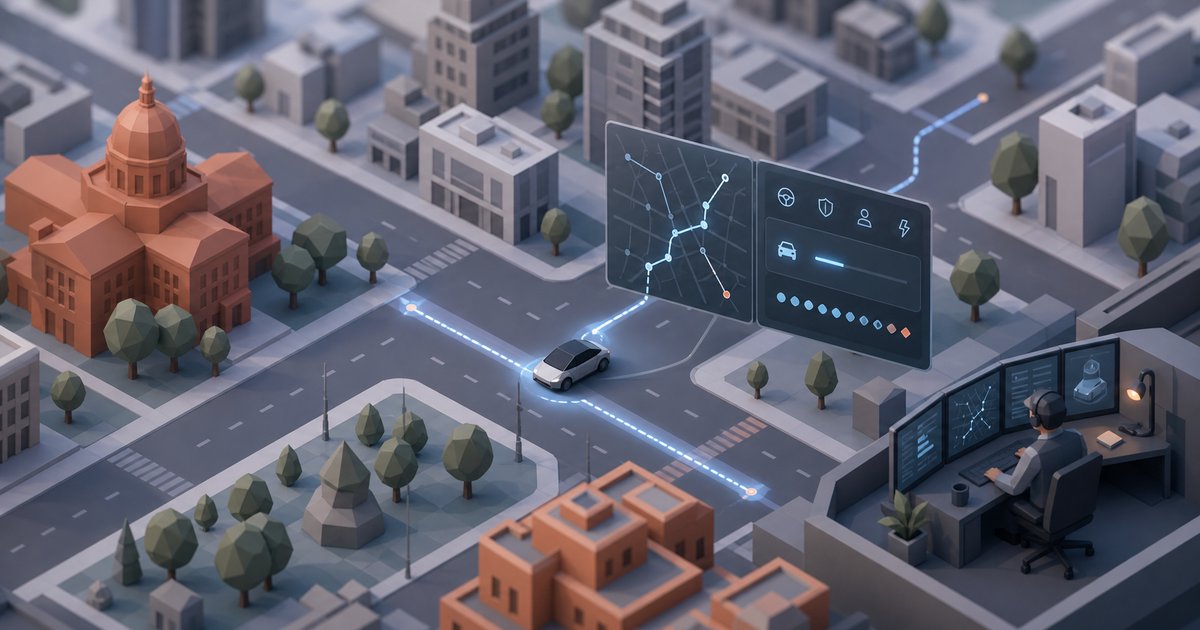
Cybercabs testing in Austin have been photographed running their own in-car interface, and it is not the passenger screen Tesla has shown publicly. It is the operator's view — and it reveals how Tesla is grading its robotaxis before it removes the safety driver.
The interface was spotted by observers tracking the test fleet, not released by Tesla, so treat the labels as evidence and the interpretations as inference. Tesla has not commented on any of it.
What the screens show
| Element | What it appears to do |
|---|---|
| Split-screen Controls | Settings menu opens over part of the screen, leaving the map visible above it |
| Rodeo controls | Buttons marked Short Oops, Long Oops, Win and Voice Note, plus a shortcut to drive settings |
| "Roaming" status | A trip state for driving with no confirmed rider aboard |
| Ride-review form | A web form with a 10-star rating and yes/no questions |
The split-screen Controls layout is the small detail owners will envy. On production Teslas the settings panel covers the map; here it sits below a still-visible map. That is a straightforward interface improvement, and there is no indication whether it reaches customer cars.
"Rodeo" is a grading tool, not a driving mode
The Rodeo panel reads like feedback tooling for staff riding along. Short Oops and Long Oops suggest a rider tagging a mistake by severity — a brief hesitation versus a sustained error — while Win marks the car handling something well. Voice Note lets the reviewer dictate context instead of typing it at 50 km/h.
Paired with that, Tesla is reportedly using a web-based evaluation form carrying a 10-star ride rating and a set of yes-or-no questions. The most telling of them asks whether the trip was acceptable for an unsupervised car — which is to say, whether the ride would have been fine with nobody in the driver's seat.
That question is the story. It shows Tesla scoring current supervised rides against the standard it has to meet to remove supervision, one trip at a time, rather than waiting on a single go/no-go verdict.
"Roaming" means the car keeps moving
The status labelled Roaming describes a Cybercab in motion without a booked passenger. The plain reading is repositioning: rather than parking where it drops someone off, the car drifts toward denser areas to shorten the next pickup.
Every robotaxi operator faces this, and it is a known cost of the model — deadhead kilometres burn energy and add congestion without earning a fare. That Tesla has given the state a name in the production interface suggests it is planned behaviour, not an experiment.
The passenger-facing interface, by contrast, stays deliberately thin: destination, ETA, map, media and passenger controls, with vehicle settings hidden. That is the correct decision for a car strangers ride in.
Why a European Tesla owner should care
Nothing here ships to Europe soon. FSD (Supervised) is still unapproved across the EU, and the Cybercab's Austin public launch is a US event on US roads with Starlink-connected cars already testing publicly.
What does transfer is the evidence about readiness. European regulators will eventually be asked to accept Tesla's own assessment that its cars are safe unsupervised, and this is the first look at the instrument producing that assessment — a ten-star form and an "acceptable for unsupervised cars" checkbox. Whether that satisfies a European type-approval authority is a different question from whether it satisfies Tesla.