
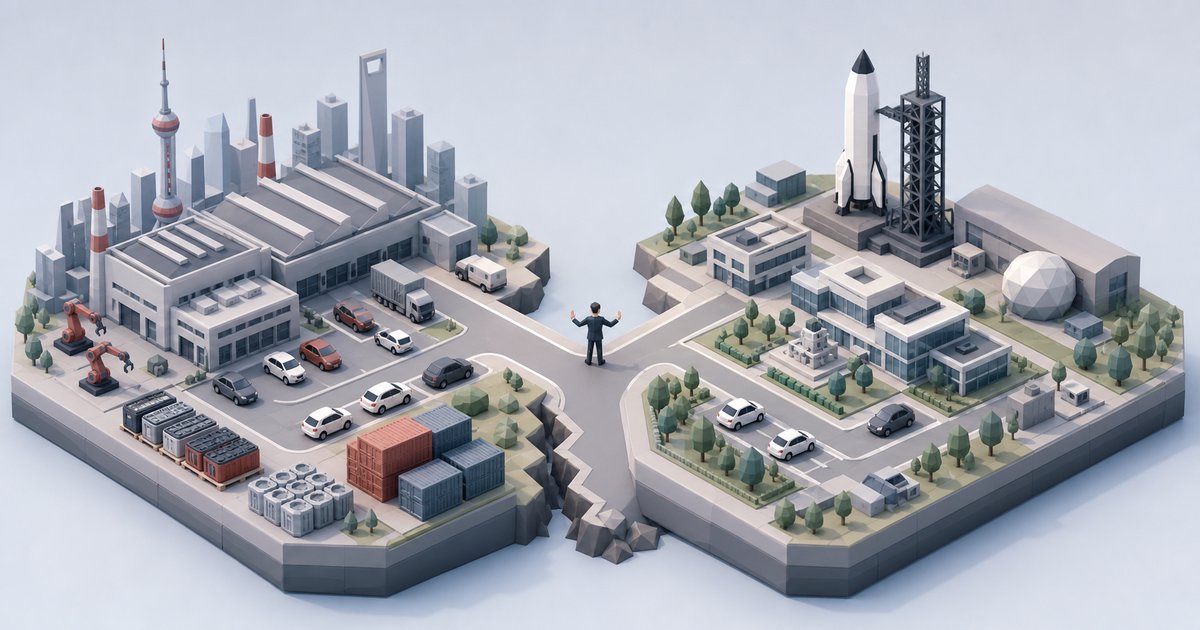
The Wall Street Journal reported on 30 July 2026 that Elon Musk had told Tesla managers to prepare an organisational separation of the company's China operations, the Shanghai factory included, with a spin-off, a sale and an outright closure all under evaluation. Musk's answer arrived within hours and left no room for interpretation. The report was "absurdly fake news", he wrote, and the idea "has never even come up in a discussion ever."
So a flat denial from the chief executive against sourced reporting from a major financial paper. Both cannot be right. TeslAnt is filing this as a rumour until something firmer than either side's word turns up.
What the report claimed
Two separate threads run through the WSJ account, and they are worth pulling apart because they carry different weight.
The first is geopolitical hedging. According to the report, Musk has for several years pushed executives to keep a clean line between Tesla's American and Chinese businesses, so that the US side could be insulated if relations deteriorated — over Taiwan in particular. That is a defensive posture, not a transaction, and it is the more plausible half of the story.
The second is the merger. SpaceX holds classified US military contracts, and a company carrying that kind of clearance does not comfortably share a corporate parent with a wholly-owned Chinese manufacturing operation. On that reading, separating China is not the goal; it is the precondition for something else.
Why Shanghai is the awkward asset
Tesla's position in China is unusual. Most foreign carmakers operate there through joint ventures with a domestic partner. Tesla owns Shanghai outright, which for years was the arrangement everyone envied — full control, no shared margin, no technology hand-off.
An outright-owned plant is also the hardest kind to quietly unwind. And it is not a rounding error: China accounted for roughly 18% of Tesla's sales in the first half of 2026. The WSJ also notes Chinese regulators' interest in data flowing out of a fleet of roughly two million Chinese-owned vehicles, which is its own obstacle to any structural change.
This is the second time in a fortnight that a Tesla–SpaceX combination has surfaced, after the merger hint on the Q2 earnings call. One hint plus one denied report is not a plan, but it is no longer a single data point either.
What it changes for European owners
Directly, close to nothing — and that deserves saying plainly rather than dressed up. Tesla builds for Europe at Grünheide, and a restructuring of the Chinese business would not by itself alter a European price list, a delivery date or a service appointment.
The indirect exposure is in cells and chips, which is exactly the dependency the report says Musk wants to hedge. European-built cars sit downstream of the same Asian battery and semiconductor supply base as everything else Tesla makes. A Tesla that genuinely decoupled from China would be a Tesla with a different cost structure, and that would eventually reach European showrooms.
None of which is happening yet. What exists today is a report, a denial, and a supply chain that both sides of the story agree is concentrated in one part of the world.