
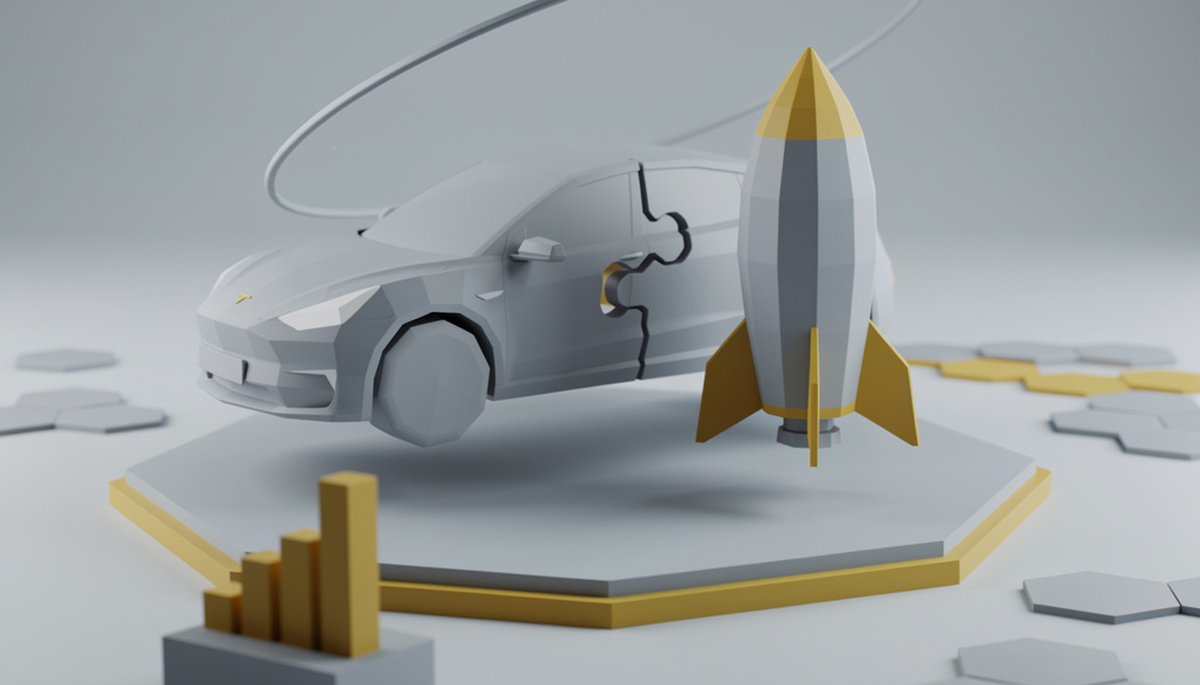
Tesla's Q2 2026 earnings call was supposed to be about the numbers. Instead, one of its most-watched moments was Elon Musk declining to shut down the idea that Tesla and SpaceX could one day become a single company.
This is speculation, not a plan. Musk explicitly said the companies "can't talk about" merging on an earnings call and deferred to Tesla's general counsel and "the appropriate process". No merger has been proposed, agreed or filed. What follows is what he actually said and why investors are reading so much into it.
What was actually said
The question came from Colin Rusch of Wells Fargo, who asked whether Musk sees synergies from eventually combining the businesses. Rather than dismiss it, Musk leaned into the collaboration already under way, noting there is "more and more overlap" between the two firms. He singled out Terafab — Tesla's planned mega-scale chip fabrication effort — as "really going to be a gigantic project" that draws the companies closer together.
The topic was clearly on shareholders' minds: 22 separate investor questions submitted for the call touched on a possible SpaceX tie-up, making it one of the most-asked subjects of the quarter.
Why the speculation has legs
The two companies are already entangled in ways that were unimaginable a few years ago. Tesla's forthcoming Cybercab is the first vehicle to embed SpaceX's Starlink V5 terminal, and the in-car Grok assistant leans on xAI, another Musk-controlled entity. Shared silicon, shared connectivity and shared AI ambitions make the corporate boundaries look increasingly artificial.
Professional bettors have taken notice. Prediction markets currently price the probability of a Tesla-SpaceX combination at roughly 41% before 1 March 2027, rising to about 45% before 1 May 2027 — high enough to show the market takes it seriously, low enough to underline that it is far from a done deal.
What it would mean for European owners
For Tesla drivers in Europe, the practical stakes are less about corporate structure and more about integration. A tighter Tesla-SpaceX relationship would likely accelerate Starlink connectivity in future European cars and deepen the ties between vehicle software and SpaceX's satellite network. But any actual merger would face enormous regulatory scrutiny on both sides of the Atlantic, and SpaceX's defence and launch work makes a clean combination legally complex. For now, this remains a hint — a notable one, but a hint all the same.
Update: 2026-08-02
On 30 July 2026, the Wall Street Journal reported that Tesla advisers had discussed separating the company's China business — through a spin-off, sale or closure — so the unit could be detached if tensions between Washington and Beijing escalated. As Electrek noted, the reasoning ran straight through this merger question: SpaceX's classified US defence and satellite work would invite Chinese regulatory scrutiny if the two firms combined, making a cleanly separable China arm a prerequisite. Elon Musk flatly rejected the account, calling it "absurdly fake news" and writing on X that such a separation "has never even come up in a discussion ever." It is the first concrete corporate-structure scenario floated around the merger chatter — and, for now, one the CEO insists is baseless. Tesla's Shanghai plant still supplies more than half of global production capacity and roughly 17–18% of first-half 2026 revenue.
Update: 2026-09-15
On 15 September 2026, at the All-In Summit in Los Angeles, Musk was asked directly why Tesla and SpaceX are still separate companies. He again declined to answer: "Great question there. With all this collaboration, on so many levels, who can imagine what action one might take when there's so much close collaboration in so many areas." SpaceX president Gwynne Shotwell, beside him, said the businesses are integrating "faster than I thought" but are "not fully integrated yet." The sell side then produced figures the July call did not: JPMorgan called a combination "strategically coherent on paper", and Jefferies estimated Musk would keep roughly 55.3% voting control in a deal struck without a premium. Kalshi now prices a merger before 2028 at about 66% — a longer window than the 41% and 45% figures above, so not a directly comparable move. Still nothing proposed, filed or voted on.