
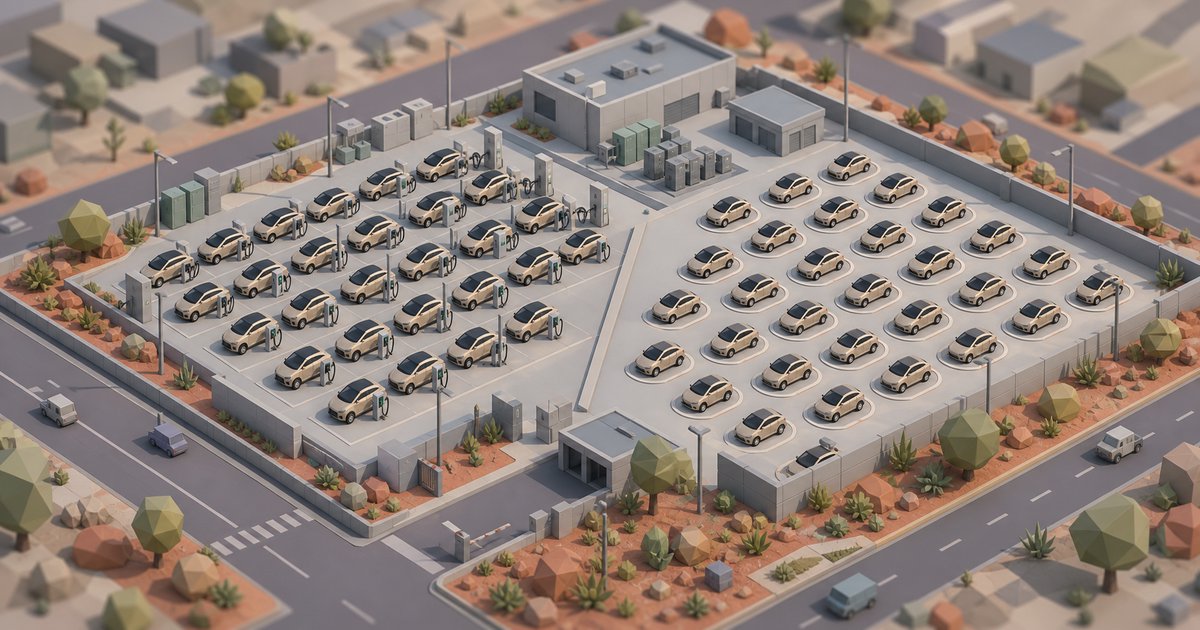
Tesla has filed permits for a charging depot in Austin built for cars that drive themselves, and the second phase of it does away with the cable altogether.
The site is 405 E. St. Elmo Road, an existing logistics lot across from Tesla's St. Elmo service centre, assembled from a storage yard and a neighbouring property the company had used as a transporter drop-off. The filings describe roughly 128 parking spots and split the build in two.
What the filings describe
| Phase 1 | Phase 2 | |
|---|---|---|
| Hardware | 48 V4 Supercharger posts | Equipment to support 80 wireless chargers |
| Cabinets | 12 V3.5 Supercharger cabinets | One V4 charging cabinet |
| Also listed | Transformers, lighting, security cameras, Wi-Fi access points | — |
| Dates | Not stated | Not stated |
Phase 1 is a conventional, if large, Supercharger installation. Phase 2 is the interesting one: the key notes specify a V4 charging cabinet "to support 80 wireless chargers", turning the remaining spots into inductive bays.
Why wireless, and why here
Wireless charging is not a convenience feature for a robotaxi — it is the missing piece. A driverless fleet can drive itself to a charger and position itself over a pad, but it cannot open a charge port and insert a connector, and stationing humans at depots to do it undoes much of the economics. The Cybercab is built for exactly this: it carries a charge port at the rear bumper, but Tesla has said it should eventually charge wirelessly as a matter of course, and the company has already obtained FCC approval covering wireless Cybercab charging.
The timing lines up with the fleet. Tesla is days from a public Cybercab launch in Austin on an end-of-August internal target, has Cybercabs testing on public roads, and submitted plans for its first robotaxi-only Supercharger sites in Arizona back in April.
What to hold lightly
This is a permit filing, not an announcement. Tesla has not published a timeline for either phase, and the wireless line item carries a caveat: the drawings reportedly point at V3 cabinets already tied to existing Superchargers, so the reference to a V4 cabinet supporting 80 wireless chargers may be a drafting error rather than a specification. No power figure per bay appears anywhere in the documents. Filings also get revised, downsized and abandoned.
What it would mean in Europe
Nothing directly, and that is the point worth registering. Tesla sells no wireless charging hardware to any customer in any market, and there is no European homologation path for a driverless two-seater to be operating in a depot like this — Tesla is still working through approval for FSD Supervised, the version with a driver in it.
What European readers can take from an Austin car park is the operating model. If Tesla's robotaxi economics depend on depots with inductive pads rather than on public Supercharger stalls, then the eventual European build-out is a property and grid-connection exercise in industrial lots, not an extension of the network owners already use. That is a much slower thing to assemble than software approval, and it starts with filings like this one.