
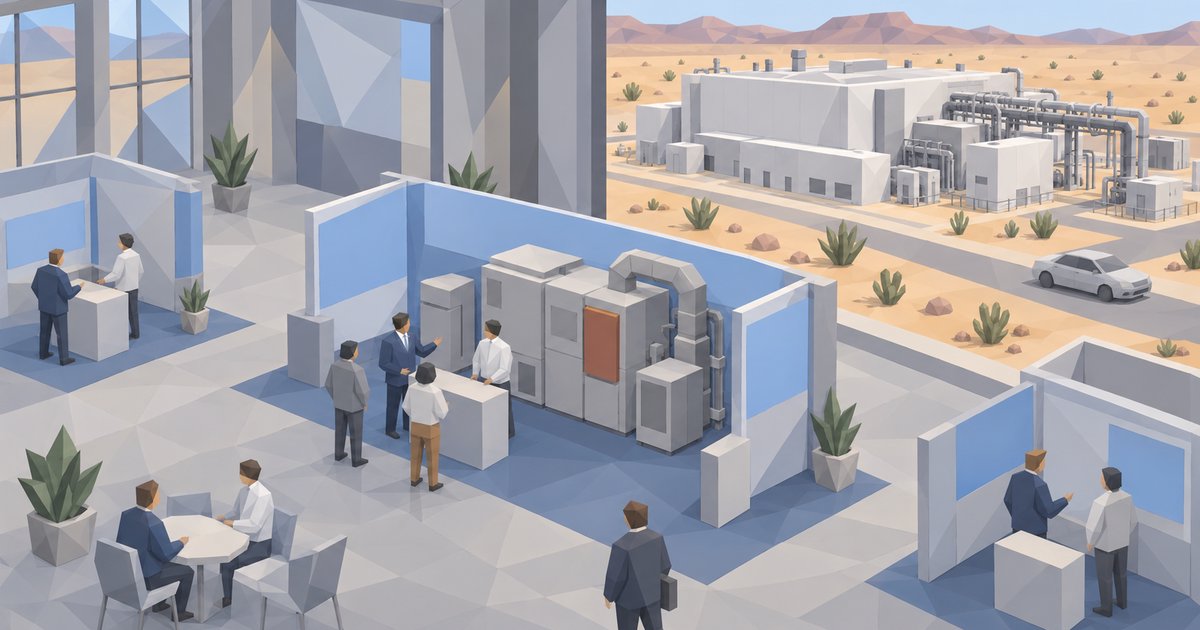
Tesla and SpaceX staff working on Terafab, the chip plant the two companies are building in Texas, toured about ten Korean suppliers' stands on the opening morning of SEMICON West in San Francisco on 13 October 2026, the Korean semiconductor trade paper The Elec reported on 20 October. Several of those suppliers have signed non-disclosure agreements, and one, HPSP, has agreed to supply a high-pressure hydrogen annealing tool to Terafab's research and development line. Until now, The Elec says, HPSP and Hanmi Semiconductor were the only Korean suppliers known to be working with the project. Tesla and SpaceX have not commented.
Who is talking to Terafab
The visitors were a mix of Tesla and SpaceX employees: materials buyers went to the materials makers, and gas-delivery engineers went to the piping suppliers. One company meeting them for the first time had a non-disclosure agreement in its inbox that evening.
| Company | What it supplies | Stage, per The Elec |
|---|---|---|
| HPSP | High-pressure hydrogen annealing equipment | Agreed to supply one tool to the R&D line |
| Hanmi Semiconductor | Thermo-compression bonders | In talks after a SpaceX request |
| Komico | Parts cleaning | Three-way NDA with Tesla and SpaceX about a month ago, for the Texas R&D pilot line |
| Dongjin Semichem | Process chemicals | In talks with Tesla for two to three months, looking at supply from its Texas thinner plant |
| Unisem | Waste-gas scrubbers | NDA signed |
| BMT | Valves and fluid components | Under NDA, earlier talks |
| ISC | Rubber test sockets | Exchanging samples and design data |
| ENF Technology, Asflow, G&G Intech | Process materials; piping and valves; wastewater reuse | First contact at SEMICON West |
At G&G Intech, three Tesla facilities staff asked whether its wastewater-reuse equipment could be used. Most of the companies already sell to Tesla or SpaceX: BMT supplies SpaceX with piping parts, Komico cleans parts for Tesla's car business, and Hanmi supplies SpaceX with equipment for satellite materials. Four of them, ENF, Asflow, ISC and HPSP, are Intel suppliers, which The Elec links to Terafab being led by a former Intel executive.
Built without Chinese suppliers
According to The Elec, Tesla and SpaceX do not buy from Chinese suppliers. "Apart from China there are few suppliers, and Japan is expensive," one Korean equipment maker told the paper. Another said Terafab wants prices lower than Chinese ones. Japan's Fujifilm meets the procurement team regularly about polishing slurries, photoresists, etchants and cleaning chemicals, and Lam Research and Applied Materials are reported to have set up dedicated Terafab teams.
A pilot line in Austin first
The equipment under discussion is for research, not volume production. The Elec says a pilot fab for process research is being built at Giga Texas in Austin, while the main plant goes to Grimes County, where Tesla and SpaceX put the first phase at about $16.8 billion. The long-term target is one million wafer starts a month within ten years. The first purpose is in-house supply of chips for Tesla's self-driving computers and robots and for SpaceX's satellites. For logic chips, Terafab works with Intel and is in talks with TSMC, which wants to run any fab it joins.
What it means for owners
Nothing yet. A research line tells Tesla whether its processes work; it does not make the chips that go into a car. Terafab will not add a single car computer for years, so it changes nothing about the open question of an HW3 upgrade in the near term. The next checkpoint is Tesla's third-quarter results call on 21 October, its first earnings call since Elon Musk confirmed the TSMC talks.
Update: 2026-10-21
Elon Musk put dates on Terafab on SpaceX's third-quarter earnings call on 20 October 2026, Reuters reported. A first test chip, built from SRAM memory circuits, should be working at the Terafab research facility in Austin around May or June 2027. Volume production is "at least in the set of possible outcomes for Q3 or Q4 of '28", Musk said, adding: "I put big error bars on this because we don't know if we will actually achieve this or not." He called the dates "very aggressive" and thanked "ASML and all of our other suppliers" for speeding up equipment deliveries. When an analyst asked whether SpaceX has ordered ASML's EUV lithography machines, he did not answer directly. Even on Musk's own schedule, volume output, the point at which Terafab chips could start reaching Tesla's car computers, is about two years away.