
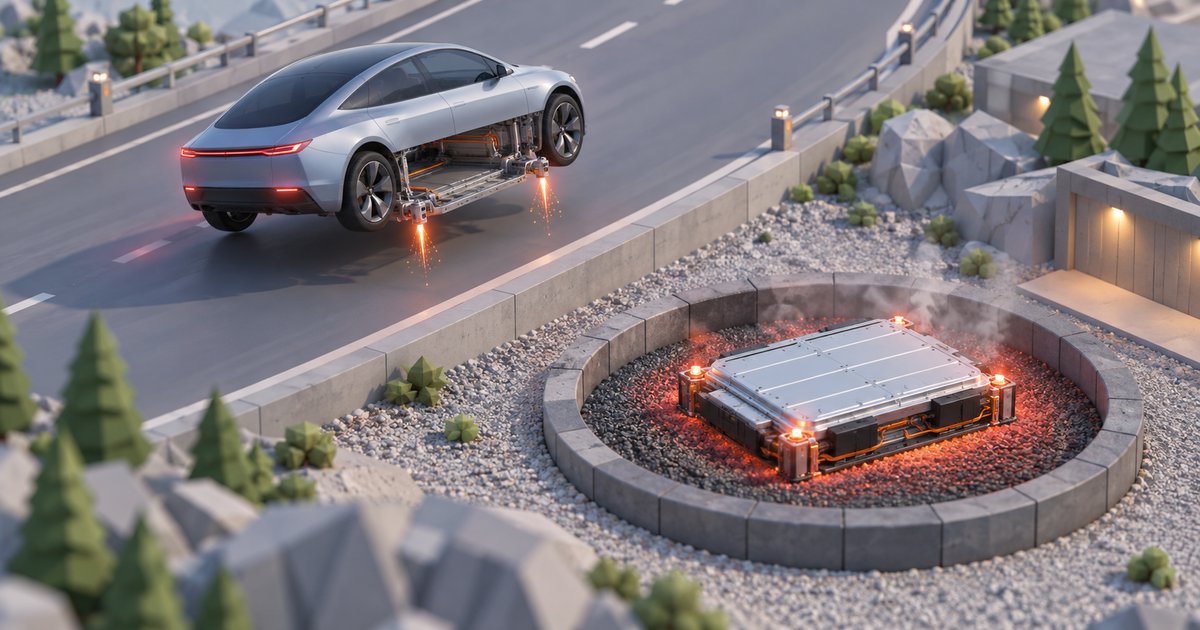
A lithium-ion pack in thermal runaway is one of the few failures on a modern car that firefighters cannot reliably stop. It is not usually extinguished so much as waited out. Stellantis has patented an unusually direct answer to that: get the battery out of the car.
US patent application 2026/0274078, assigned to FCA US, describes a system that separates the high-voltage pack from the vehicle during a thermal event and lets it fall away through the floor.
How the filing says it works
| Stage | Mechanism described |
|---|---|
| Trigger | Automatic, via the vehicle's electrical system; or a mechanical or electronic lever; or a touchscreen button |
| Disconnect | The high-voltage electrical connection is cut before release |
| Release | Pyrotechnic fasteners — explosive bolts — break apart to free the pack |
| Alternative release | Interlocking "castellated" frames, one section sliding clear so the pack drops |
| After ejection | The car runs on its conventional 12-volt battery, moving itself away from the discarded pack, potentially without the driver |
That last row is the part that makes the idea coherent rather than merely dramatic. Dropping a pack on the road is only useful if the car can then leave, and a pack weighing the better part of a tonne takes the vehicle's ride height up with it when it goes.
This is a patent, and patents are not products
Nothing here is a Stellantis product announcement. Carmakers file heavily to protect ideas they never build, and this is filed under rumours for that reason. The drawings do not even show an electric car — the vehicle illustrated is a combustion-engined Dodge Challenger, which is the sort of detail that marks a filing written to cover a concept rather than to document a programme.
The obvious objections are the ones a road authority would raise. Depositing a burning pack on a public carriageway relocates the fire rather than ending it, and does so without choosing where. Pyrotechnic actuators on a structural floor member have failure modes of their own. Nothing in a patent has to survive type approval.
Why a Tesla owner should care
Because it is the clearest available illustration of two opposed philosophies for the same problem, and Tesla has published its side.
Earlier this month TeslAnt covered Tesla's own account of how it stops a bad cell from taking the pack with it — cell spacing, barrier materials, venting paths and structural choices all aimed at containing a runaway inside the pack and keeping the cabin survivable. The design goal is that the event stays where it started.
Stellantis's filing starts from the opposite assumption: the pack is already lost, so the objective is to save everything else. One approach tries to make ejection unnecessary. The other treats ejection as the remedy of last resort and builds hardware for it.
Which is right is not obvious, and it is not purely an engineering question. Structural packs — Tesla's included — are load-bearing parts of the body. A floor designed to release its battery on command is a floor designed to lose a structural member, which constrains how much of the car's stiffness the pack is allowed to carry in the first place. That is a decision taken years before anyone thinks about fires.
What it changes today
Nothing. No Stellantis model has this, none has been announced, and the company has a more conventional battery programme running in parallel — it is already selling remanufactured high-voltage packs through its SUSTAINera line.
The value in the document is as a marker of where the industry's thinking has got to. Nine years ago the assumption was that better cells would make pack fires a solved problem. A 2026 patent application that budgets for explosive bolts is an admission that a fraction of packs will still go, and that the argument has moved on to what the car should do about it when one does.