
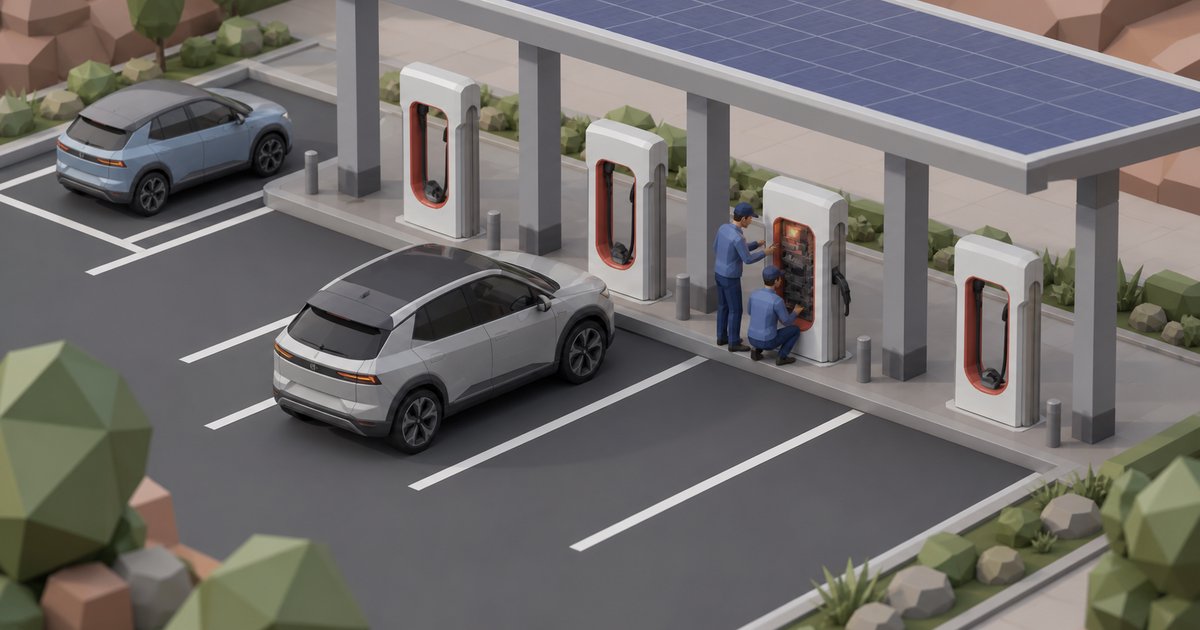
Rivian has begun telling some R2 owners to stop using DC fast chargers until their car has been inspected. There is no recall behind the instruction and no public statement — the message is arriving privately, through the service channel in the Rivian app.
What owners are being told
The clearest account comes from an in-app service conversation dated 19 August 2026, in which Rivian describes the work as an engineering investigation on that owner's vehicle and recommends holding off on DC fast charging as a precaution until the inspection is done. Rivian is contacting affected owners directly to book the appointment.
The area under investigation is the high-voltage distribution system, and specifically a gap at the DC fast-charging connector-to-header joint. A technician inspects that joint for the gap itself and for thermal abnormalities. If it fails, both the DCFC header assembly and the DCFC connector assembly are removed and replaced.
That is the whole of it: a fit problem where the charging inlet meets the car's high-voltage hardware, and heat as the thing being looked for.
What has not been said
| Question | Answer as of 23 August 2026 |
|---|---|
| Cars affected | Not disclosed; no count published |
| Affected build range or VIN list | Not published |
| NHTSA recall filing | None, and no customer complaint on file either |
| Remedy if the joint fails | DCFC header and connector assemblies replaced |
| How an owner finds out | A call or app message from Rivian service |
Without a filing there is no public register to check, so an owner's only route is the contact from service, or asking service directly. Rivian's own in-app wording reached for the word recall; nothing corresponding has been lodged with the regulator.
Why this reaches a Tesla owner
The R2 is the car Rivian built to take on the Model Y — a 4.7-metre mid-size SUV that began reaching North American customers in spring 2026. It also plugs into Tesla's network natively: Rivian moved the R2's charge port to the rear left and fitted a NACS connector, so it uses Superchargers without an adapter, though the oldest V2 stalls stay out of reach on a protocol the car does not speak.
So this is a fault in the charging hardware of a car that shares Tesla's plug and Tesla's network. As more brands move onto that connector — a Zeekr X drawing 257 kW from a Supercharger, GM going native NACS from the 2027 model year — the inlet and the high-voltage joint behind it become a shared point of failure rather than a Tesla-specific one.
What it means for Europe
Nothing yet, and that is the useful part. Rivian has said it intends to bring the R2 to Europe, left-hand-drive markets first, with recent reporting pointing to 2027 rather than this year. European buyers will meet the R2 after this campaign has run its course in North America, which makes the way Rivian handles it worth watching now. A quiet service action with no published scope is harder to audit than a filed recall, and it is the version of events European owners would inherit.
For an R2 owner today the practical advice is Rivian's own: if service has been in touch, charge on AC until the joint has been checked. For everyone else, the absence of a count is not evidence of a small one.