
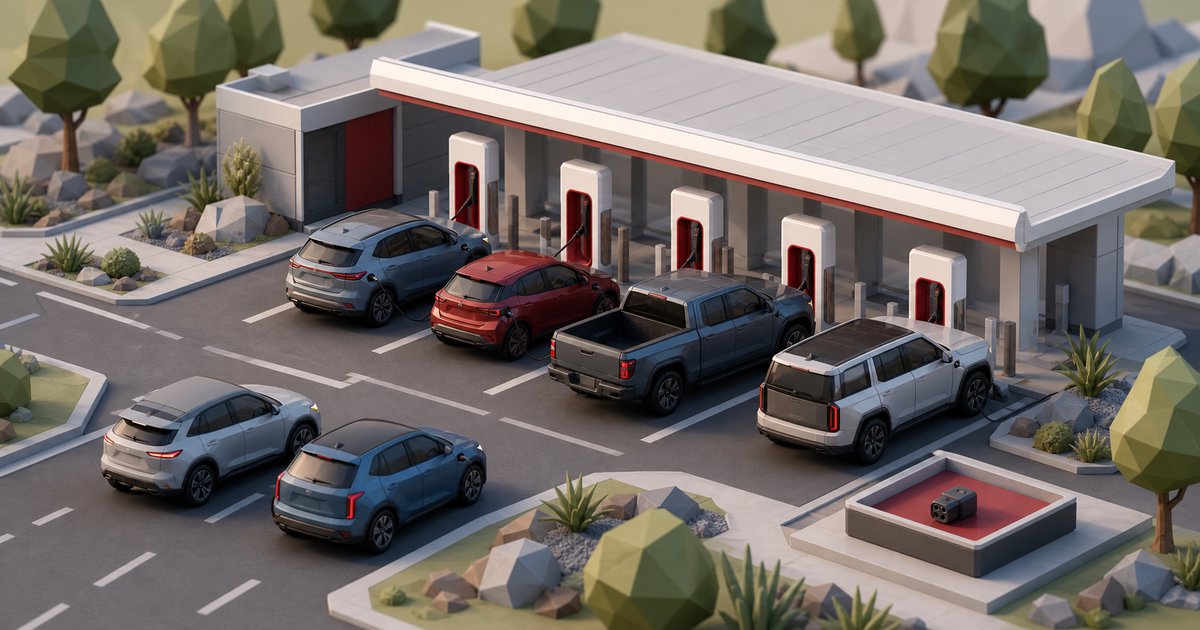
General Motors will build Tesla's NACS connector into every electric vehicle it makes from the 2027 model year, across Cadillac, Chevrolet and GMC. The adapter that GM drivers have carried since September 2024 stops being the price of admission to a Supercharger.
The 2027 list
| Brand | Models with a factory NACS port |
|---|---|
| Cadillac | Escalade IQ, Escalade IQL, Lyriq, Optiq, Vistiq |
| Chevrolet | Bolt EV, Blazer EV, Equinox EV, Silverado EV |
| GMC | Hummer EV Pickup, Hummer EV SUV, Sierra EV |
The 2026 Cadillac Optiq got there first and is still the only GM car with the port fitted on the line. The revived Chevrolet Bolt, which arrives during 2026 badged as a 2027 model, also ships with it. Everything else on sale today — Lyriq, Vistiq, both Escalades, Blazer EV, Equinox EV, Silverado EV, Sierra EV and both Hummers — still leaves the factory with CCS1.
The adapter box does not go away
GM cars have been able to charge at Superchargers since September 2024 by carrying a $275 NACS adapter. From 2027 that hardware becomes optional rather than mandatory, but the reverse problem is now the live one: a large share of American DC chargers still hang CCS1 cables, so a native-NACS GM will sometimes need an adapter pointing the other way.
| Adapter | Price |
|---|---|
| NACS DC — CCS1 car at a Tesla plug | $275 |
| CCS1 DC — NACS car at a CCS1 plug | $189 |
| J1772 AC | $67 |
| CCS1 + J1772 bundle | $256 |
The access covers more than 27,500 Tesla Superchargers, and not all of them: some sites stay Tesla-only. Finding and paying runs through GM's Energy Pass, built into the brand apps for Cadillac, Chevrolet and GMC, which also covers IONNA, Electrify America and other major networks, with Plug & Charge where a station supports it.
Tesla wins the plug and inherits the queue
Tesla opened its connector as NACS in November 2022 and the North American industry lined up behind it, first through adapters and then at the port itself. GM is the largest domestic manufacturer to finish that second step across an entire range in a single model year, which effectively closes the standards argument in the United States.
The trade-off for Tesla owners is arithmetic. Superchargers are a growth business rather than a private amenity, and every additional native-NACS car is one that can pull into a stall without hunting for a dongle first. Tesla has been adding V4 capacity and opening sites to other brands precisely because it wants that traffic — but drivers who remember empty stalls are the ones paying for it in queue time.
Nothing changes at a European Supercharger
None of this crosses the Atlantic. Europe settled on CCS2 years ago, and Tesla builds both its European cars and its European Superchargers to that standard — the Berlin-made Model Y has never worn a proprietary plug. No European owner will see a connector change from this decision.
What Europe already has is the same commercial logic without the hardware fight. Superchargers here have been opening to other brands market by market, and a non-Tesla was recently recorded pulling 257 kW at a Supercharger stall — more than a European Tesla is allowed to draw. The plug is settled on both continents. Who gets the power is not.