
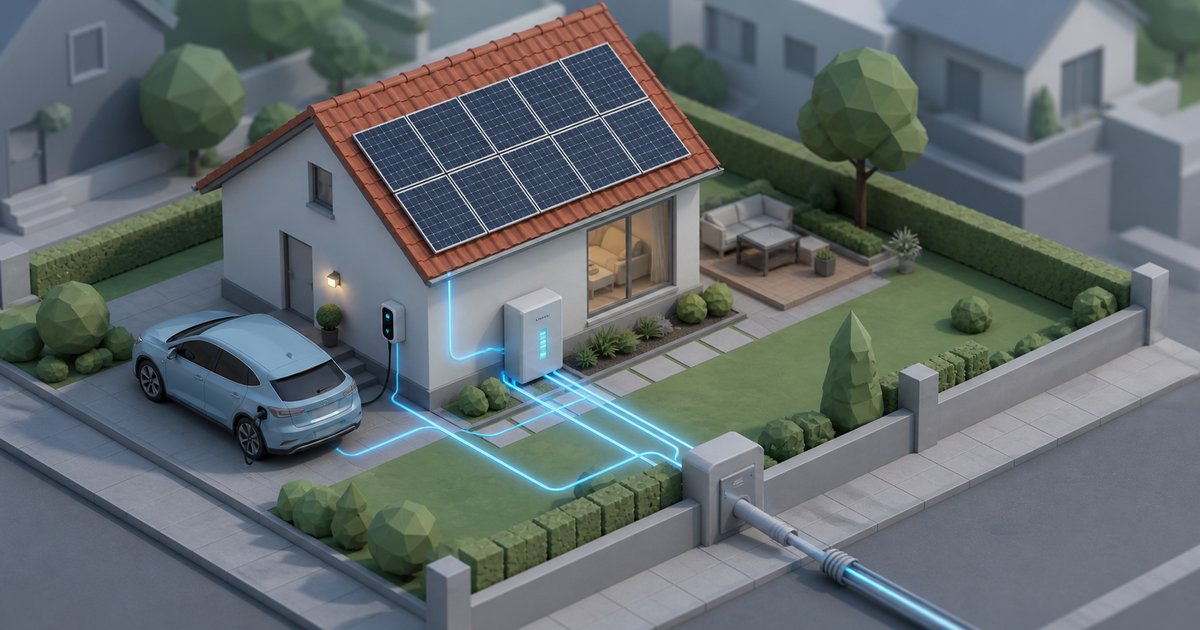
Germany's draft renewable-energy law for 2027 contains a clause written for solar panels that would, as drafted, also throttle home batteries and electric cars.
What the clause says
The provision is §9 of the draft EEG 2027, from the ministry of Federal Economics Minister Katherina Reiche. It permanently limits new solar installations below 100 kW to feeding a maximum of 50% of their installed capacity into the grid. Output above that ceiling has to be self-consumed or curtailed.
The detail that turns this from a solar story into a car story is where the ceiling is measured: at the grid connection point of the property, not at the inverter. Everything behind that connection shares one cap.
| Where the limit is applied | What it catches |
|---|---|
| The PV inverter alone | Solar output only; storage and vehicle unaffected |
| The household grid connection (as drafted) | Solar, home battery and a bidirectional car share a single 50% ceiling |
Why that breaks vehicle-to-grid
V2G economics depend on discharging hard for a short window. A car earns its keep by pushing power back during the evening peak, when prices are highest, and recharging when they are low. A permanent cap on the connection point removes precisely that ability — it throttles the discharge exactly when the discharge is worth most.
Industry submissions have called it a flexibility prohibition. The practical consequence is that a bidirectional wallbox and a compatible car, both of which carry a real premium, stop paying for themselves. German V2G tariffs currently advertise savings of up to €720 a year.
That also cuts against the direction the rest of German law has been moving. A separate reform removed the double network fees that used to make discharging an EV uneconomic, and the Bundesnetzagentur's AgNes process has been working to treat a car battery as the equivalent of stationary storage — rules TeslAnt covered when the drafts appeared, with a framework decision expected by the end of 2026.
The objectors are unusually aligned
The solar industry and the car industry are on the same side of this one.
- The VDA, Germany's automotive association, warns of a setback for sector coupling and for V2G specifically.
- Maximilian Wilshaus of Elli, Volkswagen's energy arm, argues the clause holds back technology worth billions.
- Jannik Schall of 1Komma5° makes the targeting argument: the problem being solved is dumb, uncontrolled PV, and the rule instead catches intelligent storage and cars.
- Netze BW, a grid operator, says smart systems need dynamic control rather than a rigid cap — notable, because grid operators are the intended beneficiaries.
- Enpal and Octopus Energy have joined the calls for amendment in the Bundestag.
What it means for a Tesla owner in Germany
Nothing changes for an existing installation. The cap applies to new systems, from 2027.
If you are planning solar plus a Powerwall, the drafted rule would limit what that combination can export, which weakens the case for sizing either one generously — the extra capacity cannot reach the grid.
For the car itself the effect is deferred. Tesla does not currently offer vehicle-to-grid on its European cars, so the clause devalues a capability German owners are waiting for rather than one they have. Rivals are further along — Hyundai and Kia have put bidirectional charging behind a single brand — which is why the objection is being pressed now, while the text is still a draft in the Bundestag.