
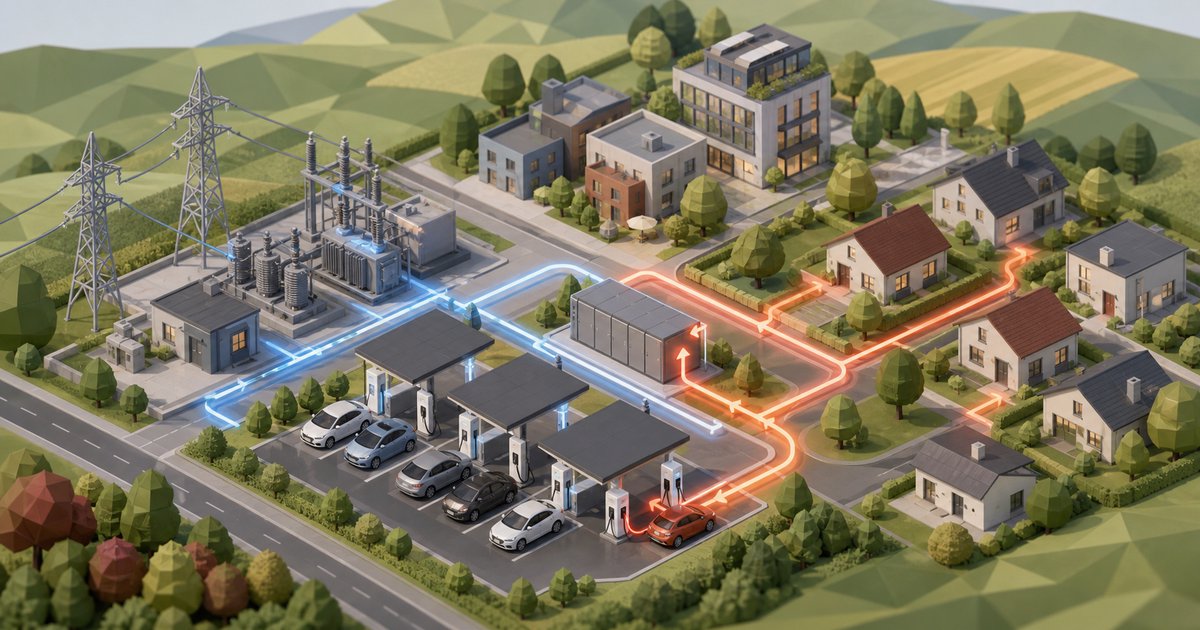
Germany's network regulator is moving two reforms at once that between them settle a pair of questions the charging industry has been asking for years: what a high-power charging hub should pay for its grid connection, and whether sending electricity back out of a car battery will ever make financial sense. On 5 August 2026 the Bundesnetzagentur published the current working status of the second one.
Neither reform is finished. Both are far enough along to change purchasing decisions.
Two reforms, two different jobs
| Reform | Full name | What it changes |
|---|---|---|
| AgNes | Allgemeine Netzentgeltsystematik Strom | How grid fees are structured, including what large charging parks pay for connection capacity |
| MiSpeL | Marktintegration von Speichern und Ladepunkten | Metering, delineation and market integration for storage systems and charging points — the technical basis for V2G |
AgNes: charging parks pay for the capacity they book
Under AgNes, large charging parks would pay more in line with the connection capacity they order rather than the energy they actually draw.
The logic is defensible. A hub that books several megawatts of headroom and averages a fraction of it is reserving capacity the network operator has to build and everyone else helps pay for. Pricing the booking rather than the throughput puts that cost where the decision is made.
The flip side deserves saying plainly: it raises fixed costs for exactly the high-power sites Europe has committed to building. The EU's AFIR targets require power that only comes with large connections, and sites like Plenitude's 400 kW hub near Rostock exist because someone booked capacity ahead of demand — which is what a charging network has to do.
MiSpeL: the piece vehicle-to-grid has been waiting for
MiSpeL sets binding detail rules for measuring, delineating and market-integrating storage systems and charging points, including the mixed case of a home battery and a bidirectionally capable car on the same connection.
Two changes matter. First, electricity fed back to the grid is treated like storage electricity rather than fresh consumption, so it stops attracting consumption-based grid fees and levies a second time on the way out. Second, and more practically, the process is being simplified so that V2G no longer requires a second electricity meter or a bespoke procedure per installation.
Double-charging and metering bureaucracy were the two reasons bidirectional charging stayed a pilot in Germany rather than a product. Both are being removed.
Do not read this as switched on
The regulator's working draft is public and the federal legal barrier has been cleared, but network operators are expected to need six to twelve months to implement, so this grows into the market gradually rather than starting on a date.
If you are weighing a car or a wallbox now on the strength of V2G, treat it as a capability that will arrive during your ownership rather than one that pays back next winter. Buying hardware today for a tariff that does not exist yet is a bet, not a saving.
What it means for Tesla owners in Germany
Less than for most, for now. These rules reward cars that can already export, and a Model 3 or Model Y in Europe cannot feed the grid regardless of what the tariff says — so the immediate beneficiaries are the brands already shipping bidirectional hardware.
The AgNes side reaches Tesla owners anyway, just indirectly. Supercharger sites are large connections, and a fee structure that prices booked capacity is a cost input for every operator building high-power sites in Germany — Tesla included.