
Tesla has spent two years telling HW3 owners that their cars are getting better without ever saying how much worse they remain than HW4. Someone has now measured it.
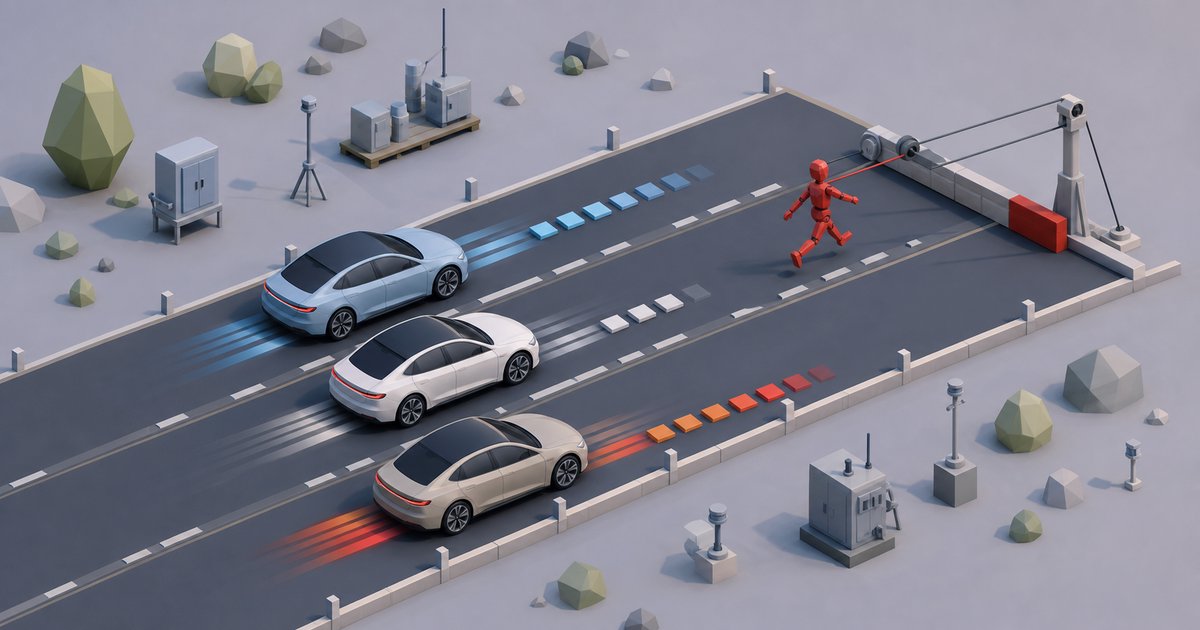
The channel TechGeek Tesla built a pulley rig that yanks a custom-made dummy into the road directly ahead of an approaching car. Three Teslas drove the same stretch under Full Self-Driving at matched speeds, while telemetry software recorded the interval between the dummy starting to move and the car braking or swerving.
What the stopwatch said
| Comparison | Reaction time improvement |
|---|---|
| HW4 on v14.3 vs HW3 on v12.6.4 | 57.8% faster |
| HW4 on v14.3 vs HW3 on v14 Lite | 36.6% faster |
| HW3 on v14 Lite vs HW3 on v12.6.4 | ~37% faster |
Read the middle row first, because it is the one that carries the argument. FSD v14 Lite is the version Tesla built specifically to bring v14-era behaviour to HW3 cars, and it delivers a real, large improvement — roughly 37% quicker than the v12.6.4 build it replaces, on identical hardware. That is software alone, and it is not a marginal gain.
Then read the top row. Even after that software improvement, the HW4 car still responds well over a third faster. The remaining gap is silicon, and no update closes it.
How much weight this deserves
This is one enthusiast's test, not a controlled study. There is no published sample size, no confidence interval, and a single test road. A percentage derived from a handful of runs of a stochastic system should be treated as an indication of magnitude, not a specification.
What makes it worth reporting anyway is that nobody else is producing this number. Tesla publishes no per-hardware reaction-time data, and regulators have not required any. An imperfect independent measurement is the only measurement there is, and its direction matches what Tesla itself conceded when Elon Musk withdrew the claim in April 2026 that HW3 would be sufficient for autonomy.
What this means for European owners
Two caveats keep this from mapping directly onto a European driveway.
The first is that Europe runs its own FSD branch. The builds in this test are North American; European cars received FSD 14.2.2.6 with firmware 2026.21.100 in July 2026, a different version on a different schedule. The hardware conclusion carries across. The exact software numbers do not.
The second is that HW3 is not simply slower — it is also running hot enough on v14 Lite that owners have reported computer failures, and that thermal headroom problem is what a heavier network on old silicon looks like from the outside.
For an owner deciding whether to pay for FSD on an HW3 car in Europe, the useful framing is that v14 Lite genuinely improved the car, that a measurable and permanent gap to current hardware remains, and that the gap is in the one metric that matters most when something steps into the road. Tesla's own release cadence points the same way: v14.3.7 shipped for HW4 to fix regressions in the previous build, on a branch HW3 cars do not receive.