
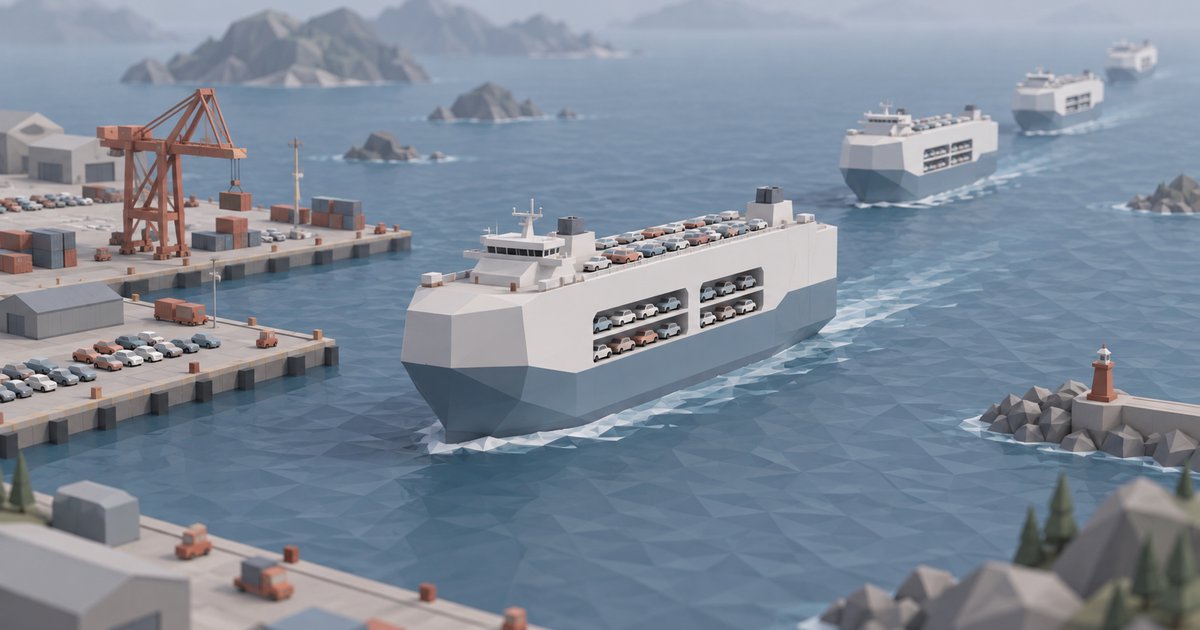
BYD has ordered ten more car carriers, each able to hold 9,200 vehicles, according to maritime trade reports picked up on 11 September. Neither BYD nor the shipyard has announced it and no contract value has surfaced, so this is reported rather than confirmed.
If the reports are right, it roughly triples the shipping capacity BYD controls.
The fleet, before and after
| Ships | Combined capacity | |
|---|---|---|
| Today | 8 | over 40,000 car slots |
| After the order | 18 | over 130,000 car slots |
The builder is China Merchants Industry, at its Jinling and Haimen yards, with deliveries spread across 2027 to 2029. BYD completed its first eight-ship fleet in September 2025; one of them, BYD Shenzhen, was the largest car carrier in the world when it was handed over.
Why a carmaker owns ships at all
Because for two years it could not reliably rent them. Charter rates for roll-on/roll-off vessels spiked when Chinese exports took off, and shipping capacity rather than factory capacity set the ceiling on how many cars could leave the country. Owning the vessels turns that market risk into a fixed asset, and it lets BYD decide which port gets which cars, and when.
The volume behind the order is not hypothetical. BYD exported 184,000 vehicles in August 2026, up 131% year on year, and 1,127,000 in the first eight months, up 88%. That sits alongside a record 256,230 battery-electric cars sold in August, roughly 43% of which left China.
How Tesla moves cars, by comparison
Tesla charters ro-ro capacity rather than owning it. Model 3s bound for Europe still sail from Shanghai, a voyage of about 30 days to Zeebrugge, Koper or Barcelona. European Model Ys come off the line at Grünheide and never see a ship at all.
That is the honest counterweight to the headline. Building locally beats shipping efficiently, and it is the conclusion BYD has reached too: its Hungarian and Turkish plants exist because EU countervailing duties sit on top of the standard import duty for Chinese-built electric cars, and a car built in Szeged pays neither. No amount of shipping solves a tariff.
What the ships buy, and what Europe gets
Reach beyond the EU tariff wall, mostly. Britain applies no duty on Chinese-built electric cars, which is why Chinese brands keep naming it as their first European market, and BYD's fastest export growth is in Latin America, Southeast Asia and the Middle East rather than the EU. European buyers can already see where this ends up: Chinese brands passed their entire 2025 European total before this year was out.
The second thing the ships buy is timing. A manufacturer that owns its hulls can push a quarter-end wave of cars at a specific market, which is a pricing lever as much as a logistics one.
The caveats
Nothing here lands in 2026. The first of the ten ships is a 2027 delivery and the last a 2029 one, by which point more of BYD's European volume will be built in Europe. Capacity is also not demand: 130,000 car slots is what the fleet could move, not what anyone has ordered.
And the order is still unconfirmed by the only two parties in a position to confirm it.