
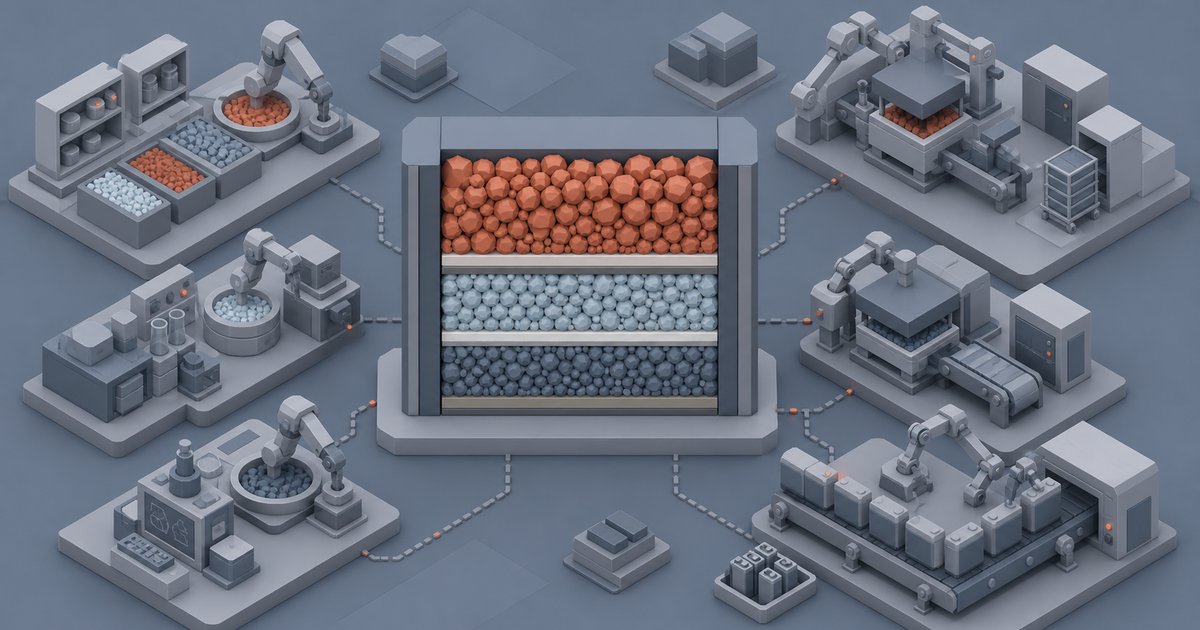
Patent filings are a poor guide to what a company will ship and a good guide to what it is stuck on. BYD has just published six of them covering solid-state batteries, and read together they point at one problem repeatedly: in a cell with no liquid in it, getting solid particles to touch each other properly is genuinely difficult.
Four of the six cover materials and chemistry. Two cover manufacturing.
The chemistry filings
The first addresses a specific incompatibility. Halide and sulphide solid electrolytes each have properties worth having, but put them in contact and they react with each other. BYD's filing describes an ion-conducting interlayer that sits between the two and keeps them chemically separated while still letting lithium ions through.
A second targets the cathode-electrolyte boundary, describing a solid electrolyte buffer layer between the cathode and the sulphide electrolyte, with thermal output held to 117 joules per gram — a safety figure as much as a performance one.
The remaining two rework the cathode itself. One is a dual-layer composite combining monocrystalline and polycrystalline material; the other is a three-material cathode mixing lithiated metal oxides, metal sulphides and solid electrolyte directly into the same electrode.
The manufacturing filings
These are the more revealing pair, because they describe how you would actually build the thing at scale.
One covers ionic liquid wetting agents applied in a gradient distribution to improve ion transport — a small amount of liquid used deliberately to solve the contact problem rather than eliminated entirely. The other defines a measurable quality metric BYD calls the contact ratio, or 'Re': at least 60% of a cathode particle's perimeter should be in physical contact with electrolyte particles.
That second filing is the tell. Writing a production specification with a numeric threshold is what a company does when it is preparing to inspect cells coming off a line, not when it is still exploring the chemistry.
The timeline is not near
BYD is reported to be targeting pilot production of dual-electrolyte cells in 2027, with prototype vehicle evaluation following, and broader commercialisation towards the end of the decade. "Dual-electrolyte" is the honest part of that description — these are not fully solid cells but a hybrid step towards them.
The reporting originates with carnewschina and was picked up by electrive; BYD has not published a production commitment of its own, so treat the 2027 date as a target rather than a schedule.
For European buyers the relevance is indirect but real. Solid-state cells promise higher energy density and better thermal behaviour, but they arrive on top of a supply chain where Asian manufacturers already control 98% of Europe's battery cell capacity and CATL alone supplies around 40% of the world's EV batteries. A next-generation chemistry commercialised in China first would deepen that position rather than reset it.