
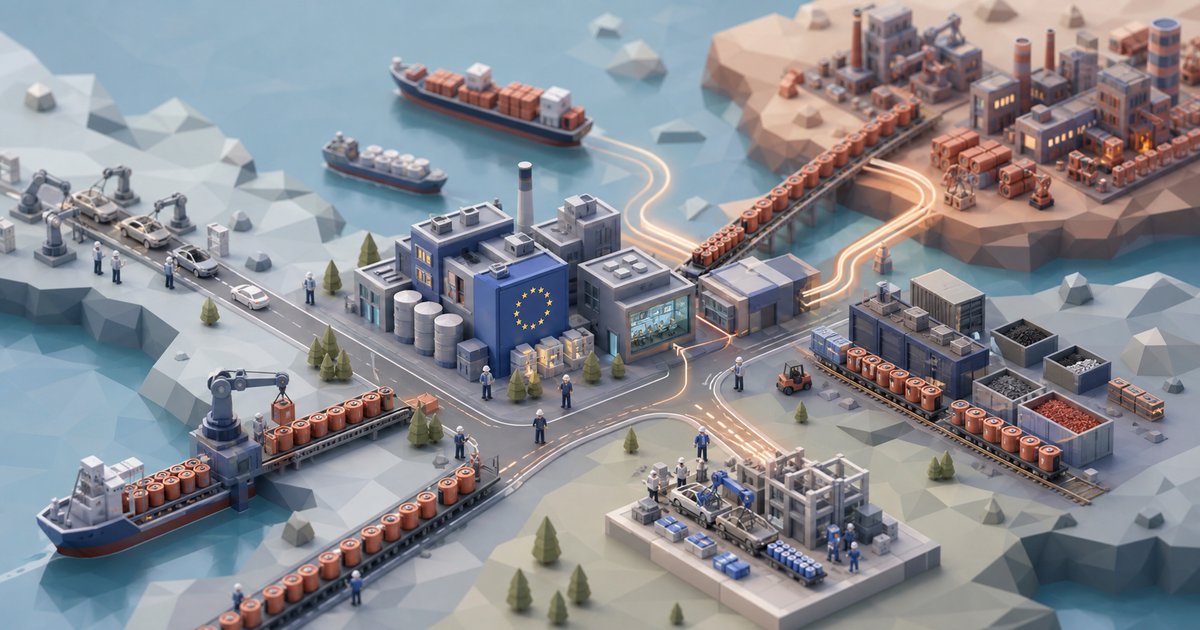
Europe builds a growing share of the world's electric cars and almost none of the cells that power them. A new Deloitte study, Europe's Battery Industry at a Crossroads, puts numbers on how expensive that arrangement has become — and the headline figure is not the one about profits.
The findings
| Metric | Value |
|---|---|
| EV batteries produced in Asia (2025) | 77%, up from 70% in 2024 |
| Europe's share of global cell factory capacity | 13% |
| European capacity controlled by Asian manufacturers | 98% |
| Profits forgone by European cell makers over four years | €10.5 billion |
| Total value added at risk by 2030 | €100–150 billion |
The €10.5 billion is the narrow number: what European battery companies stand to miss out on over the next four years if they do not produce the cells that European-built EVs require. The €100–150 billion is the broad one, and it is the more revealing of the two. It counts what leaves the continent when you follow the whole chain — imported precursor materials, the production equipment that outfits the factories, and the skilled engineers dispatched from Asia to commission and run them.
Owning the building is not owning the industry
That 13%-versus-98% pairing is the crux of the report. Europe genuinely has cell factory capacity on its soil: about an eighth of the global total. But 98% of it is controlled by Asian manufacturers — CATL, LG Energy Solution, Samsung SDI, SK On and their peers operating European plants.
Those plants create European jobs and shorten logistics chains, both real benefits. What they do not create is European control over cell chemistry roadmaps, process know-how, or the pricing of the single most expensive component in an electric car. When the technology moves — as it has repeatedly, from NMC toward LFP and now toward sodium-ion and solid-state — the decisions are made elsewhere.
Europe's homegrown attempt at closing that gap has not gone well. Northvolt's collapse removed the continent's most credible independent cell champion, and the assets that survived it largely passed to buyers who were not European.
Why European drivers pay for this
The cell pack is roughly a third of the cost of an electric car. A continent that imports its cells, its precursors and its factory equipment imports the currency risk, the tariff exposure and the freight cost attached to all three. That surfaces in European list prices, and it is part of why the same model frequently costs more in Berlin than in Shanghai.
It also shapes what gets built here. Tesla's Giga Berlin has run on cells sourced from multiple suppliers rather than a single European chain — a pragmatic arrangement that leaves the same dependency in place at company scale that Deloitte describes at continental scale.
What Deloitte is actually recommending
The study frames this as a maturity problem rather than a subsidy problem: Europe has capital and capacity but lags on process engineering depth, on the precursor and refining steps upstream of the cell, and on the trained workforce that lets a plant reach yield quickly. Those are slower to fix than a factory is to fund, which is why the 2030 date in the headline figure matters. The window in which building this capability changes the outcome is a few years wide, not a decade.