
Slovakia now has a law for cars with nobody in the driver's seat. Parliament approved the framework for fully automated vehicles, and it takes effect on 1 December 2026.
The interesting part is not that Slovakia allowed them. It is how narrowly the law defines what a remote human is allowed to do.
Three gates, in order
An operator cannot simply put a driverless car on a public road. The law stages the approval, and each stage has to be cleared before the next one opens.
| Stage | What it requires |
|---|---|
| Testing | Conducted in a secured area, to verify the automated system functions, the vehicle's safety properties and its technical compatibility |
| Trial operation | A permit granted after testing is completed successfully |
| Operator licence | Issued by the Ministry of Transport of the Slovak Republic, with input from the police |
Running a fully automated vehicle without that licence carries a fine of €5,000 to €50,000, applying to individuals and companies alike.
The one-operator-one-vehicle rule
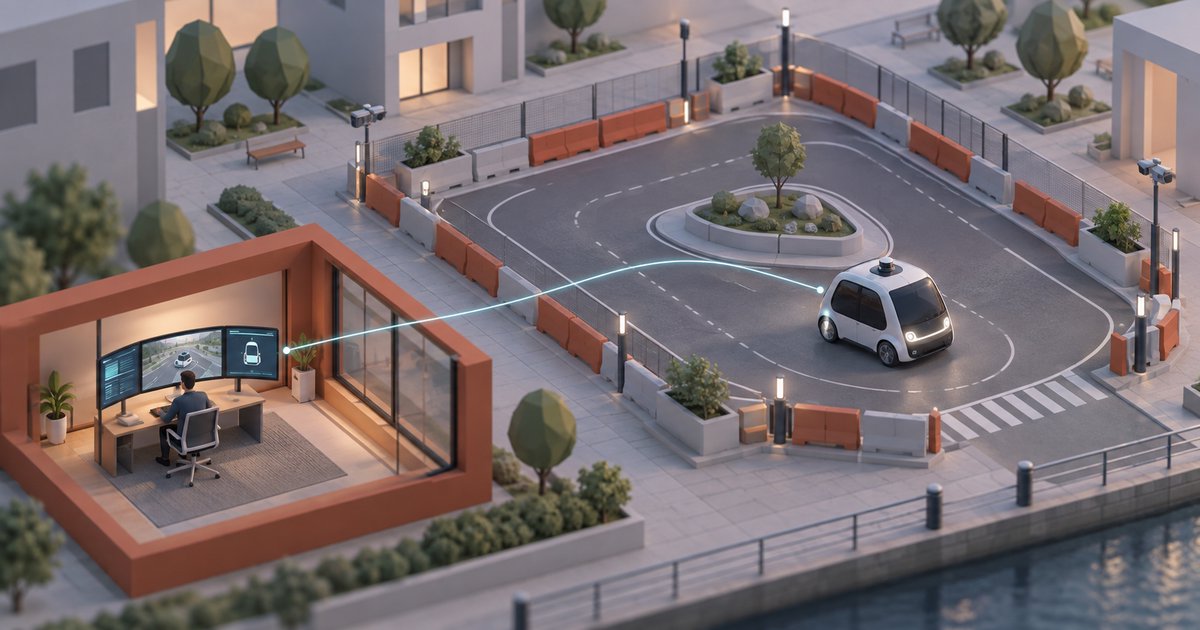
Every licensed vehicle must sit under continuous technical supervision from a control centre able to intervene remotely and to bring the car to a safe stop. That much is now standard in European drafting.
What is not standard is the constraint on the human. During an intervention, a remote operator may handle only one vehicle, and may not supervise another at the same time. Written plainly: a Slovak driverless fleet cannot be run by one person watching a wall of screens, because the moment a car needs help, that operator is committed to it alone.
This is the economic heart of driverless operation, and Slovakia has legislated it rather than left it to the operator. Remote-assistance ratios are how a robotaxi fleet's cost per kilometre is built, and a country that fixes the ratio at one-to-one during interventions has set a floor under the staffing cost of every fleet on its roads.
Why a Tesla owner should read this
Slovakia is not writing rules in the abstract. The country already hosted WeRide's first robotaxi test drives in August through a domestic partner, and this law is what turns that from a demonstration into something with a licence behind it.
For Tesla specifically, the relevance is what the framework asks of a system rather than of a brand. There is no national approval here for a consumer feature bought with a car — the licence attaches to an operator running vehicles under supervision, which fits a robotaxi service and does not fit a privately owned car running FSD Supervised. A Slovak owner gets no new permission from this law.
What it does supply is a template. Central European states have been legislating autonomy one at a time — the Czech Republic passed its Level 3 amendment ahead of 2026 — and each national rulebook adds a set of conditions any operator must satisfy country by country. Tesla's stated ambition of a European robotaxi service runs into exactly this: not one approval, but a queue of them, each with its own supervision rules and its own ministry.
The law is passed and dated. The first licence under it cannot be issued before 1 December, and none has been applied for publicly.