
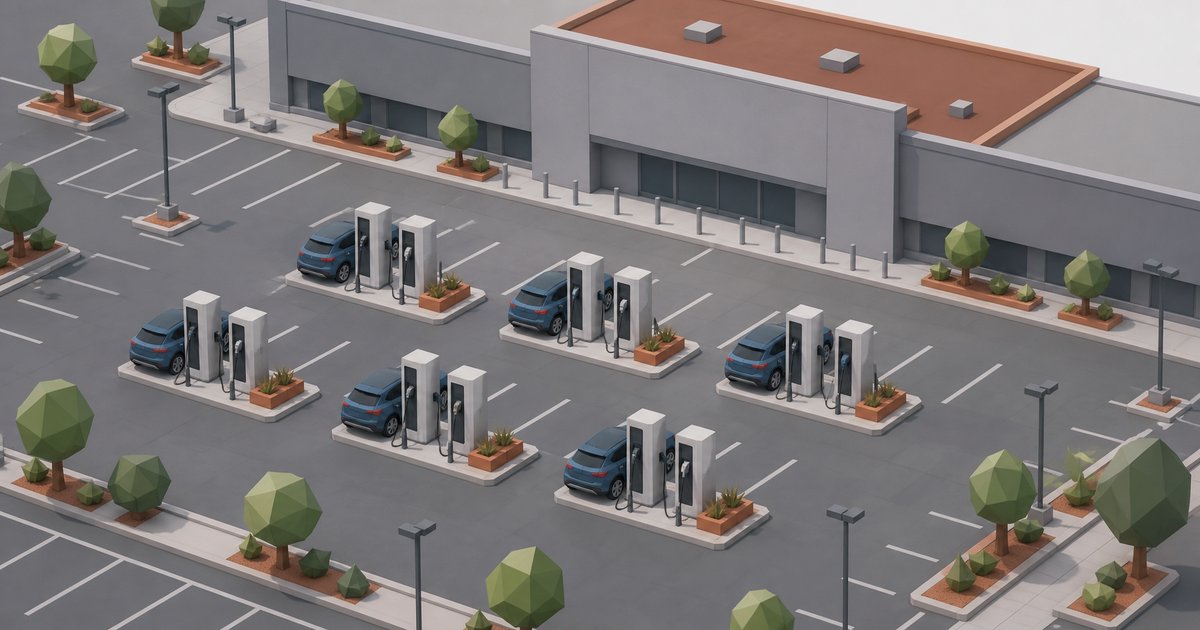
Walmart reached 100 DC fast-charging locations across 20 US states on 24 August, a network it built, owns and operates itself rather than leasing the parking space to a charging company. Each site carries eight to sixteen charging points at up to 400 kW, and — the detail that matters to Tesla — every one of them offers both CCS and NACS connectors.
"Reaching 100 sites is an important milestone, and our broad footprint positions us to make EV charging more accessible for communities," said Walmart senior vice president Shayne Wahlmeier. The company says it will keep rolling out in markets where it sees a need, working with local utilities and other partners, but it has published no target number and no date.
The price is the point
Walmart is not trying to out-cover Tesla. It is undercutting it.
| Network | Average price per kWh |
|---|---|
| Ionna | $0.37 |
| Walmart | $0.43 |
| US national average | $0.538 |
| Tesla | $0.56 |
| Electrify America | $0.56 |
The per-network figures are Paren's charging benchmarking data as reported by InsideEVs, which ranked Ionna the cheapest of 17 networks and Walmart the fourth cheapest. The national average is Paren's own published figure for Q2 2026. Walmart+ members get a further 10% off, which takes an already-cheap session to roughly $0.39.
That puts Walmart about 23% below Tesla per kWh, and Ionna about 34% below. Charging cost is not a rounding error in ownership economics: on a 60 kWh fill, the gap between Ionna and Tesla is about $11.
Tesla's share crossed a line this quarter
Paren's Q2 2026 report, published on 14 July, recorded something that had not happened before — Tesla's all-time share of US DC fast-charging ports fell below 50%.
Tesla is still the largest single operator and still building heavily: it added 1,185 ports in the quarter. But that was 27.0% of the 4,382 ports added nationally. Roughly three quarters of new US fast-charging capacity is now being installed by somebody else.
None of that is decline. It is the end of a monopoly position.
Why the NACS plug changes the argument
Tesla's structural advantage in North America was never price. It was that a Tesla could conveniently charge only on Superchargers, and that nobody else could charge there at all. Both halves of that have now gone. Walmart fits NACS at every site; so does Ionna. A Tesla driver can pull into a Walmart, use the connector already on the car, and pay about a quarter less than at a Supercharger.
It is the same pressure that surfaced in J.D. Power's 2026 study, where the Supercharger network fell to fourth on cost and payment.
What this means in Europe
Directly, nothing. Walmart and Ionna do not operate here, and European Superchargers price against a different set of rivals.
The direction is the relevant part. Tesla has spent two years opening Superchargers to other brands across Europe, which converts the network from a reason to buy a Tesla into a business that has to compete on tariff. Once the connector stops being a moat — on either continent — the network gets judged on price and reliability like any other. The US is simply further into that transition.