
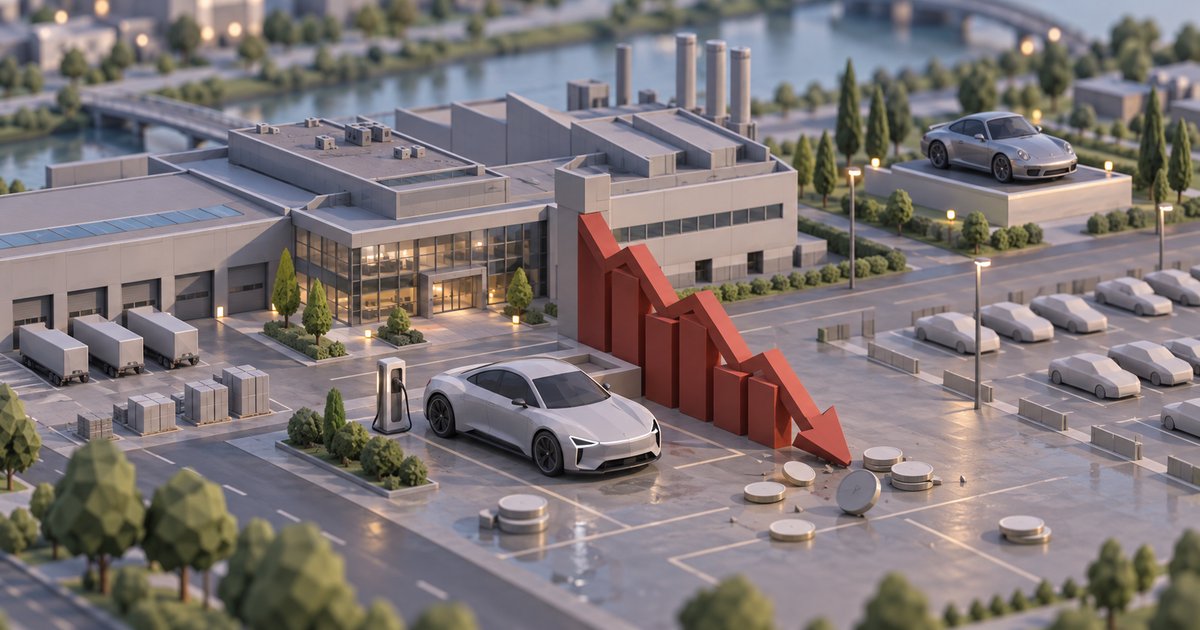
Volkswagen told investors on 18 September 2026 that its operating margin this year will be no more than 1%, against guidance of 4% to 5.5%. The shares fell more than 7%. The largest single reason is a 6 billion euro non-cash impairment of goodwill in Porsche, booked in the third quarter.
What Volkswagen actually announced
The group put roughly 10 billion euros of special items against its 2026 operating profit and itemised them: about 0.9 billion already booked in the first half, the 6 billion Porsche impairment, and around 2 billion covering expanded early retirement, the sale of Volkswagen Osnabrück and write-downs on Chinese subsidiaries.
A goodwill impairment is a statement about the future rather than the past. Volkswagen, which holds 75.4% of Porsche AG, is saying the mid-term earnings it now expects from Porsche are materially lower than the ones it once paid for. This is separate from the writedowns at Porsche SE, the holding company that controls Volkswagen, which took its own 3 billion euro hit in August.
The electric half of the range is what fell
Porsche's own half-year figures show where the forecast broke.
| Model line | H1 2026 deliveries | Change |
|---|---|---|
| Cayenne | 38,141 | strongest line |
| 911 (combustion) | 30,534 | +19% |
| Macan Electric | 15,620 | line as a whole -22% |
| Taycan | 6,219 | -25% |
| Total | 122,306 | -16% |
The 911 — the oldest and least electric thing Porsche sells — is the line that grew. The Taycan, the car Porsche built to prove it could beat Tesla at a saloon, now sells at roughly a fifth of the 911's rate.
Porsche's stated reasons are narrower than the headline: the end of combustion 718 production, an unusually strong prior-year period for the Macan Electric, and the expiry of US tax credits. All three are real, and none explains a 6 billion euro write-down on its own.
The job figure, with its scope attached
Handelsblatt reported on 19 September, citing documents tied to the board decision behind Volkswagen's Future Plan 2030 restructuring, that about 4,100 further posts would go in the Sport & Luxury brand group — the brand group Volkswagen builds around Porsche. Overhead costs alone were said to be some 700 million euros short, and the reduction is expressly additional to what is already agreed.
What is already agreed runs to roughly 9,000 posts by 2035: a 1,900-post plan later expanded to 3,900, about 500 at subsidiaries, and 5,000 more agreed in July 2026. Against a headcount of 45,049 in March 2026, that is close to one in five. Neither Volkswagen nor Porsche has confirmed the 4,100, and the Zuffenhausen and Weissach sites hold guarantees to 2035 backed by a 2.1 billion euro investment.
What it means in Europe, and for Tesla
The Taycan was the Model S's most direct rival, and TeslAnt covered the reported plan to wind it down by 2030. The 6 billion euro figure puts a price on the assumption underneath it — that European premium electric demand would arrive at the volume Porsche planned for. It did not, and Porsche is retreating to combustion while it waits.
That cuts two ways for European buyers. The segment Tesla has led since the Model S loses its most credible European challenger — less competition, and less pressure to improve. But the same restructuring is how Volkswagen funds cheaper electric cars, and cheaper Volkswagens are what eventually press on Model Y pricing here. One of those effects arrives sooner than the other.