
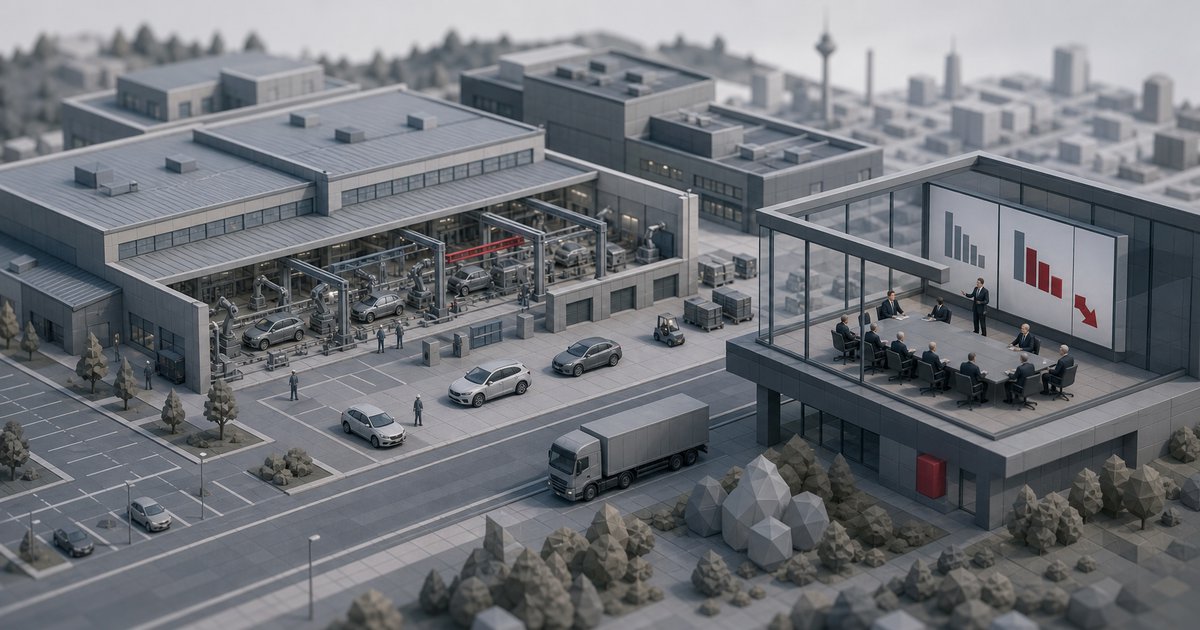
Porsche SE, the holding company that controls Volkswagen, reported a net loss of €2.2 billion for the first half of 2026 on 7 August — a swing from a €300 million profit in the same period a year earlier. Its chairman, Hans Dieter Pötsch, described the Volkswagen Group as standing at a "historic crossroads" and pressed for faster action on costs and excess capacity.
When a company's majority owner says this publicly rather than in a board room, it is a message aimed at the board.
Where the loss came from
The €2.2 billion is almost entirely non-cash. Porsche SE's principal assets are stakes in Volkswagen AG and Porsche AG, and its results are largely a mirror of theirs:
- roughly €3 billion in writedowns on the Volkswagen stake
- a further €200 million written down on Porsche AG
- around €0.5 billion of costs absorbed from winding down ID.4 production at Volkswagen's Chattanooga plant in the United States, which stopped in mid-April 2026
Writedowns are an accounting recognition that an asset is worth less than the books said, not a cash outflow. But they are also a formal admission, audited and published, that the holding company no longer believes its own earlier valuation of Europe's largest carmaker.
The argument is about speed, not direction
Nobody at Volkswagen disputes that costs have to come down. The group has been working through a restructuring programme for the better part of two years, covering capacity, headcount and product spending, and it has been slow, contested and expensive — as any change of that size involving German plants and IG Metall inevitably is.
Pötsch's intervention is about the clock. His warning is that the longer decisions are deferred, the larger the problem to be solved becomes — which is a statement about compounding, not about strategy. Every quarter of delay is a quarter of fixed cost carried against falling volume.
The pressure is coming from two directions
China was Volkswagen's profit engine for two decades and is no longer. Domestic Chinese brands have taken share at a pace that leaves no realistic path back to the old volumes, and the group is now defending rather than growing there.
Europe is the newer problem. The same Chinese manufacturers are now selling into Volkswagen's home market with competitive products — BYD alone matched Tesla's European share in the first half of 2026. A carmaker can absorb losing a foreign growth market. Losing share at home while the foreign market is already gone is harder.
A pattern, not an isolated case
This is the second time in a fortnight that a German manufacturer's leadership has said something publicly that would once have been said only in private. Porsche AG's new chief executive told staff the company cannot survive alone — an unusually direct assessment from a brand whose independence has been an article of faith.
What European EV buyers should take from it
The practical read-through is about product. Volkswagen's affordable electric line-up — the ID. Polo and the small models behind it — is the group's answer to Chinese competition on price, and it is being launched by a company under instruction from its own shareholder to spend less. Those two facts have to be reconciled in the model plan, and that reconciliation is what the next board meeting is actually about.