
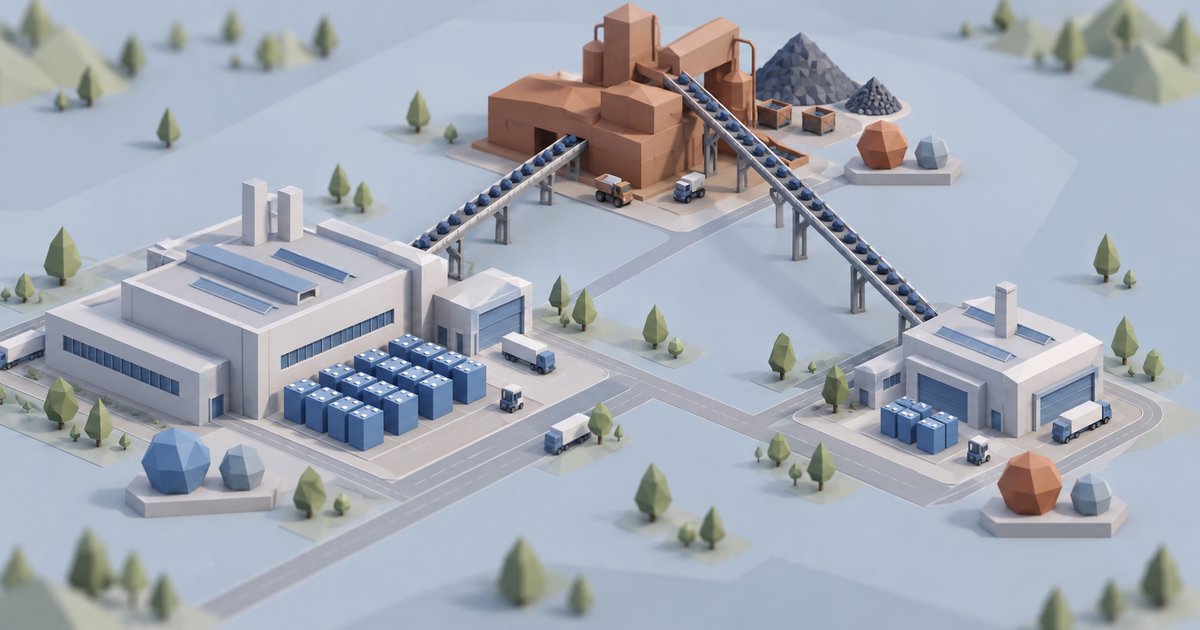
Volkswagen's battery unit PowerCo and the Chinese cell maker Gotion High-tech announced on 28 September 2026 that they plan to build three joint ventures together, worth about €3.22 billion, covering cell plants in Spain and Slovakia and a cathode-material plant in Morocco. The headline is the money. The detail worth reading is who ends up in control, and how much capacity is left.
The three projects
| Site | Investment | Capacity | PowerCo | Gotion |
|---|---|---|---|---|
| Sagunt, Valencia (Spain) | €2.26 billion | 29.1 GWh a year | 51% | 49% |
| Šurany (Slovakia) | about €480 million | 8.4 GWh a year | 49% | 51% |
| Kénitra (Morocco) | about €480 million | LFP cathode material | 49% | 51% |
Gotion puts in roughly €1.6 billion and PowerCo roughly €1.62 billion. The Moroccan plant is to make LFP cathode material — an initial 100 thousand tonnes a year — and supply both European cell plants.
Volkswagen keeps control of one plant out of three
In Spain, Gotion buys 49% of the existing PowerCo Spain entity through a capital increase and Volkswagen keeps the majority. In Slovakia and Morocco the split is reversed: Gotion takes 51% and PowerCo 49%.
That is a change of posture. PowerCo was created so Volkswagen would own its cell supply the way Tesla set out to own its own — Salzgitter, then Valencia, then St. Thomas in Canada no earlier than 2029. Two of the three new sites will be controlled by a Chinese partner instead.
The capacities shrank
Both European plants are much smaller than originally planned. Sagunt was announced at 40 GWh a year and is now 29.1 GWh. Šurany was discussed at 20 to 40 GWh and is now 8.4 GWh. Slovak construction began in 2025, with pilot production targeted for September 2026 and series production in 2027; each project has a construction window of up to five years.
That pattern is the subject of our earlier reporting on Europe's shortfall against its own 'made in EU' battery rules: cell capacity here keeps arriving later and smaller than announced.
Nothing is signed yet
There is no formal investment agreement. The deal needs shareholder approval at both companies and regulatory clearance in China and in Europe. Until those land, this is a declaration of intent with a number attached.
In the meantime, Gotion ships cells from Hefei in China for the ID. Polo and the Cupra Raval. That is the situation the Spanish plant is meant to end, and it is the situation that continues for now.
What this means for a European Tesla buyer
Cell cost is most of the cost of an electric car, and it sets the floor under what a manufacturer can charge. Volkswagen is telling you how it intends to get its floor down: not by building the cells itself, but by partnering with a Chinese company that already builds them cheaply, and paying for that with control of two sites out of three.
For a Model Y shopper the practical read is about timing. Sagunt at 29.1 GWh and Šurany at 8.4 GWh will not move Volkswagen's prices in 2027, when the ID. Tiguan replaces the ID.4. Cells from these plants are a late-decade input at best, assuming the agreements are signed at all.
The broader point is the one the EU is currently legislating around. Europe's answer to cheap Chinese cells is increasingly to invite Chinese cell makers in as majority partners. Whether that counts as localisation depends on which rule you are reading.