
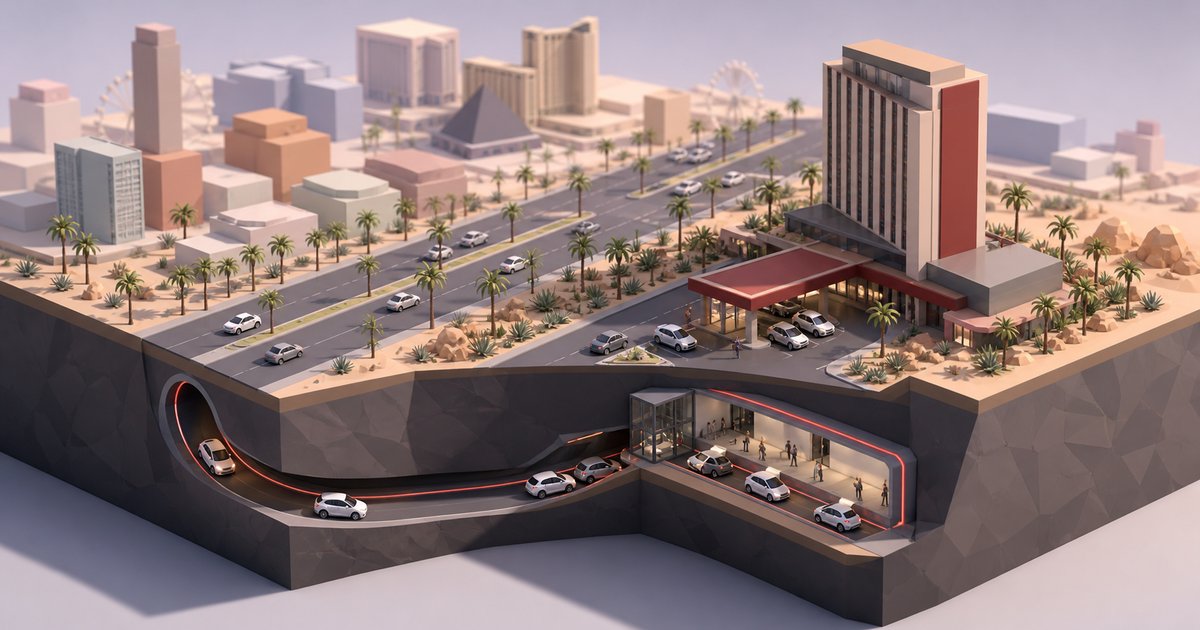
The Boring Company opened a Vegas Loop station at Sahara Las Vegas on Thursday 6 August 2026, extending the tunnel network to the northernmost point of the Las Vegas Strip. The station sits at surface level by the resort's Paradise Road entrance, on the southeast corner of Las Vegas Boulevard and Sahara Avenue, and runs from 07:00 to 21:00 with extended hours during conventions.
Where the network stands
| Location | Type |
|---|---|
| Las Vegas Convention Center | Five stations |
| Resorts World | Resort station |
| Westgate | Resort station |
| Encore | Resort station |
| Fontainebleau | Resort station |
| Sahara Las Vegas | Resort station (new) |
The Sahara addition matters geographically more than numerically. The Loop grew outward from the Convention Center, and its resort stations have clustered in that part of the city; reaching Sahara Avenue pushes the network to the top of the Strip and makes the north end reachable without a surface journey.
What the Loop actually is
It is worth being precise, because the system is frequently described as something it is not. The Vegas Loop is Tesla cars driven through single-lane tunnels by human drivers, stopping at fixed stations. It is not an autonomous system today, and it is not a train. Passengers ride in a Model Y or Model 3 rather than a carriage.
That design is the source of both its advantages and its ceiling. Stations are cheap and small, because a station is essentially a car park with a ramp — which is why a resort can add one to an existing entrance. Tunnels are narrow and therefore cheap to bore. There are no platforms, no signalling and no rolling stock to procure.
The cost is capacity. A metro line moves passengers in units of hundreds; a Loop tunnel moves them in units of three or four. The Boring Company's answer has always been frequency and eventual autonomy, and the company continues to invest in the underlying vehicle technology — its Liner Truck 3 tunnelling vehicle runs on Tesla Model 3 batteries and drive units, remotely operated with nobody underground. But until the cars drive themselves, throughput is bounded by how many drivers the company can employ.
Why a European reader should care
There is no Boring Company tunnel in Europe and none announced, so the direct relevance is nil. The useful part is the experiment itself.
European cities considering new underground transit face costs that have made most schemes politically impossible, and the Loop is the only operating system testing whether small tunnels and small vehicles can substitute for large ones. Las Vegas is close to a best case for it: a linear city, short distances, dense demand between a handful of destinations, and a single commercial customer base willing to fund stations privately.
If the model struggles to scale there, it tells European planners something. If it works — particularly once the driver comes out of the loop — the cost per kilometre becomes worth a serious look.