
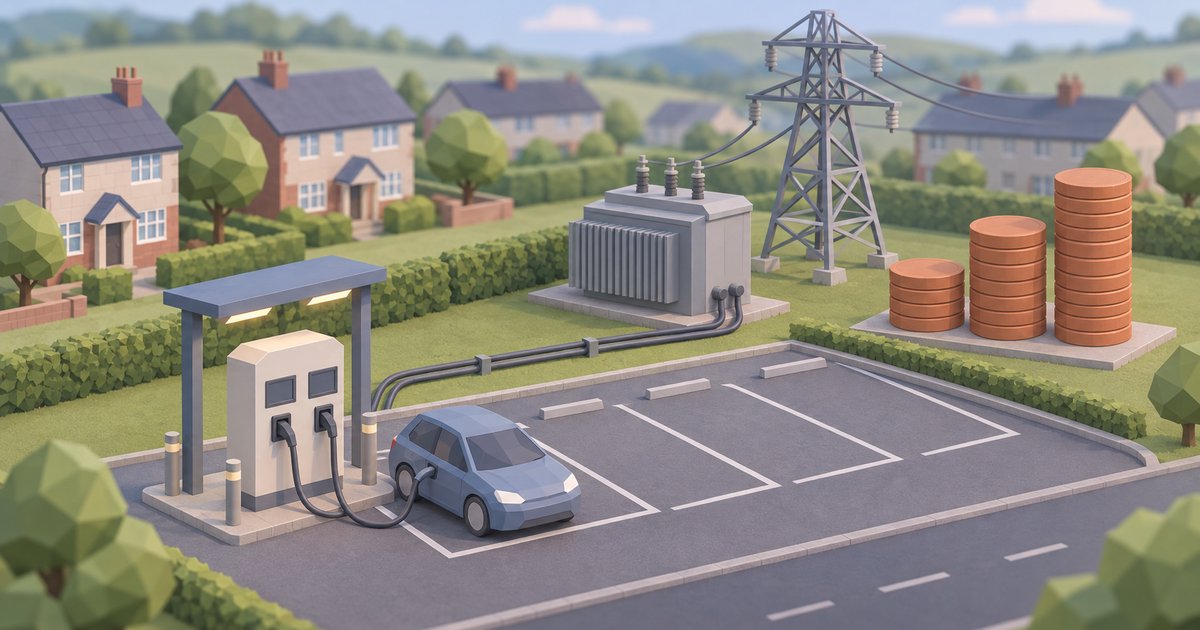
Public rapid charging in Britain could cost more than £1 per kWh next year, and the reason is not the price of electricity. That is the warning in Reverse the Charge, an impact assessment published on 11 November 2026 by Tom Riley, who writes the EV newsletter The Fast Charge, with data from the charge point operator Zest. The Times reported it first.
The report blames a rule set by the energy regulator Ofgem. Under its Targeted Charging Review, introduced in 2022 and in full from April 2023, operators pay fixed daily grid charges based on the capacity of their connection, not on how much electricity they sell.
A charger that costs £540 a week before anyone plugs in
The report models a modest rapid charger with two 100 kW connectors, using average tariffs from eight distribution areas in Great Britain and from the National Energy System Operator (NESO).
| Fixed grid charges | 2021 | 2026 | 2027 |
|---|---|---|---|
| One rapid charger, per week | £61.47 | £440 | £540 |
| Hub with six chargers and 12 connectors, per year | – | £137,698 | £169,477 |
| All UK rapid chargers, per year (estimate) | – | about £336 million | about £413 million |
That is a 616% rise in five years, and the operator pays it whether or not a car plugs in. At a charger selling about 100 kWh a day, two or three visits, electricity and grid charges alone come to £1.03 per kWh on 2027 tariffs. That is before VAT, rent, maintenance, payment fees or any margin. Zapmap's average pay-as-you-go rapid price is 82p per kWh today. Riley calls his network estimate conservative, because sites with several 350 kW units need far bigger connections.
Zest shared the breakdown of two of its own sites. The Birmingham price is before VAT.
| Zest site | Price per kWh | Electricity and grid costs | Left for everything else |
|---|---|---|---|
| Birmingham charging hub | 58p | 48p | 10p |
| London on-street ultra-rapid | 64p | 58p | 6p |
Ofgem knew, the report says
Through Freedom of Information requests, Riley obtained an Ofgem slide deck prepared for the Treasury in October 2025. It reads "High fixed network costs = high cost per customer (unproductive cycle)" and says regulatory changes "may have extended loss-leading periods" for operators. A version dated May 2026 repeats it word for word. The government's own review of public charging costs, published on Budget day, found a "severe impact" on operators' unit costs and said Ofgem must "urgently address" it. Yet the Budget's charging money went to lower-powered local chargers.
"Grid standing charges are effectively a feudal tax," Riley told EV Powered. Robin Heap, chief executive of Zest, said the fixes "are ready to implement". The report backs two rule changes that have sat in industry working groups for about three years: DCP 420 would let eligible sites drop to a lower charging band, and DCP 454 would return them to charges based on consumption.
What it means for Tesla drivers in Britain
The report names no network other than Zest, and Tesla has not said how grid charges affect its British prices. The mechanism favours busy sites, because the more energy a charger sells, the thinner the fixed charge on each kWh. Tesla made the same argument in October, when it told Supercharger for Business hosts that higher utilisation cuts their energy cost per session.
Busy sites are one reason Superchargers have stayed below the market average. In September, Tesla's British tariff without a membership was roughly 35p per kWh off-peak and 60p at peak, according to network trackers. A quiet rural site carries the same fixed charge as a busy motorway hub, though, and public charging now carries 20% VAT by law.
What to watch: Riley says he will speak to Ofgem this week. Neither DCP 420 nor DCP 454 has yet left the working groups.