
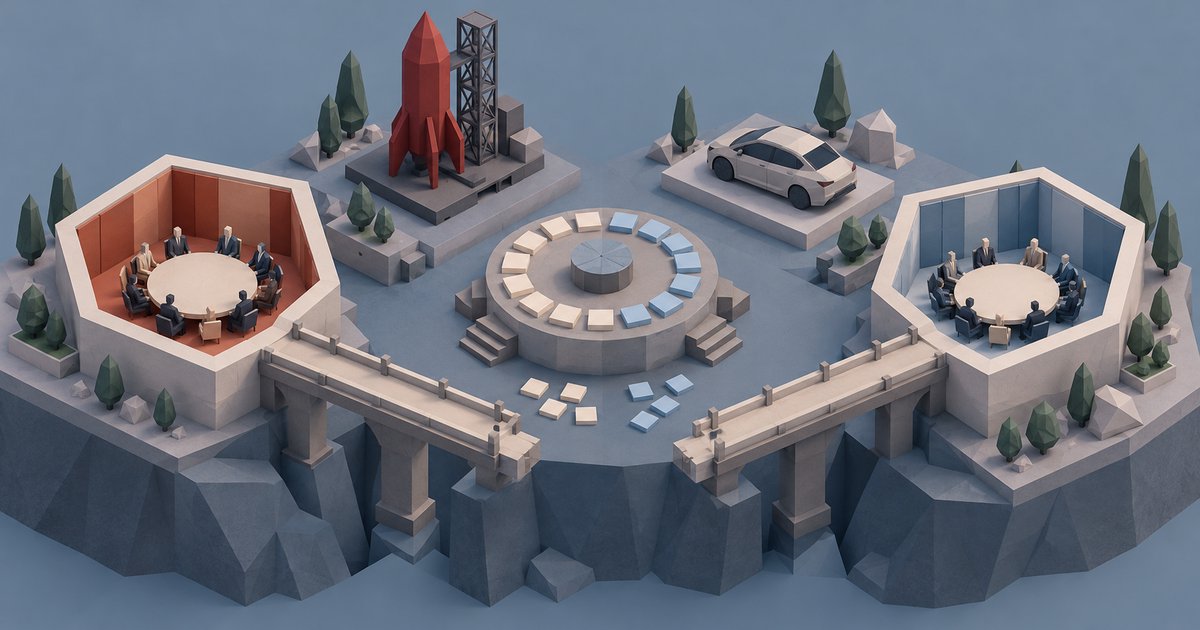
Tesla and SpaceX have each set up a special committee of independent directors to evaluate a merger of the two companies, Elon Musk said on SpaceX's third-quarter earnings call on 20 October 2026. It is the first formal step either company has taken. When the question came up on Tesla's Q2 call in July, Musk would only say that it had to go through "the appropriate process".
Neither company has put the committees in writing. SpaceX's earnings release, filed with the SEC the same day, does not mention Tesla, and Tesla has filed nothing since its proxy materials of 19 October. Musk's words on the call are the only source.
What Musk said
The committees were formed "at the request of shareholders", Musk said, and he is not part of either. "Because I'm a conflicted party, I can't actually be in the discussions of the special committees," he said, describing "an odd kabuki dance where two groups of people are talking and I can't be in the conversation."
He also played down the odds. "The special committees have not reached agreement on the terms of any transaction, and there's no guarantee that they will," he said, according to Drive Tesla. Treating a merger as a certainty "would be overstating it". His own view is not in doubt: "Do I think it would be a good idea? Yes." He named superintelligence software, chip design, the Terafab chip project, robotics, launch capacity and connectivity as shared work.
Who could sit on Tesla's committee
Musk named no members. Tesla's proxy lists seven independent directors, TechCrunch notes: chair Robyn Denholm, Ira Ehrenpreis, Joe Gebbia, Jack Hartung, James Murdoch, JB Straubel and Kathleen Wilson-Thompson. Elon and Kimbal Musk are not independent. Ehrenpreis also sits on SpaceX's board, where he chairs the compensation and nominating committee. Whether he serves on either merger committee has not been disclosed.
Why Tesla's vote is the hard part
On the Tesla side, Musk said, a deal needs "a 50 percent vote of all shares, not just those who vote", which he called "quite a high hurdle". At SpaceX he holds more than half of the voting power. At Tesla, the proxy credits him with 19.8% of the shares as of 30 September, ahead of Vanguard at 5.3%.
Tesla's own record shows how high that bar is. At the 2025 annual meeting, the board asked shareholders to remove the supermajority voting requirements from its certificate of formation and bylaws. The proposal won the support of about 39.4% of all outstanding shares and failed, although 73.6% of the shares took part in that vote. At last year's turnout of about 74%, a majority of all shares means roughly two in every three votes actually cast (TeslAnt's arithmetic). In effect, every share that is not voted counts as a no.
That gives weight to large investors, including European ones. Norway's sovereign wealth fund held 1.12% of Tesla when it voted against Musk's 2025 pay award, as TeslAnt's report on the 3 December meeting recalls.
What comes next
The ballot for the 3 December annual meeting has three items and no merger proposal, so any vote would likely need a special meeting of its own, Teslarati points out. Barclays has suggested that a deal could be announced before 3 December. The BBC values Tesla at about $1.5 trillion and SpaceX at about $2 trillion, which would make a combination one of the largest mergers on record. Which company would absorb the other is open.
Nothing changes yet for owners or buyers. Tesla reports its third-quarter results after the US market closes on 21 October, with the analyst call at 21:30 UTC (23:30 CEST).