
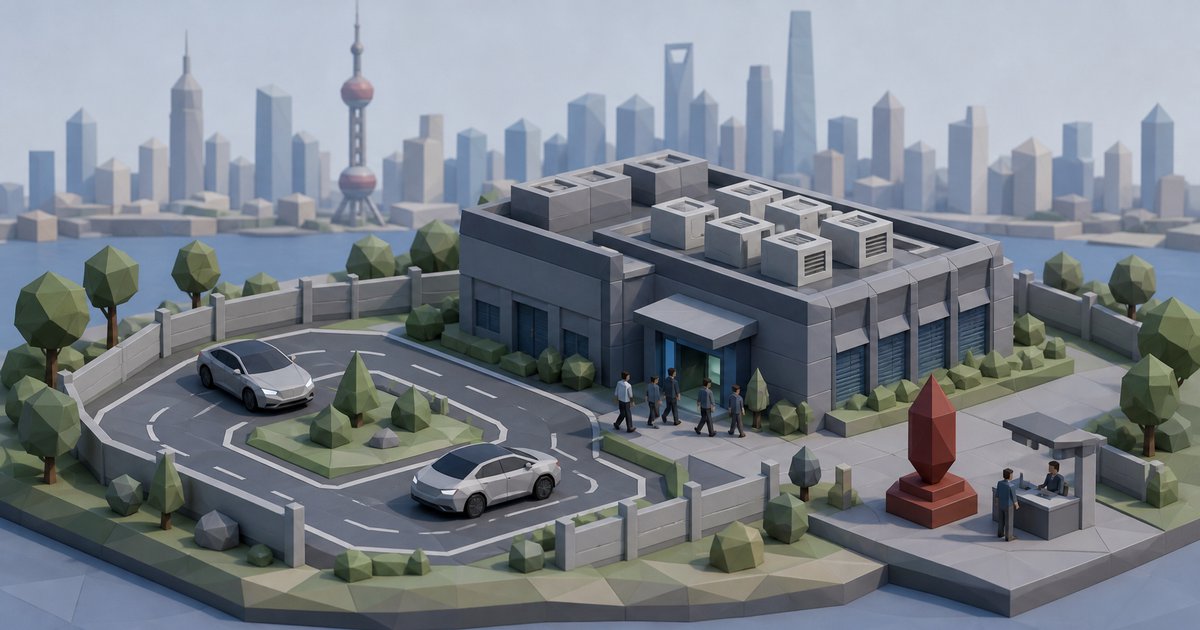
Rumours spread on Chinese social media on Tuesday claiming that Tesla's Shanghai data centre had been vacated, its liaison teams withdrawn and the related positions eliminated. Tesla China answered on Wednesday, and the answer went further than a denial.
"The reported claims are false. We have reported the matter to the public security authorities," a company representative told Global Times. "Our data center in Shanghai is operating normally, and recruitment for our assisted driving team is accelerating. All relevant work is progressing steadily."
Taking a social-media rumour to the police is not an ordinary corporate response. It is a measure of what Tesla has riding on the claim being false.
The data centre is the permission slip
The Shanghai facility is not a back office. It is the legal precondition for training self-driving software on Chinese roads at all. China requires that data collected from vehicles in the country stays in the country, and Tesla has assembled the compliance stack piece by piece.
| Element | Status |
|---|---|
| Shanghai data centre | Full onshore data retention |
| Lingang AI training centre | Operating since February 2026 |
| High-definition mapping | Partnership with Baidu Maps |
| Data-security certifications | Four automotive standards passed |
Remove the data centre and none of the rest has a purpose. That is why a rumour was worth answering inside a day, and why the answer led with hiring rather than merely with occupancy — an empty building can be explained away, an accelerating headcount cannot.
The gap the rumour grew in
The claim spread because there is a real absence for it to explain. China does not appear on Tesla's list of twelve markets where customers can subscribe to FSD (Supervised), a list covering the United States, Canada, Australia, South Korea and several European countries.
What Chinese customers can buy is a different product with a different name. Tesla renamed the feature "Tesla Assisted Driving" in May 2026, and has published neither subscription pricing nor a rollout timeline for it. The company has partial regulatory approval and is aiming for full approval during the third quarter, which ends in September.
So the position Tesla is defending is genuinely awkward: it is spending heavily on Chinese infrastructure for a product it cannot yet fully sell in China. A rumour that it had given up did not need to be true to be plausible.
Europe is watching a version of the same problem
European owners have no stake in a Shanghai server room, but they have a large stake in the pattern it belongs to — a market where Tesla has built the capability and is waiting on the regulator.
FSD (Supervised) has national customer approval in five European countries: the Netherlands, Lithuania, Estonia, Denmark and Belgium. There is no EU-wide type approval, and the Dutch RDW said in July it has no internal timeline for one. Meanwhile the summer update did bring FSD features to European cars, and a competitor has already named Munich as its first EU robotaxi city with a date attached.
The lesson from Shanghai is that the engineering milestones — data centres, training clusters, mapping deals, certifications — arrive well before permission does, and they do not by themselves predict when it will. Tesla's denial is credible and specific. It is also, read carefully, a statement about effort rather than about approval.