
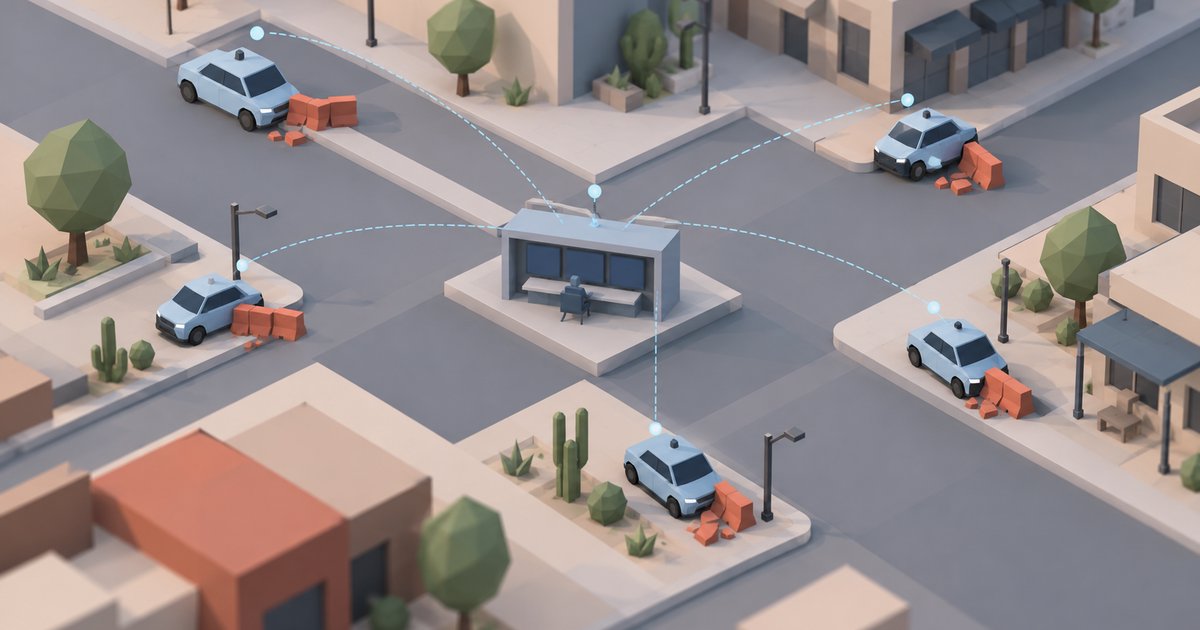
Tesla's newest crash filings with the US National Highway Traffic Safety Administration (NHTSA) add two more Robotaxi collisions in which a remote operator, not the driving software, was in control. That makes five such cases in the public record, and every one of the five ended with the car hitting something.
The two reports cover incidents in August 2026 and were submitted in September under NHTSA's Standing General Order, the rule that obliges automated-driving operators to report crashes. TeslAnt read the regulator's published incident file directly: Tesla now has 36 unique Robotaxi incident reports on file, up from 22 when a Houston crash was first coded as remote operation in July.
What the two new filings say
| Report | Where | What Tesla wrote | Speed |
|---|---|---|---|
| 13781-16678 | Dallas | Car stopped on a residential street between a concrete mixer truck and a parked SUV; "the remote support operator remotely took control and while moving forward, the vehicle made contact with the SUV" | about 0.4 mph |
| 13781-16679 | Austin | "The remote support operator was in control of the vehicle" through an alley, with a utility pole on one side and a dumpster on the other; it hit the dumpster | about 1 mph |
Both are property damage only, with no passengers aboard, and both carry Tesla's structured operator code "Remote (Commercial / Test)", first used on the Houston tree-stump crash in May. Three of the five are now coded that way. The other two, from July 2025 and January 2026 in Austin, only became visible when Tesla unredacted its crash narratives in May: a teleoperator drove one car up a kerb into a fence at 8 mph and another into a construction barricade at 9 mph.
Five for five
Every report follows the same script. The automated system gets stuck or asks for help, a human takes the car over remotely, and the human hits something. The damage is trivial and nobody has been hurt in any of the five. The problem is the denominator: Tesla does not disclose how often remote operators intervene, so no rate can be calculated. What the public can see is that five takeovers have surfaced in the crash data, and five ended in contact.
The file as a whole is low-severity. Of the 36 reports, 32 are property damage only, two record no injuries and two list minor injuries, one with a hospital visit. Twenty-six happened in Austin, seven in Dallas, two in Houston and one in Tampa. Nine date from August alone, the busiest month yet.
How Waymo answers the same problem
Tesla's main robotaxi rival has put its position on the record. In a February 2026 letter to US Senator Ed Markey, quoted by Electrek, Waymo wrote that it "has not used remote driving or 'tele-operations' where a human performs the Dynamic Driving Task". Its remote staff give the car guidance it can accept or reject; they do not steer. Waymo's one exception is a trained agent nudging a stuck vehicle forward at 2 mph at fixed steering angles, a tool it says has never been used outside training. Both companies built a way to rescue a stuck car. One capped it at a crawl and has never used it on a public road; the other has logged five rescues that ended in a collision.
Why this matters in Europe
Remote driving means latency, a limited camera view and no physical feel for the car, and European law has already taken a view on it. Germany's 2021 framework for driverless operation lets the technical supervisor release or veto a manoeuvre, not drive the car remotely. Slovakia's automated-vehicle law, covered by TeslAnt in September, limits a remote operator to one vehicle at a time. Tesla has no driverless service in Europe and no approval to run one. When it applies, the question of who holds the wheel when the software gives up will be asked first, and the US data already answers it: a person, remotely, and not always well.