
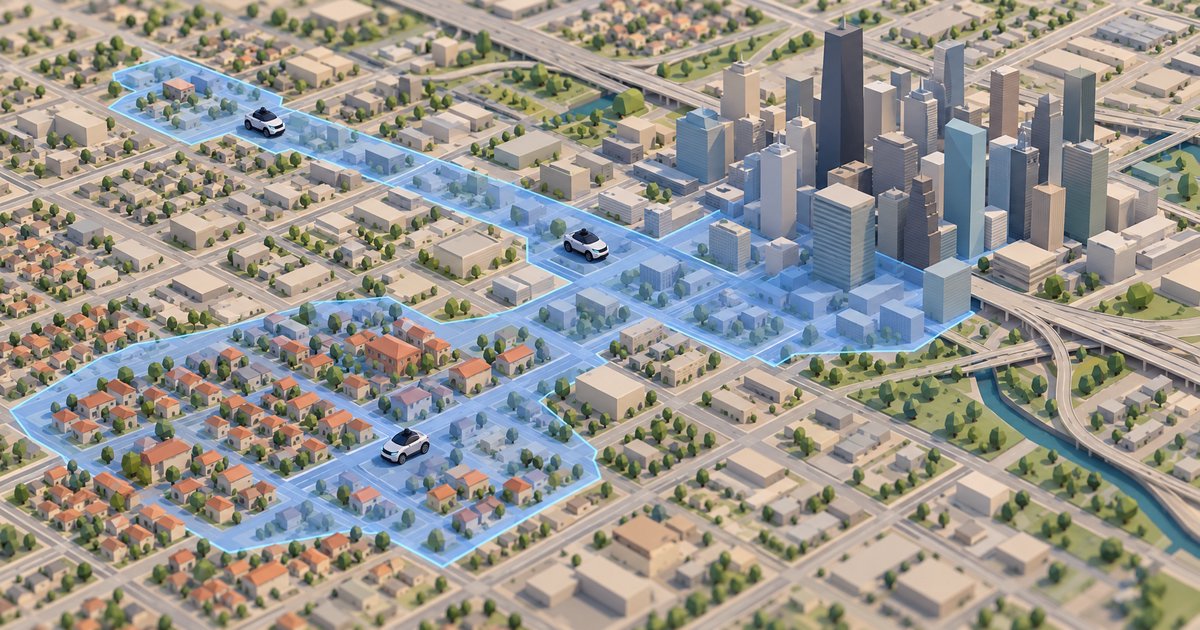
Tesla has enlarged its Robotaxi service area in Houston. The service's account on X posted a map on 26 October 2026 at 13:38 UTC with the line "Houston, we have liftoff. Bigger service area now live." As with the Dallas enlargement in August, Tesla gave no area figure, no fleet size and no list of neighbourhoods.
What the map shows
The old zone, outlined in white on Tesla's map, is the pocket of north-west Houston around Jersey Village and Willowbrook where driverless rides began on 18 April. The new zone, in blue, starts a little further north-west and runs south-east as a long band through central Houston into downtown. There it widens to take in Bellaire and the districts south-east of downtown, stopping short of Pasadena and South Houston.
By our measurement of Tesla's own map, the new zone covers roughly eight times the area of the old one. That is an estimate, not a Tesla figure, but the direction is not in doubt: the service now reaches the city centre, which the April zone did not.
Three Texas cities, one pattern
Houston and Dallas opened on the same day in April with small zones. Dallas was enlarged on 29 August, from about 31 to about 81 square miles by NotATeslaApp's count. Houston waited six months for its first enlargement, then took a larger step in one move. Each time Tesla has published a map and left the measuring to others.
Tesla has not said how many cars serve Houston. The Texas register of automated vehicles, as compiled by the Texas Robotaxi Database, listed 970 Tesla vehicles statewide on 26 October: 507 Model Ys and 463 Cybercabs. It does not split them by city. According to Drive Tesla, Houston's fleet still has no Cybercabs, although the two-seater has been testing on the city's streets for months.
Why the size of the zone matters
On its Q3 call, Tesla said the first customer-owned cars could drive unsupervised around the second quarter of 2027, but only by joining the Robotaxi fleet and only inside Tesla's service zones. That turns a geofence from a rider's convenience into the boundary of what an owner's car may do on its own. A zone that grows roughly eightfold in one step shows how fast that boundary can move in a state that puts little in its way.
What it means for Europe
None of this is available in Europe. What Tesla sells here is the supervised Tesla Assisted Driving, which today won its tenth EU approval, in Latvia and still needs a driver ready to take over. Driverless services are further off: France has promised national rules by mid-2027, and Greater Paris is lining up robotaxi pilots for 2028, none of them involving Tesla.
Update: 2026-10-26
Robotaxi Tracker, a crowdsourced site that maps Tesla's service areas and logs its cars, puts the new Houston zone at about 254 square miles, against about 25 square miles before the expansion, Electrek reported on 26 October. Sawyer Merritt posted the same figure as a 916% increase. That makes the enlargement roughly tenfold, more than the eightfold estimate above, which we measured from Tesla's map. The tracker counts 34 driverless Model Ys in Houston, up from 22 three months earlier, and no Cybercabs, or about one car for every 7.5 square miles. Tesla itself has still given no area or fleet figure. Waymo, which has offered driverless rides in Houston since February, covers nearly 50 square miles of the city, according to Electrek.