
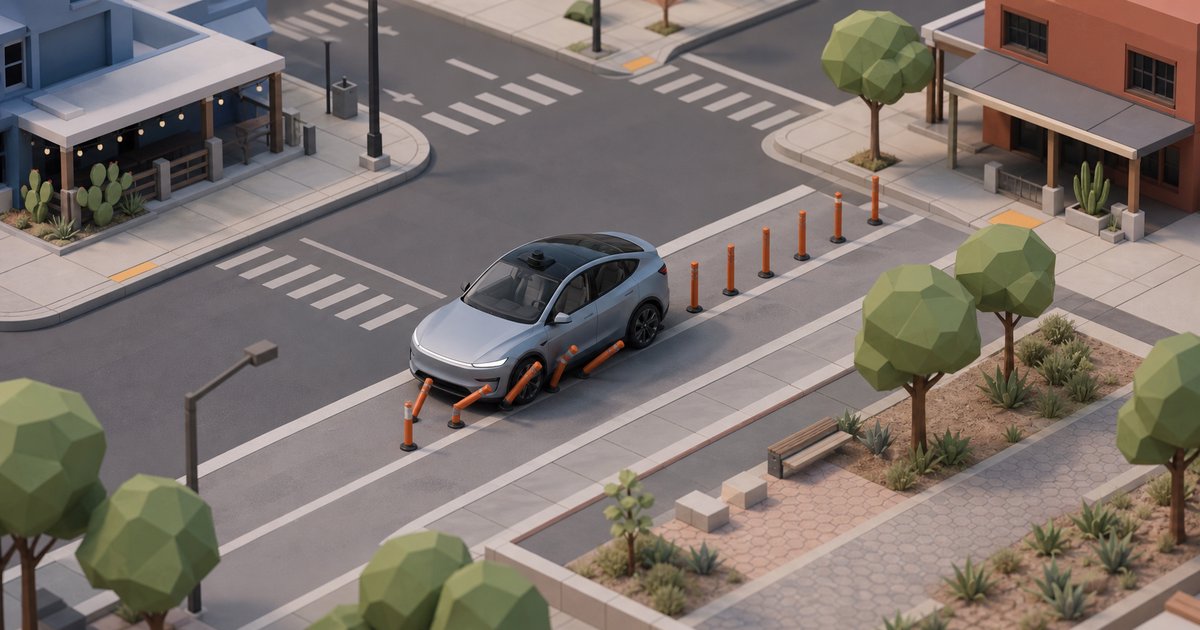
A Tesla Robotaxi with nobody in the driver's seat drove through a line of plastic bollards at an Austin intersection, and the sequence matters more than the damage.
In video that surfaced on Monday, the driverless Model Y approaches a protected closed lane, detects the posts and stops. Then it inches forward, stops again, and eventually pushes through the row with an audible impact before continuing across the separated area rather than reversing out. Reddit users matched the surroundings to an intersection near the Texas Orthopedics building in Austin; the bollards appear in Street View imagery going back to at least February 2024.
Perception was not the problem
The car saw the obstacle. It stopped for it, repeatedly. What failed sits above perception, in the decision layer: Tesla does not run the detailed prior maps that Waymo relies on, so the vehicle works out road layout live. It read the geometry as a right-turn lane, committed to it, and then had no way to unwind a manoeuvre it had already begun. Faced with a barrier it had correctly identified, its answer was to drive through it.
That is the failure mode worth watching in a system that will shortly carry passengers with no controls to grab. A car that cannot back out of its own mistake needs a human somewhere in the loop, and it is not clear from the footage whether a remote operator was involved.
Set against what Tesla told investors
| 22 July 2026 | Tesla's VP of AI tells investors the robotaxi programme has driven "more than 380,000 miles of unsupervised robotaxi" with "zero notable incidents", calling the record "impeccable" |
| July 2026 | A Tesla remote operator drives a Robotaxi into a tree stump in Houston while recovering it from a dead-end street |
| June 2026 | Electrek counts 14 cars running without a safety monitor across all markets, down from a peak of about 25 |
| 17 August 2026 | Bollard video surfaces |
The 380,000-mile figure is the same one Tesla cited when it expanded the service to Tampa and Orlando in July. The claim was never that nothing happens; it was that nothing notable happens. An empty-seat vehicle demolishing lane protection in a city centre is a reasonable test of where that line sits, and Tesla has not published an incident definition that would let anyone check it independently.
Why this lands in Europe now
Two reasons, and neither is schadenfreude.
The first is timing. Tesla is days away from launching the Cybercab in Austin, a two-seater with no steering wheel and no pedals. Every failure mode that today ends with a safety monitor taking over, or a car reversing under remote supervision, has to be handled by software in a vehicle where there is nothing to take over.
The second is regulatory. European approval for FSD Supervised — the version that still has a driver — is being decided country by country, and the file that national authorities read is built from exactly this kind of material: how the system behaves when its own plan is wrong. A clip of a car choosing to push through a barrier it had already stopped for is not a rounding error in that process. It is the argument.